

Let me tell you about the day my fear of motorcycle group riding just… went out the window. I’d had my license for two years before I ever started riding. Two years. I took the safety course, I did everything I was supposed to do, and I was still terrified. Then I rolled up to my first group ride with my buddy Leo and the crew, and somewhere in the first ten miles, all that fear was gone. I felt so comfortable. That’s the magic of riding with people, and that’s what this whole guide is about.
Why ride in a group at all? (Community, mostly)
The truth is, it took me 30 years to do something I really love doing. Thirty years. And the only reason it took that long is that nobody around me rode. I had no one to go with. That’s it. That’s the whole reason I waited half my life.
So when people ask me why bother riding in a group, my answer isn’t really about safety, even though it’s safer (and make no mistake, riding is a real risk you manage, not erase). It’s about community. Riding alone is fine. Riding with your people is something else entirely. You pull into a gas station and there’s six bikes lined up and everybody’s laughing about that one corner somebody took too hot. You learn faster. You see how the experienced guys handle stuff. And honestly, you just feel less alone out there.
My buddy Leo’s been riding 30 years. G’s got about 15 and he usually leads our rides. Being around guys like that taught me more in a month than two years of reading forums ever did. That’s the real argument for group riding: you light up when someone drops a route, and then you go ride it together.
Start with the pre-ride meeting
Every good ride starts standing around in a parking lot before anybody fires up. The pre-ride meeting is the most boring-sounding, most important part of the whole day. Skip it and you get chaos. Do it and the ride basically runs itself. And do a quick bike check before you roll. Nobody wants to hold up the pack with a dead battery.
We knock it out in about five minutes:
- The route and the stops. Where we’re going, where we fuel up, where we rest.
- Who’s leading and who’s sweeping. More on those two jobs in a second.
- The hand signals. Quick refresher so everybody’s speaking the same language.
- What to do if we get split up. Usually: nobody panics, lead slows down, we regroup at the next stop.
- Pace and experience levels. Slowest, newest rider sets the tone. Always.
That last one matters more than people admit. If you’ve got a brand-new rider in the mix, the group rides to their comfort, not the fastest guy’s ego. Part of that is making sure a new rider is on a bike they can actually hold up, not something too heavy to manage yet. And if they’re still shaky on the how-to-ride basics, get those down before the first group run. The good ones ride like they have something to lose, and that includes looking out for the new person.
Staggered formation: the heart of group riding
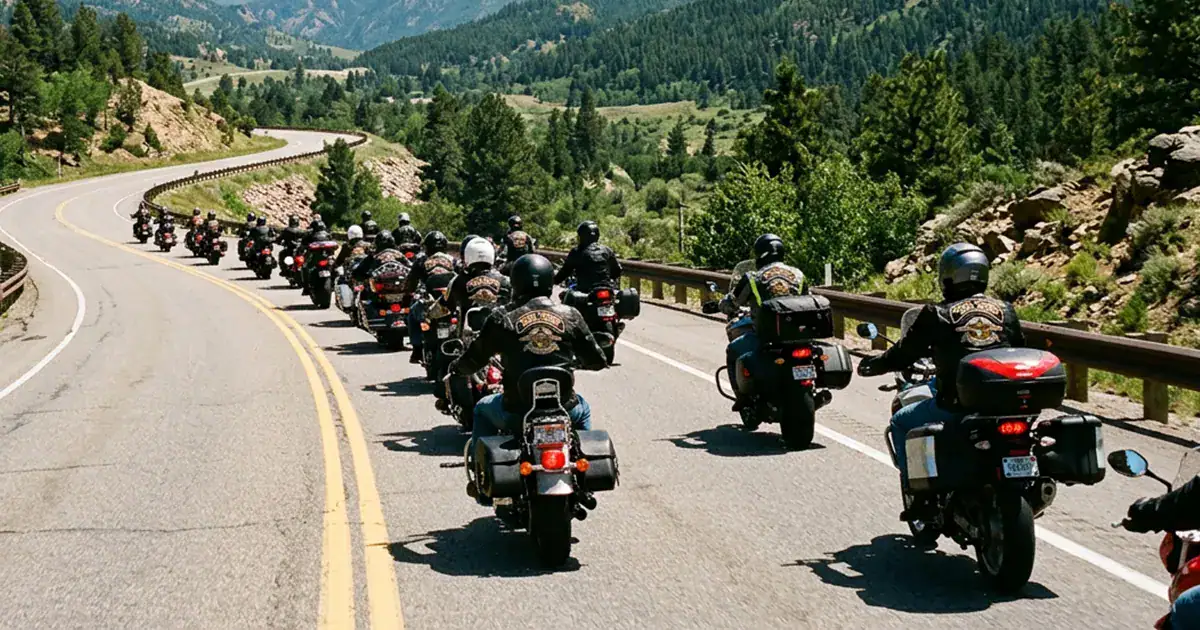
The single most important skill in motorcycle group riding is the staggered formation. It’s not single file and it’s definitely not side by side. The leader rides in the left third of the lane, the next rider sits back in the right third, the one after that goes back to the left, and so on, zig-zagging down the lane.
Why? Because it gives everybody their own space cushion while keeping the group tight enough to stay together. You’re never directly behind the bike in front of you, so you’ve got room to react. The Motorcycle Safety Foundation recommends roughly a two-second gap to the rider directly ahead of you in your track, and about a one-second gap to the staggered rider beside you. When the road gets twisty, you drop the stagger and go single file with bigger gaps, because you need the whole lane to take a corner properly. One more reason for that cushion: a rider slowing on engine braking shows no brake light, so the gap is often your only warning that the pack is slowing.
| Situation | Formation | Spacing |
|---|---|---|
| Open highway / straight roads | Staggered | 2 sec to rider ahead in your track, 1 sec to staggered rider |
| Curvy canyon roads | Single file | 2–3 sec, full lane to each rider |
| Slow speeds / city traffic | Single file | Tighten up, stay alert, no tailgating |
| Poor weather or low visibility | Single file | Increase to 3+ sec |
Lead and sweep: the two jobs that run the ride
A group ride has two anchor positions, and you give them to your most experienced people. The lead rides up front, sets the pace, picks the route, reads the road ahead, and calls the signals. The sweep (or “tail gunner”) rides dead last, keeps an eye on everybody in front of them, and never passes anyone in the group. If a bike pulls over, the sweep pulls over too. Nobody gets left behind.
| Role | Where they ride | The job |
|---|---|---|
| Lead | Front of the group | Sets the pace, picks the route, reads the road ahead, and calls the hand signals |
| Sweep (“tail gunner”) | Dead last | Watches everyone ahead, never passes a rider, and pulls over whenever anyone does — so nobody gets left behind |
When I started, I rode in the middle of the pack every single time. That’s where new riders belong: protected, with experience in front and behind you. G leads, somebody solid sweeps, and the rest of us tuck in. Don’t volunteer to lead on day one. There’s no shame in the middle. That’s the whole point of it. Stretch that same crew onto a multi-day run and the logistics change more than the riding does, which is the whole of planning a trip with a group.
Hand signals and communication
You can’t exactly yell “hey, cop ahead” at 65 miles an hour, so the group talks with its hands. These get passed back down the line, rider to rider, so everybody gets the message. Learn them before your first ride. Here are the ones we actually use:
| Signal | What it means |
|---|---|
| Left arm straight out | Left turn |
| Left arm out, forearm up (fist) | Right turn |
| Left arm out, palm down, patting | Slow down |
| Hand up, palm forward | Stop ahead |
| Foot or hand pointing down | Hazard / debris in the road |
| Index finger up, circling | Start ’em up / let’s roll |
| Tapping top of helmet | Cops ahead |
| Left arm up, finger pointing | Single file |
| Two fingers straight up | Double file — back to staggered formation |
| Hand pointing at fuel tank | Need fuel |
Hand signals are the baseline, the tool everybody should have in the bag; I broke down the 14 official MSF hand signals one by one if you want the full list. But these days a lot of crews run Bluetooth headsets too, so you can actually talk to each other. It’s a thing I wish I’d had on day one. If you’re curious which setups are worth the money, I broke it down in our guide to the best motorcycle communication systems for group rides. Headsets don’t replace the signals, though. Batteries die, so you always keep the hands fluent.
Keep the group small (and split when it gets big)
Here’s a lesson nobody tells beginners: a big group is a dangerous group. Once you get past seven or eight bikes, things fall apart. The pack gets strung out across multiple light cycles, gaps open up, people rush to catch up, and rushing is how folks get hurt.
So we keep it small. Five to seven bikes is the sweet spot. If more people show up (and on a good Sunday they do), we split into two separate groups with their own lead and sweep, and we leave a little gap between them. Two clean groups of six beats one messy group of twelve every day of the week. The Motorcycle Safety Foundation’s group-riding guidelines say the same thing: keep groups manageable and split the big ones up.
Passing, fuel, and rest stops
Passing as a group takes discipline. You don’t all swarm past a car at once. Each rider passes individually when they have a safe gap, then settles back into the staggered slot. The lead doesn’t leave people stuck behind a truck. A good leader waits until the whole group can clear it.
And please, build in stops. This one’s personal. I did a full day up to Lake Arrowhead once, beautiful ride, and on the way home I was running 80, 85 with the sun straight in my eyes and I was exhausted. Cooked. I learned my lesson the hard way: stop every hour or so on long freeway days, hydrate, stretch, top off the tank, and slow it down. Fatigue sneaks up on you and it’s every bit as dangerous as the other guy. Fuel and rest stops aren’t a detour from the ride. They’re part of riding smart.
For the nervous first-timer (I was you)
Look, I’m going to be honest with you. I get it, because I lived it. Everybody I knew said, “Buy a bike, you’re going to die, especially in Los Angeles.” I wasn’t even comfortable riding my own Night Train home when I bought it. Leo rode it home for me. Leo saved the day, and he didn’t even know who was texting him.
So if you’re scared of your first group ride, this is what actually helped me:
- Ride your own pace. This is the big one. Never, ever ride faster than your own comfort to keep up. A good crew will slow down for you. If they won’t, find a better crew.
- Tuck into the middle of the pack. Experience in front of you, experience behind you. Just follow the lines.
- Speak up at the pre-ride meeting. Tell them you’re new. Every decent rider respects that and rides accordingly.
- Gear up. Full helmet, an airbag vest, daytime, weekends. That’s how I ride. That’s just me being aware.
- Remember the fear lives beforehand. These fears consume you in the driveway, but once you’re rolling with the crew, you don’t even think about it.
The first ride is the hardest. After that, you’re just a rider with a crew, and there’s nothing better.
Frequently Asked Questions
How many bikes is too many for a group ride?
More than seven or eight bikes gets hard to manage. The pack strings out across traffic lights and gaps open up, which leads to people rushing. The fix is simple: keep groups to five to seven riders, and when more show up, split into two smaller groups, each with its own lead and sweep.
Where should a beginner ride in the group?
In the middle of the pack. You want an experienced rider in front of you setting the line and an experienced sweep behind you keeping watch. You just follow along at your own pace. Don’t volunteer to lead or sweep on your first few rides — those jobs go to seasoned riders.
What is staggered formation in motorcycle group riding?
Staggered formation is when riders alternate between the left and right thirds of the lane instead of riding single file or side by side. It keeps the group compact while giving each rider a safe space cushion. You drop the stagger and go single file on curvy roads, in slow traffic, or in bad weather.
Do I still need hand signals if we have Bluetooth headsets?
Yes. Headsets are great and make a ride way more fun, but batteries die and connections drop. Hand signals are the reliable baseline every rider should know. Learn the core signals: turns, slow, stop, hazards, fuel. Treat the headset as a bonus on top, not a replacement.
How often should a group stop on a long ride?
Roughly every hour on long freeway days. Stop to hydrate, stretch, rest your eyes, and top off the tank. Fatigue is sneaky and just as dangerous as traffic — I learned that the hard way coming home from Lake Arrowhead. Build the stops into the plan during your pre-ride meeting.
That’s the whole game. Pre-ride meeting, staggered formation, a solid lead and sweep, hands you trust, a group you can actually manage, and a pace that’s yours. None of it is complicated. It just takes someone to show you the ropes and walk you in, which, when I think about it, is exactly why I built RideWolf in the first place. The whole idea was to fix the thing that cost me 30 years: having no one to ride with. The app connects riders, shares routes, and helps you find a crew, so once you’ve got the bike (and if you’re still pricing that out, here’s what you’ll actually pay for a bike), the next step is finding your people, and getting early access to RideWolf is how you start. You’ll find more of our group-riding resources over on the motorcycle rides hub. And when you’re ready to point the crew somewhere good, line up one of the best scenic rides in Southern California.
Don’t let the fear win. Don’t be the one on your deathbed wishing you’d got on that bike and found your crew. Be responsible, do your research, find some good people, and put that first foot forward. We’ll see you on the road. Peace.