


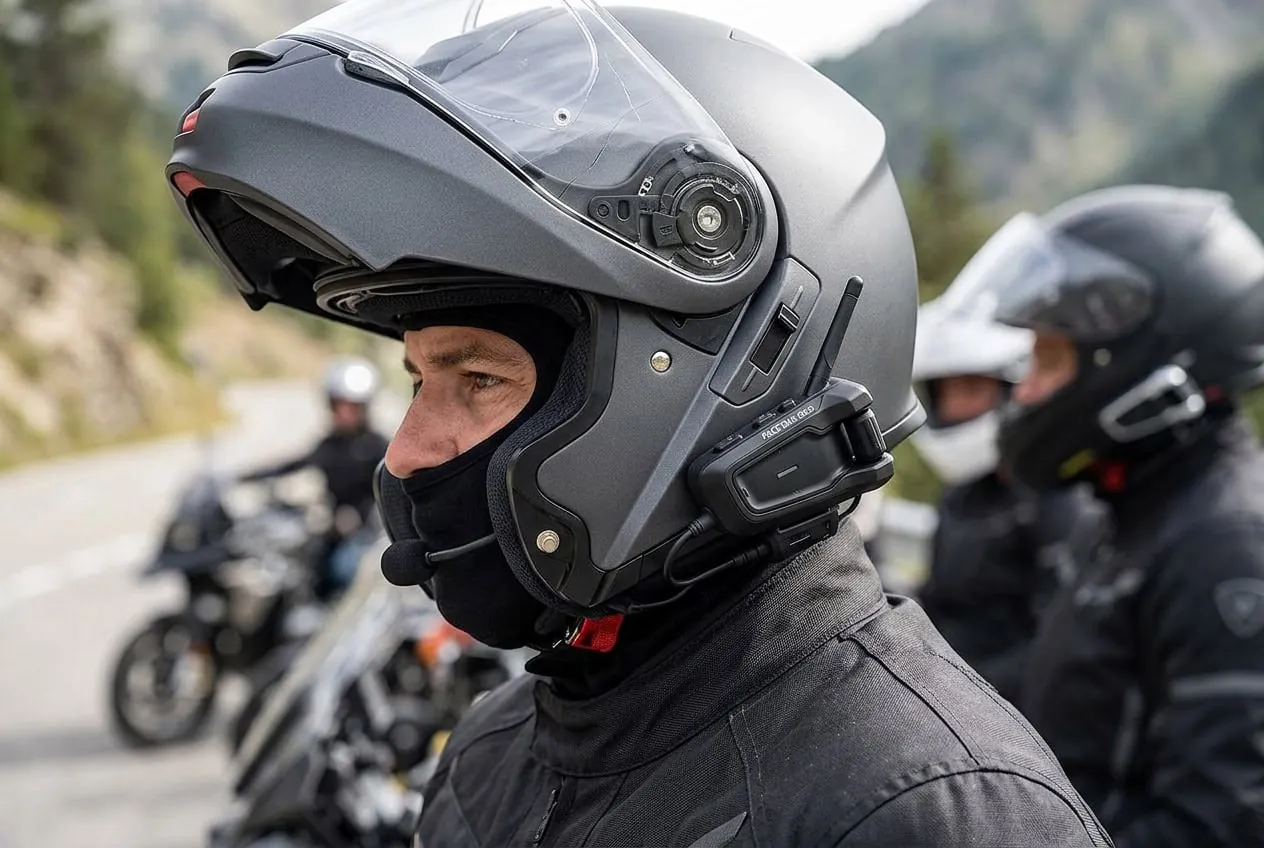
Here’s the real reason I went down this rabbit hole: I ride Sundays with the crew, and for the longest time, the actual riding was the only part where I couldn’t talk to anybody. We’d pull over at a light, somebody’d yell a plan, half of us wouldn’t hear it, and then we’d guess. The standard hand signals cover slow down and fuel stop, but they can’t say “left at the second light, then gas.” So I dug in. The best motorcycle communication for group rides in 2026, for most of us, is a mesh intercom, and right now that’s a two-horse race between Cardo and Sena, with a few budget units that’ll get you talking for way less. Let me walk you through what I found.
Why I stopped riding in silence
I started riding at 50. I spent 30 years wanting to and not doing it, and a big chunk of that was because I didn’t have anybody to ride with. So when I finally found my crew (Leo, G, my father-in-law on his old shovelhead), the last thing I wanted was to feel cut off from them the second the wheels started turning.
That’s really what a comms system is. It’s the difference between five guys riding near each other and five guys riding together. G can call out the gravel in the corner before I hit it. Leo can say “gas in two miles” instead of us all guessing. And honestly? Half the fun is just the dumb talk between turns. That’s the wind therapy with a soundtrack.
Mesh vs Bluetooth: the one thing you actually need to understand
So I went digging, and here’s what the numbers actually say. Old-school Bluetooth intercoms daisy-chain riders in a fixed line: rider one talks to two, two to three, and if a middle rider drops out or rides off, the chain breaks and somebody has to re-pair. For two people, fine. For a Sunday pack, it’s a headache.
Mesh is different. Every helmet is a node in a self-healing network. Riders can drift apart, drop off for gas, catch back up, and the network just stitches itself back together. No re-pairing, no fuss. For a group, mesh wins. It’s not even close.
| Mesh intercom | Bluetooth intercom | |
|---|---|---|
| Best for | Groups of 3+, riders spreading out | Solo, two-up, or a fixed pair |
| If a rider drops | Network self-heals automatically | Chain can break, re-pair needed |
| Group size | Many riders (15+ on top units) | Usually 2–4 reliably |
| Setup | Quick, one channel for the group | More fiddly as the group grows |
| Price | Higher (mostly $300–$500) | Lower (budget units $60–$150) |
My take: if you ride with a crew, pay for mesh. If it’s just you and your music, or you and one buddy, Bluetooth is plenty and saves you real money.
The top units for 2026 (what they cost, what they connect)
Two brands run this market, Cardo and Sena, with a handful of budget makers nipping at their heels. Here’s the lineup with the numbers I could verify from the manufacturers and gear sites like RevZilla. Prices move around with sales, so treat these as ballpark.
| Model | Type | Range (unit-to-unit / group) | Riders | Approx. price |
|---|---|---|---|---|
| Cardo Packtalk Pro | Mesh + Bluetooth | ~1 mi / up to ~5 mi | Up to 15 | ~$450–$500 |
| Cardo Packtalk Edge | Mesh + Bluetooth | ~1 mi / up to ~5 mi | Up to 15 | ~$440 |
| Cardo Packtalk Neo | Mesh + Bluetooth | ~1 mi / up to ~5 mi | Up to 15 | ~$390 |
| Sena 60S | Mesh + Bluetooth + Wave (app) | ~1 mi / up to ~5 mi mesh | Many (near-unlimited open mesh) | ~$400+ |
| Sena 50S | Mesh + Bluetooth | Up to ~5 mi mesh network | Up to 24 (private group) | ~$300–$340 |
| Fodsports M1-S Pro | Bluetooth (group) | ~1 km claimed | Up to ~8 | ~$60 |
| Lexin B4FM | Bluetooth (group) | ~1 mi claimed | Up to 4 | ~$80 |
A couple of notes on the “range” column, because the marketing gets a little optimistic. That top-line group range (the “5 miles” type number) only happens when you’ve got six or more riders strung out in a line, each one relaying the signal down the chain. Real, useful unit-to-unit range is closer to a mile in clear conditions, and a lot less once you put hills, traffic, and buildings between you. Independent testers have clocked real-world mesh links holding well under a mile bike-to-bike. So plan around a mile, not five, and you won’t be disappointed.
Cardo vs Sena: which one for the crew?
This is the question everybody asks, so let me give it to you straight, the way I’d tell Leo.
| Cardo | Sena | |
|---|---|---|
| Mesh tech | DMC mesh — built its reputation on it | Mesh, plus Wave app-data linking on the 60S |
| Audio | JBL-tuned speakers | Harman Kardon |
| Controls | “Hey Cardo” voice control, glove-friendly | Jog-dial a lot of riders swear by |
| Standout feature | Magnetic Air Mount; crash detection on the Pro | 50S runs a private group up to 24 riders |
| Value pick | Packtalk Neo (~$390) | 50S (~$300) |
Cardo built its whole reputation on mesh (they call it DMC), and it shows. The Packtalk line just connects and stays connected. The speakers are tuned by JBL, the voice control (“Hey Cardo”) is genuinely good with gloves on, and the magnetic Air Mount on the Edge and Pro is the kind of thing you don’t know you needed until you’ve used it. The Packtalk Pro even adds crash detection that’ll ping a contact if it thinks you went down, and it’s smart enough to tell a real crash from a pothole, giving you 30 seconds to say “ignore.” For a safety-first guy like me, that one got my attention.
Sena has the Harman Kardon audio partnership, the jog-dial control a lot of riders swear by, and on the newer 60S, a Wave feature that piggybacks on your phone’s data to connect riders basically anywhere, not just within mesh range. The 50S is the value play here: it’ll run a private group of up to two dozen riders, which is more than my whole crew and then some.
Honestly? To each his own. Both brands are excellent. The one real catch worth knowing: Cardo mesh talks best to Cardo, and Sena mesh talks best to Sena. They can usually link over plain Bluetooth, but if you want the full self-healing magic, get your whole crew on the same team. We did. Made it simple.
What I’d actually buy
- Riding with a real crew, want the best: Cardo Packtalk Edge or Sena 50S. The Edge for the slick mount and rock-solid mesh; the 50S to save a hundred bucks and still run a big group.
- Want every safety feature: Cardo Packtalk Pro for the crash detection. That’s the kind of tool in the bag I like having and hope I never use.
- Just you and your music, or you and one buddy: a Lexin B4FM or Fodsports M1-S Pro. You’ll spend under $120 and cover the basics: calls, GPS, tunes, and a chat with one person.
One thing nobody tells you: mind your helmet. Most of these units fit modular and full-face helmets fine, but speaker pockets, mic placement (boom vs. wired), and the chin bar all matter. Before you buy, check the unit against your specific lid. Cheap regret is buying the right intercom for the wrong helmet.
If you’re still figuring out the bigger picture (gear budgets and all the rest), comms is just one line item. We broke the whole money side down in what a bike actually costs to own, and a $100–$500 intercom fits right in there once you’re actually riding with people.
Frequently Asked Questions
What is the best motorcycle communication for group rides in 2026?
For group rides, a mesh intercom is best, and the Cardo Packtalk Edge (around $440) and Sena 50S (around $300) lead the pack in 2026. Both connect a full crew, self-heal when riders spread out, and don’t need re-pairing mid-ride. For a budget pair, a Lexin or Fodsports unit works fine.
Is mesh really better than Bluetooth for groups?
Yes. Mesh creates a self-healing network where every helmet relays the signal, so riders can drop off for gas and rejoin without re-pairing. Bluetooth daisy-chains riders in a fixed line that breaks if a middle rider leaves. For two people Bluetooth is fine; for three or more, mesh is worth the money.
How far do motorcycle intercoms actually reach?
Plan for about a mile of real, useful bike-to-bike range in clear conditions. The big “up to 5 miles” numbers only happen with six-plus riders strung out in a line, each relaying the signal. Hills, traffic, and buildings cut it down fast, so don’t buy on the headline range alone.
Can I mix Cardo and Sena units in one group?
Usually, yes, over standard Bluetooth. But you lose the best part: the self-healing mesh only works fully between units of the same brand. If your crew wants the smoothest group experience, get everyone on the same brand. It’s the simplest decision you’ll make.
Do I need an expensive unit if I’m a new rider?
No. If you’re mostly solo or riding with one person, a $60–$120 Lexin or Fodsports handles calls, GPS, and music just fine. Save the $300–$500 mesh units for when you’re regularly rolling with a crew. That’s when the extra features earn their keep.
The point of all of it
Look, the gear matters, but it’s not really the point. The point is the people in your ears. A good intercom turns five riders into one crew: somebody warning you about the gravel, somebody calling the next stop, somebody just talking nonsense between the canyons. That’s the stuff I missed for 30 years, and it’s the whole reason I built RideWolf: to make it easier for the next person to find their people and get out there. Once you’ve picked your comms, the next step is the crew to use it with. Get early access to RideWolf to start finding your people, and our complete guide to motorcycle group riding walks you through the rest.
So do your research, check it against your helmet, get your crew on the same brand, and put that first foot forward. We’ll see you on the road. Peace.