

It took me 30 years to buy my first motorcycle, and I spent a good chunk of that time just confused by the names. Cruiser, bobber, bagger, ADV, supersport. I went from style to style to style, watching videos, sitting on bikes at dealerships, asking my buddy Leo questions that probably made him question our friendship. So this is the guide I wish somebody had handed me: every major type of motorcycle, what it actually is, and who it fits. In plain English, from a guy who was a beginner five minutes ago.
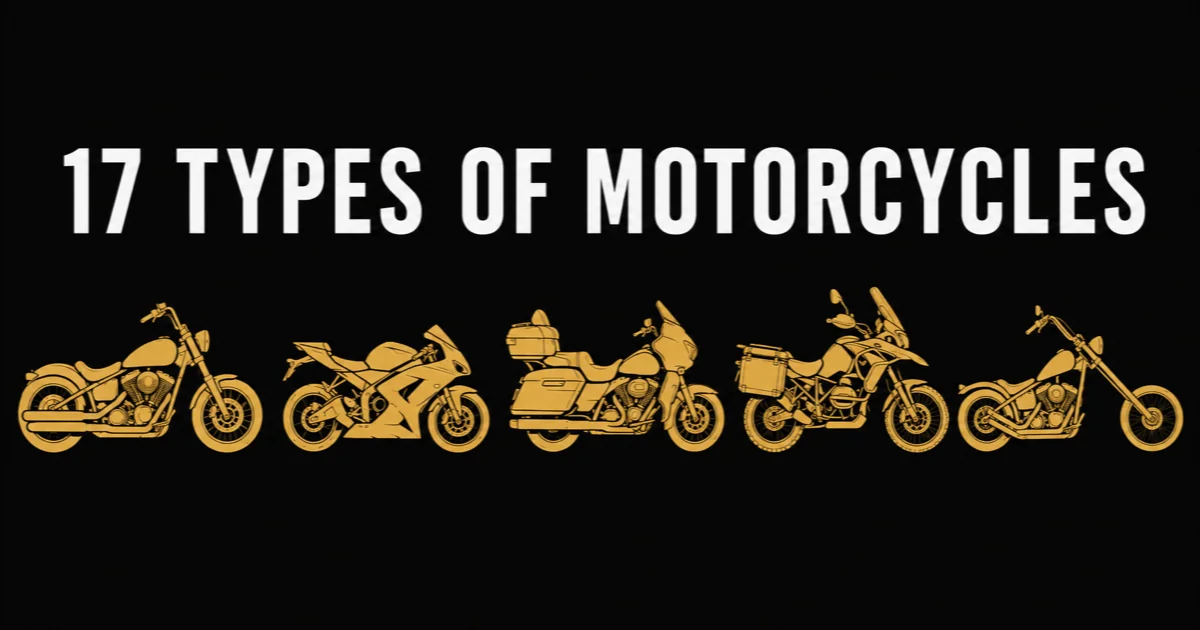
The 17 types of motorcycles at a glance
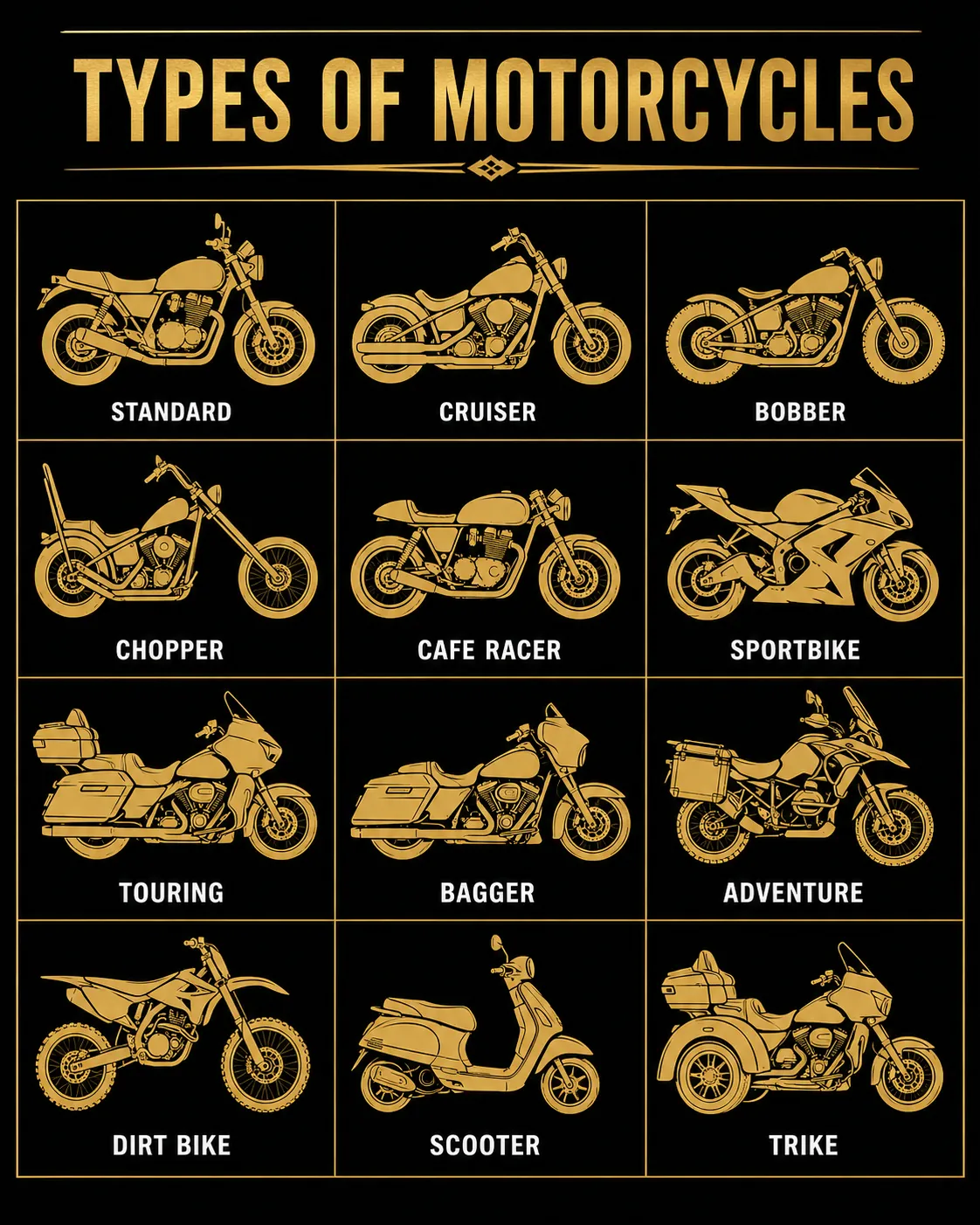
The funny part? There is no official rulebook for this. Even the insurance industry’s Highway Loss Data Institute, which classifies every street-legal bike in America, only uses ten classes, based on riding position, body style, and what the bike is built to do. Riders use a lot more names than that. Start with the chart, then the table below adds a real current example of each major type, pulled straight from the manufacturers’ spec pages.
| Type | Example | Engine | Weight* | Seat height | Starting price** |
|---|---|---|---|---|---|
| Standard / naked | Kawasaki Z500 | 451cc | 368 lb | 30.9 in | $5,699 |
| Cruiser | Honda Rebel 300 | 286cc | 379 lb | 27.2 in | $5,349 |
| Sportbike | Kawasaki Ninja 500 | 451cc | 377 lb | 30.9 in | $5,399 |
| Supersport | Honda CBR600RR | 599cc | 419 lb | 32.4 in | $11,499 |
| Touring | Honda Gold Wing Tour | 1,833cc | 845 lb | 29.3 in | $29,500 |
| Sport-touring | Suzuki GSX-S1000GT+ | 999cc | 498 lb | 31.9 in | $14,399 |
| Adventure (ADV) | Suzuki V-Strom 800DE | 776cc | 507 lb | 33.7 in | $11,799 |
| Dual-sport | Honda CRF300L | 286cc | 311 lb | 34.7 in | $5,749 |
| Dirt bike | Yamaha TT-R230 | 223cc | 251 lb | 34.3 in | $4,699 |
| Scooter | Yamaha Zuma 125 | 125cc | 282 lb | 30.9 in | $3,799 |
| Electric | Zero S | Electric (14.4 kWh) | 492 lb | 31.0 in | $13,495 |
* Manufacturer curb/wet weight with fluids and a full tank. ** Base MSRP from the manufacturer’s site, before destination fees. Specs current as of the 2025–2026 model years.
Eleven rows, and we’re not even done. The style bikes (bobbers, choppers, baggers, cafe racers), the little guys (mopeds), and trikes get their own sections below. And if seeing an 845-pound number next to a 251-pound number just raised your eyebrows, I wrote a whole post on how much motorcycles weigh and why weight matters more than horsepower for a new rider.
Standard and naked bikes: the blank canvas
A standard is the bike you draw when someone says “draw a motorcycle.” Upright seating, pegs under you, no fairings, no attitude committed in either direction. The naked bike is its modern, sharper cousin: basically a sportbike with the plastic bodywork stripped off and the bars raised, which the insurance guys literally file under “unclad sport.” Same family, more torque down low, way friendlier riding position.
Why riders love them: they do everything decently. Commute Monday, canyons Sunday. The smaller ones, like the 451cc Kawasaki Z500 in the table, are some of the most recommended first bikes on the planet because they’re light, cheap, and forgiving. If your budget question is bigger than your style question, start with my breakdown of what a motorcycle really costs, because a standard is usually the cheapest way into real motorcycling.
Cruisers: why I ended up on one
Feet forward, hands up, low seat, engine built for torque instead of screaming revs. Cruisers copy the classic American bikes of the 1930s to 1960s, which is why Harley-Davidson and Indian own the image. But every Japanese manufacturer builds them too, and honestly the little Honda Rebel might be the single most beginner-friendly motorcycle sold today. Look at that seat height in the table: 27.2 inches. Almost anybody can flat-foot that bike at a stoplight, and I can tell you from experience that two feet planted at a red light is worth more to a nervous new rider than any spec-sheet number.
Me? I ride a 2007 Harley Night Train I bought used off Marketplace with about 30,000 miles on it. I didn’t pick a cruiser from a spreadsheet. I sat on one and something in my head went quiet. That’s the part no chart can do for you. The chart gets you to the showroom; your gut picks the bike.
Bobbers, choppers, baggers, and cafe racers: the style bikes
These four confuse new riders more than anything else, because they’re less about engineering and more about looks and culture. Most of them started life as things riders did to their own bikes in a garage. This table sorts them out.
| Style | What it actually is | The telltale | Factory example |
|---|---|---|---|
| Bobber | A stripped-down cruiser. The name comes from “bobbing” (shortening) the rear fender and tossing every part the bike doesn’t need. | Chopped fenders, solo seat, minimal everything | Triumph Bonneville Bobber — 1,200cc, 553 lb, 27.2 in seat, from $13,995 |
| Chopper | A cruiser taken further: extended front fork, longer wheelbase, parts “chopped” off. Mostly custom-built. | That long, raked-out front end | Honda Fury — 1,312cc, 675 lb, 26.7 in seat, $11,499 |
| Bagger | A touring-style V-twin with hard saddlebags but less than the full touring package. | Hard bags plus a batwing or sharknose fairing, no top box | Harley-Davidson Street Glide — 117 ci (about 1,900cc), 811 lb, $24,999 |
| Cafe racer | A retro sportbike in the style of 1960s London riders who raced from cafe to cafe. Low bars, humped solo seat. | Clip-on bars, round headlight, racing crouch | Triumph Speed Twin 900 — 900cc, 476 lb, 30.8 in seat, from $11,495 |
Fun fact I did not expect when I went digging: you can buy a factory chopper brand new. Honda’s own site calls the Fury a chopper. And choppers, to me, are the high heels of motorcycling. Gorgeous, and you’ll feel every mile.
Sportbikes and supersports: fast, focused, honest about it
Sportbikes are built for cornering, braking, and acceleration: forward lean, clip-on bars, pegs up high. Within the family there’s a real line between entry sport bikes and supersports. A Ninja 500 is a sporty-looking, friendly twin. A supersport like the CBR600RR is a consumer version of a race bike, with a power-to-weight ratio higher than basically any mass-produced vehicle on the road. The Motorcycle Safety Foundation points out that some manufacturers themselves label certain sport models as intended for experienced riders. When the company that wants to sell you the bike says “maybe not yet,” listen.
And I have to be straight with you about the data, because I went digging in the stats like I always do. IIHS research found the driver death rate on supersports was about four times the rate on cruisers and standards, per registered bike. That’s not sportbike hate. Leo owned an R6 and an R1 back in the day and loved them. It’s the same lesson he gives me now, thirty years in: the bike isn’t dangerous by itself, but it will happily amplify whatever you bring to it. Bring patience.
Touring and sport-touring: built for the long haul
Touring bikes are the land yachts: huge engines, fairings, luggage, comfort for two people across three states. The Honda Gold Wing Tour runs an 1,833cc six-cylinder and weighs 845 pounds. My buddy Leo rides a Road Glide, Harley’s big-fairing tourer, and on the freeway he looks like he’s sitting in a living room. My father-in-law is 74 and still rides his 1975 Shovelhead up to Big Bear, which tells you everything about how long these platforms and the people who love them keep going. Till the wheels fall off.
Sport-touring splits the difference: sportbike DNA, touring manners. Something like Suzuki’s GSX-S1000GT+ gives you a 999cc engine, saddlebags, and a riding position you can live with for 400 miles. It’s the “I want one bike that does everything fast” answer. The trade is weight and price against a naked bike, and they run tall, so sit on one first.
Adventure and dual-sport: the on-road, off-road spectrum
People use these names interchangeably, and the bikes are actually pretty different. A dual-sport is a street-legal dirt bike: light, thin, small engine, tall seat. Honda’s CRF300L is 311 pounds and happiest when the pavement ends. An adventure bike (ADV) is a big travel machine that can handle dirt roads: bigger engine, wind protection, luggage, serious weight. BMW’s R 1300 GS, the king of the class, is a 1,300cc, 523-pound machine starting around twenty grand.
The honest test is what percentage of your riding will actually be off-pavement. If the answer is “fire roads on the weekend,” a dual-sport is cheap fun. If it’s “I want to ride to Alaska,” that’s ADV country. If it’s “probably none, I just like the look,” you want the ADV’s comfortable upright position, and welcome to the club, because most ADV bikes never see dirt. One warning for shorter riders: seat heights in this family run 33 inches and up, and that fights the first rule of a beginner bike, which is getting your feet down flat.
Dirt bikes: where a lot of riders start
Pure off-road machines. No lights, no plates, not street legal, ultra light. A trail bike like Yamaha’s TT-R230 weighs 251 pounds, about what my Harley’s shadow weighs. I begged my parents for a dirt bike as a kid and got a hard no. When I finally rode one at 19, a little 125 up north, I was on that thing constantly, riding through the woods, up hills, everywhere. A lot of the best street riders you’ll ever meet learned exactly that way, crashing cheap in the dirt instead of expensive on the street.
The licensing part surprises people: in California you don’t need a driver’s license to ride off-road on public OHV land. The bike needs a Green Sticker from the state OHV program instead of street registration. The moment you want lights, a plate, and public roads, you’re back to a motorcycle license and a dual-sport.
Scooters and mopeds: don’t laugh, they count
Step-through frame, automatic transmission, twist and go. Scooters are the easiest two-wheel learning curve there is, and a 125cc like the Zuma in the table will do city speeds all day for under four grand. Mopeds are the legal category below that; California defines them by power and a 30 mph limit, not engine size. The one hard rule: the little guys don’t belong on the freeway. In California, anything under 150cc legally can’t go there, and physically shouldn’t. Around town, though? A scooter is transportation with a grin.
Electric motorcycles: the new kid
No clutch, no gears, no noise, instant torque. Electric bikes are real motorcycles now, and the spec sheets are the most honest place to see the trade-off: strong city range, thirstier at freeway speed.
| Model | City range | Highway note | Weight | Seat height | Price |
|---|---|---|---|---|---|
| Zero S | 154 mi | Highway riding cuts range significantly | 492 lb | 31.0 in | $13,495 |
| Zero SR/F | 176 mi | 117 mi on a 50/50 city-highway cycle | 500 lb | 31.0 in | $18,495 |
| LiveWire One | 146 mi | DC fast-charges 0–80% in 40 min | 562 lb | 30 in | $16,499 |
Those range figures are the manufacturers’ own city numbers, and highway range is lower on every electric bike, so read the fine print for how you actually ride. For a Sunday-loop rider they already make sense. For the ride-to-Alaska crowd, not yet.
Trikes and three-wheelers: stability, comfort, miles
Three wheels, no balancing act. Harley’s Freewheeler and the Can-Am Spyder are the big names, and they’re a fantastic answer for riders who want wind without the tip-over risk, riders with knee or hip issues, and riders who simply refuse to quit. I’ve joked about the retirement-community crowd ripping around on three-wheelers, and honestly? Put some pipes on them. I hope that’s me one day. Licensing varies by state: some states stamp a three-wheel-only restriction on your license, while California lets you ride a trike on a regular car license. Check your DMV before you assume either way.
So which type of motorcycle should you actually get?
Here’s the framework I wish I’d had, instead of three decades of overthinking. First, fit beats style. The MSF’s actual guidance for choosing a first bike is that it should fit you: controls within easy reach, both feet reaching the ground when you’re stopped. Notice what’s missing. There is no official “beginner cc number,” and anyone quoting one at you is making it up. Second, match the bike to the riding you’ll really do, and be honest, because the numbers say a lot of us aren’t: NHTSA’s 2023 data shows about 6,300 riders killed that year, and 34% of them had no valid motorcycle license. Get licensed, take the safety course, then go shopping. I wrote about that whole path in how to learn to ride a motorcycle.
| You are… | Start your search with | Why |
|---|---|---|
| Brand new, nervous, shorter inseam | Small cruiser (Rebel 300/500) | Lowest seats sold, easy power, cheap |
| Brand new, want one do-it-all bike | Small standard/naked or entry sport twin | Light, forgiving, grows with you |
| Commuting in a city | Scooter or small naked | Cheap, easy, parkable |
| Dreaming of long two-up trips | Touring or bagger | Comfort, luggage, wind protection |
| Canyon days plus freeway miles | Sport-touring | One bike, both jobs |
| Dirt curious | Dual-sport | Street legal, trail happy |
| Buying for kids or new riders | Trail dirt bike | Learn cheap, crash soft |
| Sunday-loop rider who hates oil changes | Electric | Torque, silence, low maintenance |
| Style-first, patient with the learning curve | Bobber or cafe racer | Character bikes, moderate power |
And one more thing, because it’s the part everybody skips: the type of bike you buy matters less than who you ride with. I’m not being poetic, I mean it practically. Your first year, riding with experienced people is the best safety equipment there is. Our crew runs Harleys, a Honda in the mix, whatever phase Leo’s in that month, and nobody cares. To each his own; we can all ride together. That’s the whole idea behind RideWolf. When you’ve picked your bike, come find group rides near you, and if the app isn’t in your hands yet, get on the early-access list and we’ll tell you the second it is.
FAQ: different types of motorcycles
What type of motorcycle is best for beginners?
The one that fits you. Per MSF guidance, a beginner bike should let you reach all controls easily and plant both feet on the ground at a stop. In practice that points most new riders to small cruisers like the Honda Rebel, small standards like the Kawasaki Z500, or a dual-sport if you’re tall.
How many types of motorcycles are there?
There’s no official count. The insurance industry’s Highway Loss Data Institute sorts every street-legal bike into 10 classes, while riders commonly use 15 to 20 names once you include style bikes like bobbers, baggers, and cafe racers. This guide covers 17 types across street, off-road, electric, and three-wheel categories.
What is the most dangerous type of motorcycle?
By the data, supersports. IIHS research found the driver death rate per registered supersport was about four times the rate for cruisers and standards, with speeding the most common factor. Rider behavior drives the numbers, and supersports attract and reward aggressive riding.
Do you need a license to ride a dirt bike?
Not for off-road riding in California. Dirt bikes used on public OHV land need a state Green Sticker instead of street registration, and no driver’s license is required off-road. To ride any bike on public streets you need a motorcycle license and a street-legal machine, like a dual-sport.
What is the difference between a bobber and a chopper?
Both are stripped-down cruisers. A bobber keeps stock geometry and just removes weight: shortened “bobbed” fenders, solo seat, minimal parts. A chopper changes the frame’s geometry with an extended front fork and longer wheelbase, that classic raked-out look. Bobbers are subtraction; choppers are surgery.
How far can an electric motorcycle go on a charge?
Current full-size electrics claim roughly 146 to 176 miles of city riding per the manufacturers, with the Zero SR/F at the top. Highway range is meaningfully lower on every model, closer to 100 to 120 miles, so match the bike’s real range to your actual routes.
Whatever you end up on, cruiser or crotch rocket or electric or three wheels, you’ll get no judgment from me. Ride what you like. The only mistake is spending 30 years thinking about it like I did. Sit on some bikes, take the course, put that first foot forward and just do it. Thank you guys for reading. Peace.