


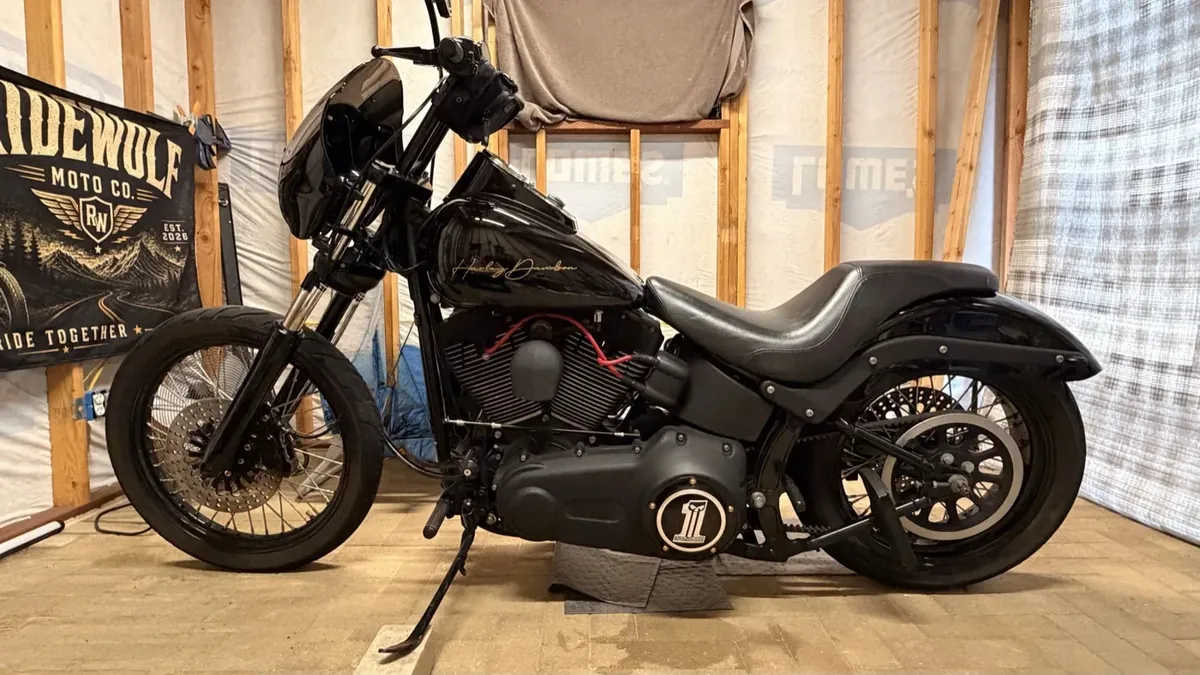
The first time I really felt how much a motorcycle weighs was the day I bought mine. I’d found a 2007 Harley Night Train on Facebook Marketplace, and when it came time to get it home, I wasn’t comfortable riding it yet. So my buddy Leo rode it back for me. Watching him muscle that thing around in the driveway, I remember thinking, “how am I ever going to handle that?” It’s about 680 pounds soaking wet. My father-in-law is 74, still rides his own bike every weekend, and even he can’t pick mine up off the kickstand anymore.
So weight is real, and it matters more than most new riders think. I went digging into the actual numbers across every kind of bike, pulled the real curb weights straight off the manufacturer spec sheets. This is everything you need to know about how much a motorcycle weighs and why it should shape the bike you buy.
So, how much does a motorcycle weigh?
A typical street motorcycle weighs somewhere between 300 and 900 pounds (roughly 135 to 410 kg) ready to ride. Most bikes people actually own cluster in the 400-to-600 range. But that band is huge because “motorcycle” covers everything from a 220-lb dirt bike you can pick up alone to a 900-lb touring rig that takes two people to load on a trailer. This is how the weight breaks down by the kind of bike, using ready-to-ride ranges from PowerSportsGuide:
| Type of motorcycle | Curb weight (lbs) | Curb weight (kg) | The gist |
|---|---|---|---|
| Dirt bike | 220–320 | 100–145 | Lightest by design, made to be tossed around |
| Dual-sport | 250–370 | 113–168 | Street-legal but still light and tall |
| Sport bike | 280–530 | 127–240 | Light for the power they make |
| Standard / naked | 280–530 | 127–240 | The do-it-all middleweights |
| Adventure (ADV) | 330–600 | 150–272 | Tall and built to carry gear for days |
| Cruiser | 300–800 | 136–363 | Low, laid-back, and often heavy |
| Touring / bagger | 400–1,000 | 181–454 | The heavyweights, loaded with everything |
Notice the overlap. A light cruiser can weigh less than a heavy adventure bike. That’s why you can’t just ask “how much does a motorcycle weigh” and get one number. You have to look at the specific bike. And before you compare two bikes on paper, you need to know one thing that dealers and spec sheets love to blur.
Wet weight vs dry weight vs curb weight
This is the part almost nobody explains, and it’s where people get fooled. A motorcycle has three different “weights” you’ll see quoted, and they are not the same number. Per RevZilla’s breakdown, this is what each one actually means:
Dry weight
The bike with no fluids: no gas, no oil, sometimes no coolant, brake fluid, or even battery. Manufacturers each drain different things, so dry weight looks artificially light and can’t be compared fairly across brands. It’s a marketing number.
Wet weight
The bike with some or all of its fluids in it. The problem is that “some or all” isn’t standardized either, so wet weight varies by how the maker measured it.
Curb weight
The whole bike, ready to ride: full tank of gas, oil, coolant, everything topped off. This is the honest number, and it’s the one to compare, because you’ll never ride your motorcycle with the fluids drained out.
How big is the gap? A gallon of gas weighs about six pounds, so a full tank plus oil and coolant usually adds 30 to 50 pounds over the dry number. When a brochure brags about a featherweight “dry weight,” mentally add a good 40 pounds to picture what you’ll actually be holding up at a stoplight. Every weight in this guide is curb or wet weight, the real-world kind.
Does engine size predict weight?
Loosely, yes. A bigger engine usually means a bigger, heavier bike, but it’s a rough guide, not a rule. A 1,000cc sport bike can weigh less than a 900cc cruiser because it’s built out of lighter stuff and carries less of it. Use this as a ballpark when you’re browsing, then check the actual spec:
| Engine size | Typical curb weight | What it usually is |
|---|---|---|
| 50–125cc | ~200–300 lbs (90–135 kg) | Scooters, minis, small commuters |
| 250–350cc | ~300–400 lbs (135–180 kg) | Classic beginner bikes |
| 400–650cc | ~350–500 lbs (160–225 kg) | Middleweight sport, standard, cruiser |
| 750–1,000cc | ~400–700 lbs (180–320 kg) | Bigger sport bikes and cruisers |
| 1,200cc and up | ~600–1,000 lbs (270–450 kg) | Big cruisers, baggers, touring |
What makes one bike heavier than another?
Two motorcycles with the same size engine can weigh hundreds of pounds apart, so it’s worth knowing what actually piles on the weight. A few things do most of the work:
- Frame and body material. A steel-framed cruiser is heavier than a sport bike built from aluminum and plastic.
- Fuel capacity. A big touring tank holds five or six gallons, and gas runs about six pounds a gallon.
- Fairings and hard bags. Full wind protection, saddlebags, and a trunk add up fast.
- Creature comforts. Touring bikes carry stereos, big batteries, reverse gear, sometimes even airbags, and all of it weighs something.
That’s why a stripped-down standard and a full-dress bagger can share an engine and still feel like different animals. The bagger hauls a road trip’s worth of hardware everywhere it goes, even to the corner store.
How much does a Harley weigh?
Harleys get their own question because people search it constantly, and because they run heavy. Harley-Davidson builds real steel cruisers and touring bikes, so even the “small” ones outweigh most starter bikes. The spread runs from the Sportster-class bikes up to the full baggers:
| Harley model | Weight (lbs) | (kg) | Class |
|---|---|---|---|
| Nightster | 481 | 218 | The Sportster successor, their lightest |
| Iron 883 (discontinued) | 564 | 256 | The old entry Sportster |
| Night Train (my ’07 Softail) | ~682 wet | 309 | A middleweight Softail cruiser |
| Street Glide | 811 | 368 | Full bagger, ready for the highway |
So when someone asks how much a Harley weighs, the honest answer is “a lot, and it depends.” A Nightster is manageable for a smaller rider. A loaded Street Glide, at over 800 pounds, is a real commitment. My Night Train sits in the middle, and trust me, you feel every one of those 680 pounds the first time you back it out of a parking spot on an incline. (Note: Harley doesn’t publish specs for the ’07 Softails anymore, so my number is cross-checked from spec databases, but it matches what my back tells me.)
Real bikes, lightest to heaviest
Ranges are useful, but real bikes make it click. Nine motorcycles a lot of people actually ride, pulled from manufacturer curb-weight specs, lined up light to heavy. This one table answers “how much does a dirt-ish 250 weigh,” “how much does a Gold Wing weigh,” and most of what people mean when they ask about a specific bike:
| Motorcycle | Curb weight (lbs) | (kg) | Source |
|---|---|---|---|
| Honda Grom (125cc) | 224 | 102 | Honda |
| Honda CRF250L (dual-sport) | ~320 | 145 | Honda |
| Kawasaki Ninja 400 | ~368 | 167 | Kawasaki |
| Yamaha MT-07 | 406 | 184 | Yamaha |
| Honda Rebel 500 | 408 | 185 | Honda |
| Harley-Davidson Nightster | 481 | 218 | Harley-Davidson |
| BMW R 1250 GS | 549 | 249 | BMW |
| Harley-Davidson Street Glide | 811 | 368 | Harley-Davidson |
| Honda Gold Wing Tour | 845 | 383 | Honda |
The Honda Grom is about as light as a real street-legal bike gets, and the Gold Wing is near the top of the mass-production heavyweights (a Gold Wing is basically a leather couch with a flat-six engine). Nearly four times the weight, both perfectly good motorcycles. That gap is the whole point: pick the one that fits how you ride and what you can actually hold up.
Does weight actually matter?
For a new rider, weight might be the single most important number on the spec sheet, more than horsepower. Here’s why. A lighter bike is easier to balance at walking pace, easier to catch when it leans a little too far at a stop, and far less likely to end up on its side while you’re still learning. A heavier bike punishes small mistakes harder. That’s not fear talking, that’s just physics, and weight is one of the few risk factors you fully control when you look honestly at how dangerous motorcycles really are.
A good starting weight for most beginners is around 300 to 400 pounds, on a bike where you can get your feet flat or close to flat on the ground. Being able to plant your feet changes everything for your confidence at low speed. Where the weight sits matters too. A low cruiser carries its mass down near the ground, so it can feel more manageable at a stop than a tall adventure bike that weighs the same on paper but stacks its weight up high. There’s a simple test the beginner guides recommend, and it’s the one I’d give anybody: in the parking lot, pull the bike straight up off its kickstand and just hold it there, balanced, engine off. If you’re fighting to keep it upright standing still, it’s too much bike for you right now. No shame in it. Start lighter and grow into the weight.
Now, heavier isn’t all bad. A big bike feels planted and calm at highway speed and gets pushed around less by wind and semis, where a very light bike can feel nervous. As the power-to-weight trade-off goes: light bikes shine in town and in the twisties, heavy bikes shine on the open road. Match the bike to where you’ll actually spend your miles. If you want the full money side of that decision, I broke down how much a motorcycle costs to buy and own, and heavier touring bikes sit at the top of that range too.
How to pick up a dropped motorcycle
Everybody drops a bike eventually. It usually happens at zero miles an hour, in a parking lot or at a stop, and it’s more embarrassing than dangerous. The good news is you don’t need to be strong to lift even a heavy bike, you need technique. This is the method from Team Oregon’s rider training, and the golden rule is: lift with your legs, never your back.
- Kill the engine with the kill switch and take a breath first.
- Turn the handlebars to full lock so the front wheel points into the ground.
- Sit your butt and lower back gently against the seat.
- Grab the lower handgrip with one hand (underhand) and a solid frame part with the other. Avoid hot pipes and soft plastic.
- Feet about a foot apart, knees bent, back straight. Then drive with your legs and take small steps backward. The bike walks up.
- Don’t over-lift or you’ll shove it over the other side. Once it’s up, kick the side stand down.
One honest caveat straight from Team Oregon: don’t try this solo until you’ve seen it demonstrated by a qualified instructor. And this is exactly where riding with people pays off. On a group ride, if somebody tips over, three of us have it upright in about four seconds and we’re back rolling. My buddy Leo has picked my Night Train up more than once. That’s half the reason we ride in a group in the first place.
How to find your bike’s exact weight
Want the real number for your specific bike? You have three easy places to look, per Dairyland:
- A label on the frame or swingarm, usually near the VIN.
- The specifications section of your owner’s manual.
- The manufacturer’s spec page for your exact year and model.
While you’re at it, learn one more number: GVWR, the gross vehicle weight rating. That’s the maximum total your bike can safely handle: the bike itself plus you, a passenger, and all your gear. Subtract the curb weight from the GVWR and you get your payload, the weight you’re allowed to add. Overload it and you hurt the bike’s stability and handling, which matters a lot the day you finally load up for a two-up trip. If you’re hauling the bike itself, remember that anything over about 600 pounds wants a full-width ramp rated for the load and a second person steadying it, so check the ramp’s weight rating before you ride up it.
Find people to help you hold it up
Every rider drops a bike, gets stuck on a hill, or just wants people to ride with. RideWolf helps you find riders and group rides near you so you’re never out there wrestling 700 pounds of steel alone.
The bottom line on motorcycle weight
So, how much does a motorcycle weigh? Anywhere from about 220 pounds for a dirt bike to over 900 for a full touring rig, with most real-world bikes landing between 400 and 600. But the number on the page matters less than the number you can handle. Be honest with yourself about what you can hold up at a stop, start on something you can flat-foot, and grow into the heavier stuff as your confidence catches up.
My Night Train scared me the day Leo rode it home. Now 680 pounds feels like nothing, because I put in the reps and I’ve got a crew that helps when it goes sideways. If a bike you love feels like too much today, that doesn’t mean never. It means not yet. Do your homework, ride within yourself, and then put that first foot forward and just do it. Peace.
Frequently asked questions
What is the average motorcycle weight?
Most street motorcycles weigh between 300 and 900 pounds (135 to 410 kg) at curb weight, with the typical everyday bike landing around 400 to 600 pounds. The exact figure depends far more on the type of bike than on engine size.
How much does a motorcycle weigh in kg?
Most motorcycles weigh between about 135 and 410 kg ready to ride. A light beginner bike is around 135 to 180 kg, a mid-size cruiser or standard is roughly 180 to 270 kg, and a big touring bike can pass 380 kg.
How much does a Harley weigh?
It depends on the model. Harley’s lightest, the Nightster, is about 481 lbs (218 kg). Softail cruisers like my Night Train run around 650 to 700 lbs, and full baggers such as the Street Glide reach 811 lbs (368 kg). Harleys run heavy compared to most starter bikes.
Is a 190 kg motorcycle heavy?
Not really. A 190 kg bike is about 419 lbs, which is a manageable middleweight, right around a Yamaha MT-07 or Honda Rebel 500. It’s a comfortable weight for most riders, including many beginners who can flat-foot it.
How much does a dirt bike weigh?
Dirt bikes are the lightest motorcycles, typically 220 to 320 lbs (100 to 145 kg). They’re built light on purpose so you can throw them around off-road and pick them up easily after a spill.
What is a good motorcycle weight for a beginner?
Around 300 to 400 lbs (135 to 180 kg) on a bike where you can plant your feet flat at a stop. That combination keeps low-speed balance easy and makes drops far less likely while you build confidence. You can always move up to a heavier bike later.