


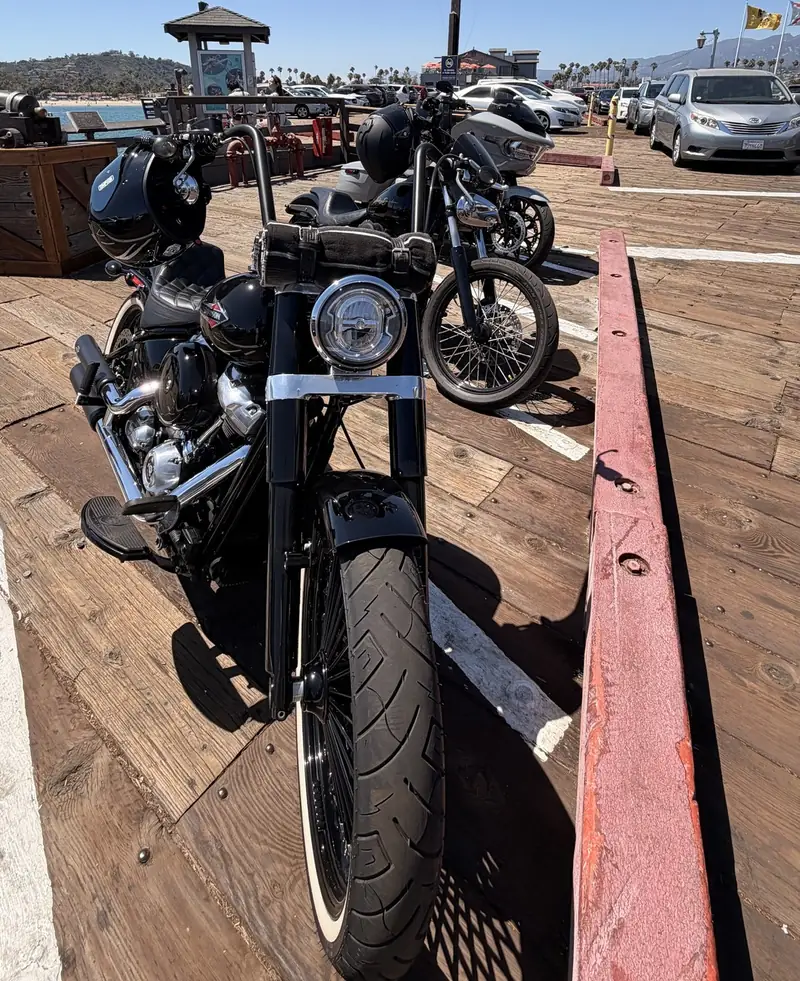
I rode up to Lake Arrowhead for the day a while back. Beautiful ride up. Great day. And then I pointed the bike home in the late afternoon with the sun sitting right on the horizon, straight in my eyes, and I did the thing everybody does when they’re tired and they just want to be home: I rode faster. Eighty, eighty-five, chasing the daylight.
Nothing happened. I got home fine. But I remember sitting in the driveway with the engine ticking, realizing I had no memory of the last forty minutes of that ride. I wasn’t riding at that point. I was commuting on autopilot on a machine that doesn’t forgive autopilot.
That day taught me the thing this whole guide is built on. The hard part of a trip isn’t the map. The hard part is you. The route is the easy half, and it’s the half everybody spends all their time on.
Start with the days, not the destination
Everybody plans a trip backwards. They pick a place they want to see, then work out how to get there, then discover the whole thing needs nine days and they have three. So start with what you actually have, and let the destination fall out of that.
Here’s how I think about the tiers, because the planning work is genuinely different at each one.
| Trip length | What you’re really planning | What you can wing | What will bite you |
|---|---|---|---|
| Day ride (out and back) | Fuel stops and a lunch stop | Almost all of it | The ride home when you’re cooked |
| Overnighter (1 night) | One bed, two fuel days | Route details, meals | Packing for weather you didn’t check |
| Long weekend (2–3 nights) | Beds in advance, a bail-out plan | Day-three route | Fatigue stacking, day three is not day one |
| A week or more | Service before you go, laundry, rest days | Less than you think | The bike, the weather, and your hands |
Notice what changes down that table. On a day ride, the only real risk is you. By the time you’re out a week, the bike becomes a genuine variable, and so does weather you can’t see from your driveway.
How far should you ride in a day?
I went looking for the official number and found something better than the one everybody quotes. There is no authority anywhere that publishes a recommended daily mileage for motorcyclists. The “300 miles a day” rule you’ve seen on every forum is somebody’s opinion that got repeated until it sounded like a fact.
But there is an official number. It’s just measured in hours. The California DMV motorcycle handbook says it flatly in its section on fatigue: riding a motorcycle is “more tiring than driving a vehicle, especially on a long trip,” and then gives you two numbers.
“Limit your distance. Experienced riders seldom ride more than about six hours a day.”
“Take frequent rest breaks. Stop and get off the motorcycle at least every two hours.”
Six hours of riding. Off the bike every two. That’s better than a mileage figure because it travels. Six hours is six hours. Droning across Nevada, working a canyon, it doesn’t matter, and the miles sort themselves out.
So build the day in hours first, then convert to miles at the pace the road actually allows.
| What you’re riding | Honest moving pace | Six hours gets you | What limits you |
|---|---|---|---|
| Interstate, faired bike | ~60 mph | ~360 mi | Fuel stops and your backside |
| Interstate, no fairing | ~55 mph | ~330 mi | Wind blast and your shoulders |
| Mixed back roads | ~40 mph | ~240 mi | Concentration |
| Twisty mountain roads | ~30 mph | ~180 mi | Corners burn focus fast |
| First season, any road | Cut to four hours | ~150 mi | All of it is still work |
| Day three of a trip | Cut by a quarter | — | Fatigue stacks, it doesn’t reset |
The mileage column is my arithmetic, not the DMV’s. Six hours is theirs.
Now the guy with the receipts. Will Brissette rides as Breezy B, he’s in Rhode Island, and he’s got over a million miles under him. He can do 1,300 miles in a day. But listen to how he describes getting there: “You don’t bang out 1300 miles in 22-26 hours without physical work and riding work.” He trains for it. Squats, core, pushups, light weight and high reps, endurance instead of size. He builds up to big mileage rather than just attempting it.
He also told me what genuinely changes as the years pile up: fatigue arrives quicker, it goes deeper, recovery takes longer, and each consecutive 500-mile day on a multi-day trip is harder than the one before it. That last part is what new riders miss completely. Day three is not day one.
The six hours start the night before
Sleep is the part of trip planning nobody puts on a checklist, and the numbers on it are ugly. In a CDC study of 92,102 people, 4% reported falling asleep at the wheel in the previous 30 days. Break that out by how much they normally slept and the gradient is brutal: people getting five hours or less reported it at 9.1%, against 2.4% for people getting eight. Nearly four times the risk, decided before you ever threw a leg over.
And you don’t have to actually fall asleep for it to cost you. A peer-reviewed study by Williamson and Feyer found that after 17 to 19 hours without sleep, performance on some tests was equivalent to or worse than a blood alcohol level of 0.05%, with response speeds up to 50% slower. It’s a lab study from 2000 with 39 subjects, so don’t treat it as gospel. But nobody would ride after a couple of beers, and plenty of us have ridden home on eighteen hours awake without thinking twice.
That was Arrowhead. I wasn’t drunk and I wasn’t reckless. I was just done, and I kept going anyway.
The practical version: stop every hour. The DMV’s floor is two, and I ride to one, because that’s what that afternoon taught me. Ten minutes off the bike every hour on a six-hour day costs you under an hour total, and it’s the whole difference between arriving and merely getting there.
Your fuel range sets your legs, not your ambition
This one surprised me when I went digging. Most manufacturers don’t publish a fuel economy number at all. You can’t work out your range from a spec sheet for most bikes on the road.
| Bike | Tank (published) | MPG (published) | What that gives you |
|---|---|---|---|
| 2026 Harley-Davidson Street Glide | 6 gal. | 44 mpg, labeled “Estimated” | ~264 mi dry tank, in theory |
| 2026 Honda Rebel 500 | 3.0 gal. | Not published | You have to measure it |
| 2026 Honda Gold Wing | 5.5 gal. | Not published | You have to measure it |
Two honest warnings about that table. Harley’s own spec sheet calls its 44 mpg Estimated, not EPA-certified, so treat it as a ballpark. And that 264-mile figure is my multiplication, not Harley’s. Nobody publishes a range number, because range depends on your wrist, the wind, and whether you’re two-up with bags.
So measure your own. Fill the tank, ride normally, fill it again, divide the miles by the gallons. Do that twice and you’ll know your real number. Then take that number and knock a quarter off it, and that’s your planning range. The last quarter tank is for the gas station that turned out to be closed.
Get the bike ready before you get excited
The Motorcycle Safety Foundation publishes a pre-ride inspection checklist called T-CLOCS. Six letters, and it’s the closest thing motorcycling has to a preflight check.
| Letter | What it covers | What matters on a loaded trip |
|---|---|---|
| T | Tires & Wheels | MSF’s own instruction: “Check when cold, adjust to load” |
| C | Controls | Cables and hoses, the stuff that stiffens on a cold morning |
| L | Lights & Electrics | You’ll be seen less than you think you are |
| O | Oil & Other Fluids | Levels and leaks, checked before you need them |
| C | Chassis | Chain or belt tension, suspension, fasteners |
| S | Stands | A loaded bike on a soft shoulder is a different animal |
One honest note: the MSF checklist doesn’t actually say “do this before a long trip.” It doesn’t state a frequency at all. The frequency instruction comes from the California DMV handbook, which says simply to “check the motorcycle before every ride.” A trip is just a lot of rides in a row.
My buddy Leo has a line about Harleys: if it’s not leaking, it needs oil. He’s joking. Mostly. The serious version is that a trip is not the time to discover something your bike has been quietly telling you about for a month. Whatever you’ve been ignoring gets louder 300 miles from home.
A pre-trip timeline that actually leaves time to fix things
| When | What | Why then |
|---|---|---|
| Four weeks out | Oil if it’s due, tires if they’re near the line, brake fluid if it’s two years old | Parts get ordered and shops get booked. This is the only step with a lead time. |
| One week out | Chain or belt, all fluid levels, every light, battery | Leaves you a working week to fix whatever you find |
| Morning of | Full T-CLOCS, tire pressure cold and set for the load | Cold pressure means before you ride, not at the first gas station |
On intervals, the manufacturers genuinely disagree, so check your own manual rather than a rule of thumb. Yamaha wants engine oil on the Ténéré 700 every 6,000 km or six months; BMW and Royal Enfield both run annual; Harley’s schedule gives mileage only and no month figure at all. Brake fluid is closer to consensus. Harley’s 2023 Touring manual says to “flush brake systems and replace DOT 4 hydraulic brake fluid every two years,” and Yamaha says the same two years, though BMW front-loads the first change to one year.
Chain lube is the interval people underestimate most. Royal Enfield asks for clean, lube and adjust every 500 km, or sooner in wet, dusty or muddy conditions. Yamaha’s chart says every 1,000 km “and after washing the motorcycle, riding in the rain or riding in wet areas.” One rainy afternoon resets the clock, which matters a lot more on a week-long trip than it does on a Sunday.
Tire pressure, and a myth I nearly repeated
Michelin’s guidance is the clearest I found: “The owner’s manual specifies a higher pressure for loaded conditions. The additional weight compresses the tire and requires more air pressure to maintain the correct profile.” They also say to check cold, use the manual’s number rather than the maximum on the sidewall, and never bleed air from a hot tire to hit a cold target, because it’ll be underinflated once it cools. Dunlop makes the same sidewall point: that number is “a maximum for that tire and may not match the recommended pressure for your motorcycle.”
Now the part where I nearly got it wrong. Search around and you’ll find it stated everywhere that Harley wants 38 front and 42 rear when you’re two-up. I went and downloaded the actual 2023 Touring owner’s manual to check. It gives one cold specification, 36 psi front and 40 psi rear, and the only adjustment table in the whole manual is for ambient temperature, not load. There’s no solo-versus-passenger split in it anywhere. Harley handles the passenger question through weight limits instead, which brings us to the number nobody looks up.
The number nobody looks up: what your bike can actually carry
Every motorcycle sold in the US has a Gross Vehicle Weight Rating, and federal regulation says exactly where to find it: on a label “as close as is practicable to the intersection of the steering post with the handle bars.” Harley’s manual points you at the frame steering head or the downtube. Go look at yours. Most riders never have.
Subtract what the bike weighs from its GVWR and what’s left is everything: you, your passenger, your gear, your bags, and the six-pack you strapped on.
| Bike | Weight as delivered | GVWR | Left for people and gear |
|---|---|---|---|
| 2023 Harley Street Glide | 829 lb | 1,360 lb | 531 lb |
| 2023 Harley Electra Glide Ultra Ltd | 917 lb | 1,360 lb | 443 lb |
| BMW R 1250 GS Adventure | 591 lb | 1,069 lb | 478 lb |
| 2023 Indian Chief | 670 lb | 1,160 lb | 490 lb |
All four figures are the manufacturers’ own published payloads. And 531 pounds sounds like plenty right up until you do the arithmetic: a 200-pound rider, a 150-pound passenger, two sets of gear and a week of luggage, and the big bagger is closer to its limit than anybody riding it would guess. The Ultra Limited, the one built for exactly this job, has the least room of the four.
Harley doesn’t hedge about it either: exceeding the rating “can lead to component failure and adversely affect stability, handling and performance, which could result in death or serious injury.” Indian says never exceed it. On packing, Harley’s manual is practical: keep the weight low and close to the bike, distribute it evenly on both sides, don’t load bulky items too far behind the rider, and recheck that it’s secure periodically, because loads shift.
Tires deserve a last word, because they end more trips than anything else and get checked least. If yours are near the line, sort them before you go rather than at a strange shop in a strange town on a Sunday. I went down that rabbit hole in when to replace motorcycle tires.
Check the road before you commit
Here’s a live example, and I mean live as in this morning. I was going to use Angeles Crest Highway as the example of a great two-day loop out of Los Angeles. Then I checked, the way I’m telling you to check. Straight from the Caltrans highway report, as of 7:20 this morning:
SR 2 is closed from 3.3 mi east of Newcomb’s Ranch to Islip Saddle. Is closed from Islip Saddle to 5.4 mi west of Big Pines.
Caltrans says the damage includes washouts, rockfalls, landslides and debris flows across the corridor, and that there is “no anticipated timeline for the completion of assessments or the reopening of SR-2.” That’s the best motorcycle road in Los Angeles County, closed, with no reopening date. If I’d planned that loop from my kitchen table on vibes and a memory of last summer, I’d have ridden ninety minutes to a gate.
Two minutes of checking. That’s the whole lesson.
| What you’re checking | Where to check it |
|---|---|
| California highways, live | Caltrans QuickMap · roads.dot.ca.gov (text, by route number) |
| Nevada | Nevada 511 |
| Arizona | AZ511 |
| Colorado | COtrip |
| Montana (Beartooth) | MDT Traveler Info |
| National parks | nps.gov/[park code]/planyourvisit/conditions.htm |
Seasonal roads open when they open
If your route crosses a mountain pass, the opening date is weather, not a schedule. The National Park Service publishes the actual opening dates for Yosemite’s Tioga Road going back decades, with the April snowpack next to each one, and the correlation is right there in the numbers.
| Year | Tioga Road opened | Snowpack, April 1 |
|---|---|---|
| 2023 | July 22 | 244% |
| 2019 | July 1 | 176% |
| 2024 | June 10 | 99% |
| 2025 | May 26 | 72% |
| 2015 | May 4 | 7% |
| Average, 2004–2023 | May 31 | 92% |
Eleven weeks of spread between a heavy snow year and a light one, on the same road. NPS says it plainly: predicting when these roads open “is not possible, even in late spring.” So if a pass is central to your route, have a second route that doesn’t need it. Source: NPS Tioga Road opening dates.
Plan for the weather you’ll actually get
Use the National Weather Service point forecast and its hourly graph, which gives you heat index and surface wind hour by hour along your route. Two things worth knowing before you trust it.
First, a “point” forecast isn’t a point. NWS runs a 2.5 km grid and says outright that values “should not be interpreted as exact point forecasts in time and space.” That’s a mile and a half wide. On a canyon road that climbs four thousand feet inside that box, the top and the bottom are different weather.
Second, on heat. NWS notes that heat index values were built for “shady, light wind conditions,” and that full sunshine can push them “up to 15°F” higher. It also warns that “strong winds, particularly with very hot, dry air, can be extremely hazardous.” Read that as a rider: you are in full sun, in a hot dry wind, by definition. Both of the conditions NWS flags are just called Tuesday when you’re on a bike in the desert.
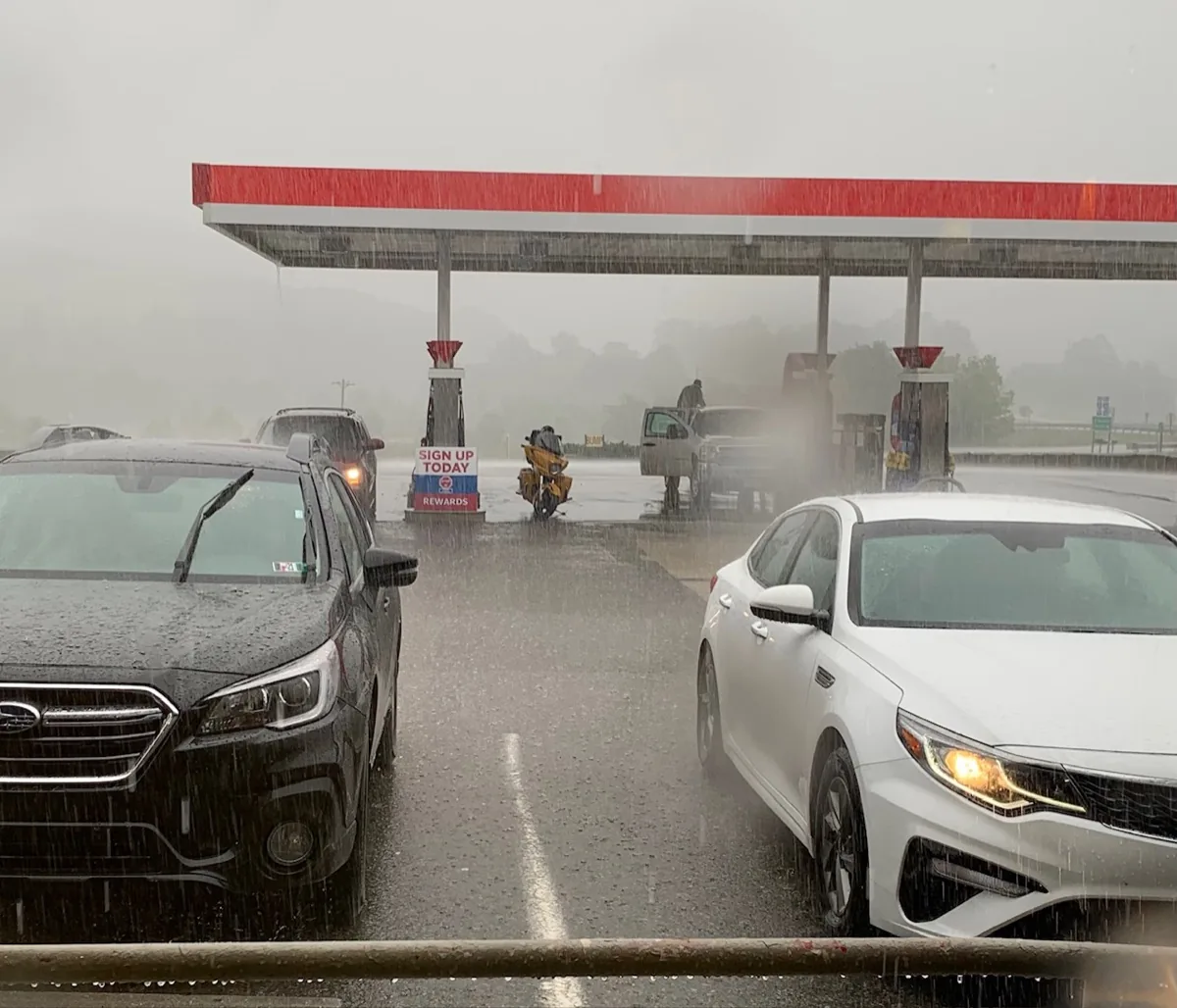
One gap worth naming honestly, because I went looking and couldn’t find it. I could not find a single official source, not NWS, not Caltrans, not ADOT, that gives wind guidance specifically for motorcycles. Every wind advisory is written around high-profile vehicles: box trucks, trailers, RVs. So when you see a Wind Advisory, understand it wasn’t written with you in mind, and make your own call.
The cold sneaks up on you at 65 mph
I wrote most of this section about heat, because heat is what we get in Southern California. Then Breezy B read the draft and sent me a wind chill chart with a note that said, more or less, you’re missing half the problem.
His story: a fall ride from LA to Salt Lake City. He told the group to wear long sleeves and sunblock, and to drink at every fuel stop. Some of them thought it was a joke. It was 92 that afternoon. By the time the sun started going down it was 45. He’d told them to pack layers too. A couple didn’t, and in his words, they paid a price.
Here’s why 45 isn’t 45. The National Weather Service publishes a wind chill formula, and it doesn’t know or care whether the wind is blowing at you or you’re riding into it. Run 45°F through it at 65 mph and you get 32°F on the skin. Freezing, on the nose. I did the arithmetic for riding speeds below, because every chart I found online was somebody’s graphic with no formula behind it.
| Riding speed | 50°F | 45°F | 40°F | 35°F | 30°F | 25°F | 20°F |
|---|---|---|---|---|---|---|---|
| 35 mph | 41° | 35° | 28° | 21° | 14° | 7° | 0° |
| 45 mph | 40° | 33° | 26° | 19° | 12° | 5° | -2° |
| 55 mph | 40° | 32° | 25° | 18° | 11° | 4° | -3° |
| 65 mph | 39° | 32° | 24° | 17° | 10° | 2° | -5° |
| 75 mph | 38° | 31° | 23° | 16° | 9° | 1° | -6° |
What the air feels like on exposed skin, from the NWS wind chill formula. NWS says the formula only applies at or below 50°F, so the table stops there. Charts that show a 60°F column are extending it past where it’s valid.
Two more things from the NWS cold-weather pages that riders should read twice. Hypothermia is your body temperature dropping below 95°F, and NWS says it can occur in temperatures as warm as 60°F if you’re outside a long time and not dressed for it. Six hours on a bike is outside a long time. And their advice for preventing frostbite includes drinking plenty of fluids, which is the part of Breezy B’s fuel-stop speech that sounded least like cold-weather advice and turns out to be exactly that.
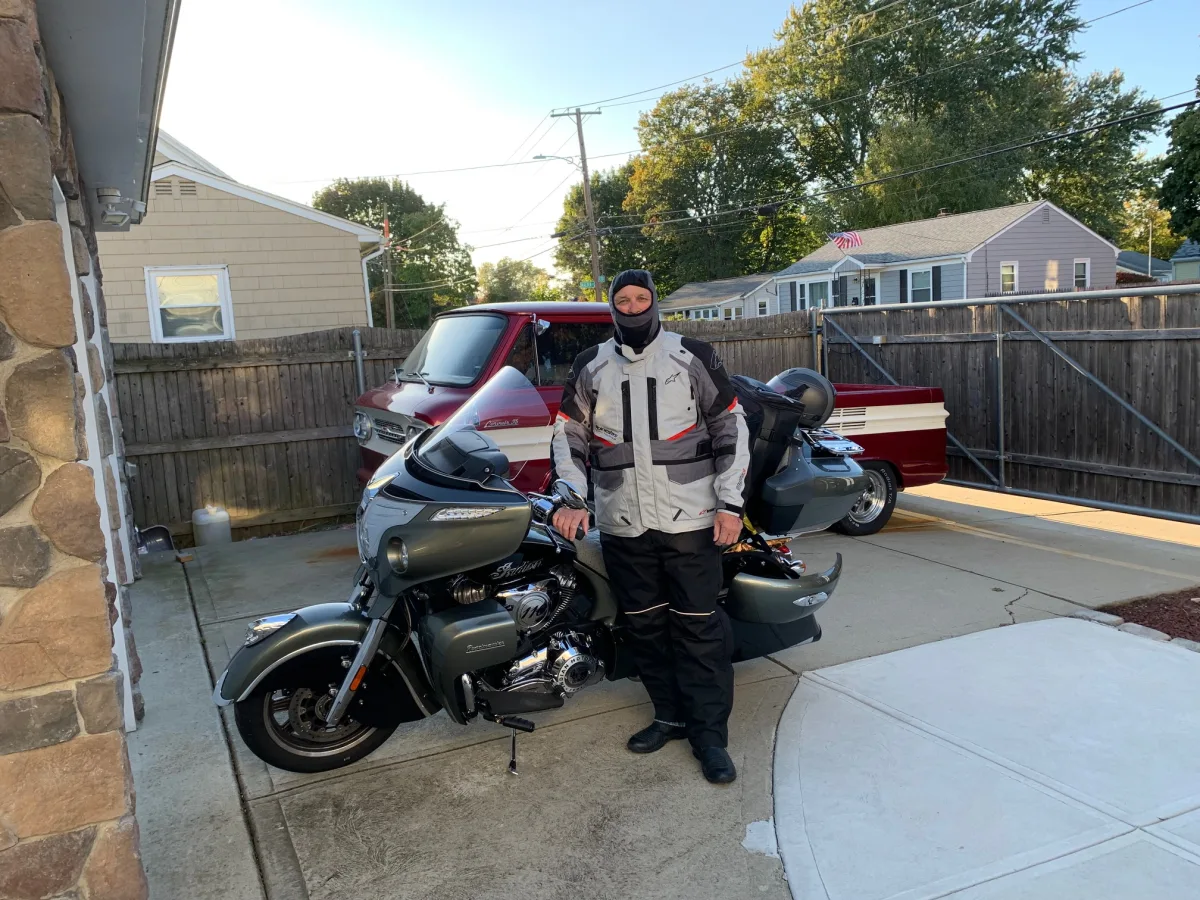
So the packing rule for a trip that crosses a mountain pass or a sunset is simple. Pack for the coldest hour of the ride, not the forecast high, and put the layers where you can reach them at a gas station. Peeling a base layer out of the bottom of a saddlebag at dusk in a parking lot is the kind of thing you only do once.
Dawn, dusk, and the deer problem
Two numbers worth carrying with you. First, the counterintuitive one: of motorcyclists killed in 2023, NHTSA records 56% in daylight and 39% in the dark, and 65% in urban areas rather than rural. That’s mostly a story about where and when bikes actually are, not about the empty back road being safe. But it does mean the lonely mountain highway isn’t where the statistics live.
Second, the one that stopped me. Wisconsin DOT counted 17,432 deer crashes in 2024. Nine people died in them. Seven of the nine were motorcyclists. Out of seventeen thousand crashes. Their own explanation is the obvious one: a bike is light and offers none of the protection a car does, so when a deer and a motorcycle meet, it goes badly in a way it usually doesn’t for a sedan.
Deer move most at dawn and dusk, which happen to be exactly the hours you’re tempted to ride when you’re pushing to make the next town. Wisconsin flags two seasonal peaks: October and November for the rut, and May and June, when riders are back out in numbers.
If one steps out, the advice from the California handbook is to do everything you safely can to avoid hitting it, but if you’re in traffic, stay in your lane. The IIHS data backs the restraint. Of animal-involved crash deaths in 2024, only 63% came from the collision with the animal itself. The other 37% came from the rollover, the fixed object, the oncoming car. The swerve kills more often than the deer does.
Planning a trip with a crew
This is the part every other trip-planning guide skips, and it’s the part that actually decides whether the trip is any good. A solo trip is a logistics problem. A group trip is a people problem wearing a logistics costume.
What actually goes wrong on a multi-day group trip, in order of how often I’ve seen it or heard about it:
- Mismatched range. Covered above. The smallest tank owns the schedule.
- Mismatched pace. One guy wants to carve, one guy wants to cruise. Over a day that’s friction. Over four days it’s a fight.
- Mismatched stamina. A 400-mile day is a nice day for one rider and a survival exercise for another, and the second guy won’t say so.
- No agreed regroup rule. Somebody misses a turn and now the group is split with no plan.
- Nobody’s actually leading. Everyone assumed somebody else booked the second night.
Most of that is fixed in one conversation before you leave. Agree the day’s distance out loud, agree that you regroup at every turn or at every fuel stop, agree who leads and who sweeps, and agree that the slowest rider sets the pace and nobody makes a thing of it. If you’re new to riding in a pack, the mechanics of leading, sweeping and staying in formation are in the complete guide to group riding.
And share the route file before you go, not at the gas station. GPX is the format everything speaks. It’s “a light-weight XML data format for the interchange of GPS data” per TopoGrafix, who publish the spec, and Garmin, among others, imports it directly. One file, everybody’s got the route, nobody’s the only one who knows where the group is going. You can build and export a route in the RideWolf route planner if you want a starting point.
Book the beds, or deliberately don’t
Both approaches work. What doesn’t work is not deciding which one you’re doing.
If you’re camping on public land, the booking windows are real and they are not uniform, which trips people up. Recreation.gov says “most campsites can be booked six months prior to your arrival date,” but that’s a general rule with big exceptions. Yosemite releases its valley campgrounds “five months in advance on the 15th of each month,” its high-country sites on a two-week rolling window, and Camp 4 one week out. California State Parks is “six months to the day in advance of the arrival date,” opening at 8 a.m. Pacific.
And it cuts the other way too. Some national forests set a minimum lead time. Arapaho & Roosevelt states that reservations “cannot be made within 3 or less days from your arrival.” So the day-before booking you were counting on may not exist.
Sources: Recreation.gov, NPS Yosemite camping, California State Parks reservations.
What I’m doing for my first overnighter
Full disclosure, because I’d rather tell you than have you assume. I haven’t done a multi-day trip yet. My riding is Sundays with the crew, big day rides, canyons and coast and home for dinner. The overnight is the thing I’m building up to, and everything above is the homework I’m doing to get there.
Here’s the actual plan, in case it’s useful. One night, not three. Somewhere I’ve already ridden most of the way to, pulled from the rides we’ve mapped around Los Angeles, so the only new part is the last stretch and the sleeping. Beds booked, because for a first one I don’t want to be hunting a motel at dusk in an unfamiliar town. The crew comes, because that’s the whole point. And a distance for day two that’s shorter than day one, because of everything Breezy B said about day three, which starts being true on day two.
That’s it. That’s not a heroic trip. But the trip you actually take beats the one you keep planning, and the first one is the one that makes the second one obvious.
Find people to ride it with
RideWolf is a free iOS app for finding and joining group rides near you. It’s in early access, and the waitlist is where you get in first.
Planning a motorcycle trip, asked and answered
How far should you ride on a motorcycle in one day?
There’s no official mileage standard, but there is an official time limit. The California DMV motorcycle handbook says experienced riders seldom ride more than about six hours a day, and to stop and get off the bike at least every two hours. Six hours is roughly 360 highway miles, or 180 in the mountains.
How do I work out my motorcycle’s fuel range?
Measure it, because most manufacturers don’t publish a fuel economy figure. Fill the tank, ride normally, fill it again, then divide miles by gallons. Do it twice for an honest average. Then subtract a quarter for your planning range, so a closed gas station is an inconvenience and not an emergency.
What should I check before a long motorcycle trip?
Run the MSF T-CLOCS check: tires and wheels, controls, lights and electrics, oil and other fluids, chassis, and stands. Set tire pressure cold and adjusted for the load you’re carrying. Handle anything with a lead time, oil, tires, brake fluid, about four weeks out so a shop delay can’t cancel the trip.
How do I check if a road is open before a motorcycle trip?
Use the state DOT’s traveler information service: Caltrans QuickMap in California, Nevada 511, AZ511, COtrip in Colorado. For national parks, check nps.gov conditions pages. Mountain passes open on weather, not a schedule, so always have a second route that avoids the pass.
How do you plan a motorcycle trip with a group?
Agree four things out loud before you leave: the day’s distance, who leads and who sweeps, where you regroup if someone misses a turn, and that the slowest rider sets the pace. Plan fuel stops around the smallest tank in the group, and share the route as a GPX file so everyone has it.
How far in advance should I book campsites for a motorcycle trip?
Most Recreation.gov campsites open six months before arrival, but exceptions are common. Yosemite’s valley campgrounds release five months out on the 15th of each month. California State Parks opens six months to the day at 8 a.m. Pacific. Some national forests also require booking at least three days ahead.
How cold does it feel on a motorcycle at highway speed?
Use the National Weather Service wind chill formula with your riding speed as the wind speed. At 65 mph, 45°F feels like 32°F on exposed skin, 35°F feels like 17°F, and 25°F feels like 2°F. NWS only applies the formula at or below 50°F. Pack for the coldest hour of the ride, not the daytime high.
Look, the planning isn’t the fun part. Nobody got into motorcycles because they love spreadsheets. But an hour at the kitchen table is what turns a trip you survived into a trip you’d do again, and it’s the difference between the ride home from Arrowhead I had and the one I should have had.
Check the road. Measure your tank. Book the bed. Then put that first foot forward and just go. Peace.