


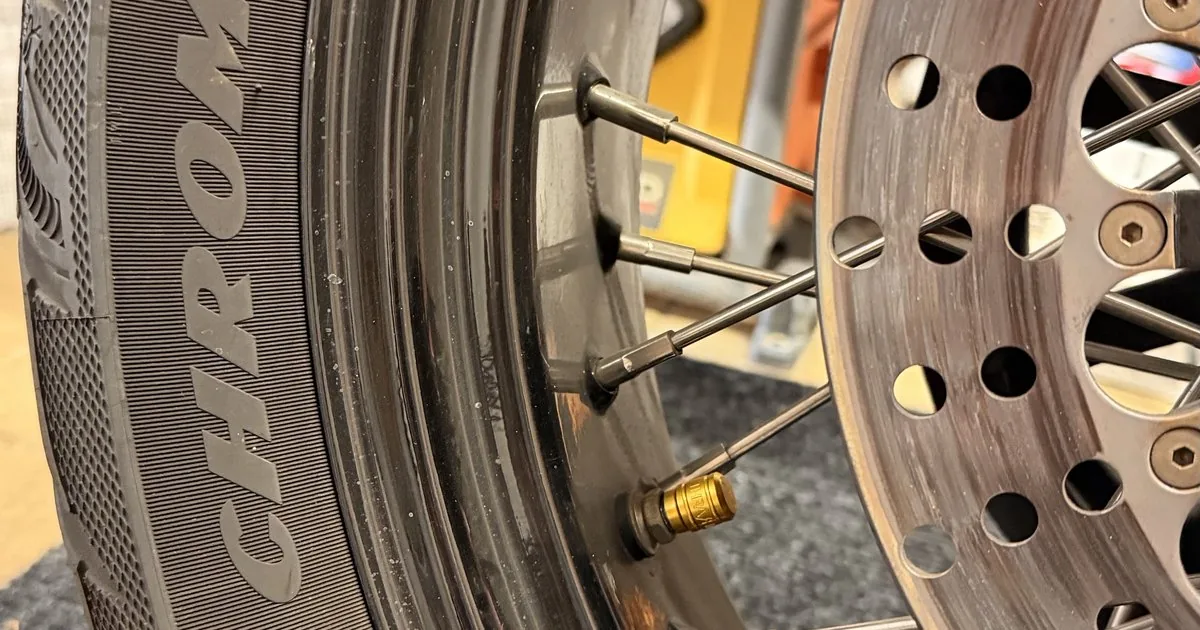
The other day G, Leo and I were rolling out for a ride, doing the usual around-the-bikes shuffle before we fired up. Leo looked down at my tire and stopped. It looked low. Out came his compressor, and sure enough, it was really low. Not flat, just quietly, sneakily low, the way tires get when nobody’s been paying attention. We filled it up, checked it again, and rolled out. Total delay, maybe ten minutes.
Then G crouched down and stuck a coin in my tread to check it, nodded like a doctor with a stethoscope, and pronounced the tire healthy.
Hold that thought about the coin. Because when I got home I went down the rabbit hole on this, and it turns out one of those two checks my crew ran that morning is exactly right, and the other one is a car thing that doesn’t belong on a motorcycle at all. I’ll get to which is which.
When should you replace motorcycle tires?
Replace a motorcycle tire when any one of three things is true: the tread has worn down to the wear bars, the tire has aged out regardless of tread, or it has damage you can see. Any one of the three. A tire with perfect tread can be dead of old age, and a six-month-old tire with a sidewall cut is done, period.
That’s the answer in one paragraph. The rest of this article is the how: how to spot the wear signs, how to read your tire’s birthday off the sidewall, what the manufacturers actually say about age (spoiler: they don’t agree with each other), and what the coin trick gets wrong.
The wear signs, and what each one is telling you
| What you see | What it means | What to do |
|---|---|---|
| Wear bars flush with the tread | The tire has reached its wear limit | Replace. Dunlop’s guidance is to replace before the bars, at 2/32” |
| Squared-off center strip | Highway miles have flattened the profile; handling gets vague in corners | Plan the replacement; the center hits the limit long before the edges |
| Cupping or scalloped dips | Uneven wear, often from suspension or pressure issues | Replace and find the cause, or the new tire repeats it |
| Cracks in the sidewall or tread grooves | Dry rot: the rubber’s protective compounds have given up | Replace. This is age damage; no tread depth saves it |
| Bulge or bubble anywhere | Internal structural failure | Stop riding on it. Replace now |
| Anything stuck in the sidewall | Sidewall damage cannot be repaired, by anyone’s rules | Replace. No exceptions, no plugs |
One more that doesn’t leave a mark: chronic low pressure, which is what Leo caught. Riding low cooks a tire from the inside through heat and flex, wears the edges fast, and it’s invisible unless somebody actually looks. Michelin’s guidance is to check pressure twice a month. Be honest: when did you last check yours?
How to read your motorcycle tire date code
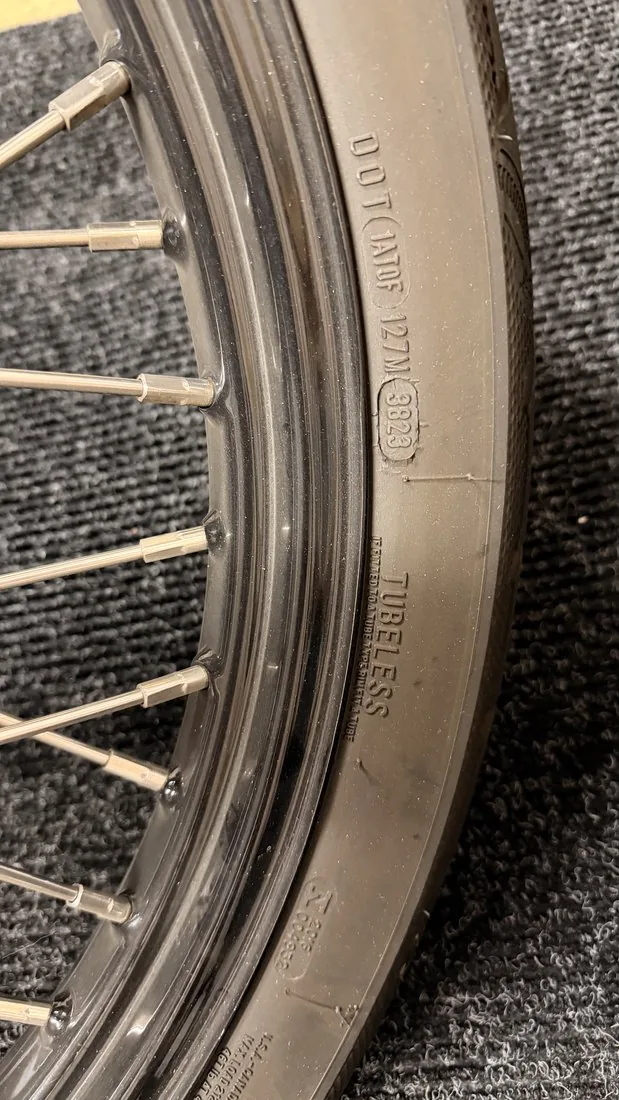
Every tire sold in the US carries its date of birth molded into the sidewall, and reading it takes ten seconds once you know the trick. Look for the letters DOT followed by a string of characters. The last four digits are the date code: two digits for the week, two for the year. That format isn’t a convention, it’s federal law. The regulation spells it out: “0109 means the tire was manufactured in the first full calendar week of 2009.”
I went out to the garage and checked mine. The front Avon on my Night Train reads 3823: thirty-eighth week of 2023. My front tire was born in late September 2023, which makes it coming up on three years old. Well inside anybody’s guidance, and now I actually know rather than guess.
| Date code | Born | Verdict |
|---|---|---|
| 3823 | 38th week of 2023 (my front tire) | Fine. Keep riding, keep checking |
| 0109 | 1st week of 2009 (the fed’s own example) | Seventeen years old. Replace, obviously |
| 2519 | 25th week of 2019 | Past seven years: inspection territory, honestly evaluate it |
| Only 3 digits | Before the year 2000 | A three-digit code means the tire predates 2000. Replace it, full stop |
Two gotchas. First, the full code may only appear on one side of the tire, so if you find DOT but no four-digit ending, check the other sidewall. Second, that three-digit thing is real: before July 2000, codes had three digits and there’s no way to tell which decade the tire is from. Michelin’s own manual gives the example that “025” could be 1995 or 1985. If you’re shopping a used bike and the code has three digits, you’re looking at a tire from another century.
How old is too old? The manufacturers don’t agree
Here’s what I didn’t expect to find. Ask the tire companies themselves how long a motorcycle tire lasts, and you get three different answers.
| Who | What they officially say |
|---|---|
| Dunlop | “Tires which have been in use for 5 years or more should continue to be inspected by a specialist at least annually,” and tires “10 years or older from the date of manufacture… be replaced with new tires as a precaution even if such tires appear serviceable” |
| Michelin | Same structure: professional inspection yearly after 5 years, and “all tires that have not been replaced after ten years should be changed, even if they appear to be in a generally good condition” |
| Pirelli | Refuses to set a number at all: “There is no scientific or technical data that establishes or identifies a minimum or maximum service life” — but the longer a tire is in service, the more likely it needs replacing |
| NHTSA (all vehicles) | “Some vehicle and tire manufacturers recommend replacing tires that are six to 10 years old, regardless of treadwear” |
So the “replace at five years” rule you’ve heard at bike nights isn’t what anybody actually says. Five years is when Dunlop and Michelin want a professional looking at the tire every year. Ten is their hard stop. And Pirelli, on the record in their own warranty document, says no fixed number is scientifically defensible at all. When the people who make the things can’t agree, the honest play is the conservative one: from five years on, treat the tire as a suspect. At ten, it’s done regardless.
What ages a tire faster is worth knowing too, because almost none of it is riding. Heat, sunlight, and ozone do the damage. Michelin’s manual explains that tires contain waxes that migrate to the surface as the tire rolls and flexes, which means a bike that sits for months ages its tires faster than one that gets ridden. Out here in SoCal sun, that clock runs faster still; NHTSA specifically calls out the Sun Belt for accelerated tire aging. And one from Pirelli that surprised me: don’t dress your sidewalls. Tire shine strips the antioxidants that protect the rubber. Your tires are supposed to look a little dull. So is mine, and now I feel better about it.
How many miles do motorcycle tires last?
You want a number, and I get it, but here’s the truth: nobody who makes motorcycle tires will give you one. Car tires come with 50,000 or 60,000-mile warranties. Motorcycle tires come with none. Dunlop’s warranty page says it flat out: “There is no warranty for any specific mileage achievement.” Michelin’s motorcycle warranty covers tread life and six years, no mileage. Pirelli prorates by tread worn, and their document adds “regardless of age or mileage.”
Why? Because a motorcycle tire’s life depends on the bike, the compound, the roads, and mostly the right wrist. A sticky sport compound ridden hard through canyons can be gone in a few thousand miles. A touring tire droning the interstate can go five times that. The one pattern the industry does acknowledge: rears wear out roughly twice as fast as fronts. Budget for two rears per front and you won’t be surprised.
Which is also why tires belong in your ownership math. When I wrote up what a motorcycle really costs, tires were one of the line items people forget, and if you’re curious how long the whole machine lasts, the bike outlives a lot of tire sets.
About that coin: wear bars and what the law actually says
So, G and his coin. The penny test is a real thing… for cars. I looked for any motorcycle authority that endorses it and came up empty, because motorcycle tires come with something better built in: wear bars. They’re small raised ribs molded into the tread grooves. When the tread wears down flush with those bars, the tire is at its limit. No pocket change required; the tire tells you itself.
(G’s been riding fifteen years and checked my tread like he was buying a used Buick. I gave him grief. He pointed out that at least somebody was checking my tires, which, fair. That’s the real lesson here anyway.)
The wear bars sit at about 1/32 of an inch, and that lines up with the law where a law exists. California Vehicle Code 27465, for example, prohibits riding on less than “one thirty-second (1/32) of an inch tread depth in any two adjacent grooves.” State laws vary, and Dunlop for their part recommends replacing at 2/32”, before you ever touch the bars. The wear bars are the floor, not the target. If you’re at the bars, you’re not deciding whether to replace the tire, you’re late.
Plugs, patches, and getting home
Pick up a nail and the question becomes whether the tire can be saved, and the manufacturers split on this one too. Dunlop allows exactly one kind of repair: a plug-patch installed from inside the dismounted tire, tread area only, hole no bigger than a quarter inch, done by a shop, and even then you’re limited to 50 mph for the first 24 hours and 75 mph forever after. Michelin “does not condone or endorse the repair” of its motorcycle tires. Pirelli doesn’t recommend repair either. And everyone, everywhere, agrees on two things: a rope plug from the roadside kit is a get-home measure, not a repair, and a sidewall is never repairable by anyone under any rule.
My take, for whatever it’s worth: the plug kit lives under my seat for getting off the highway, not for pretending nothing happened. A tire that’s been holed gets looked at by a professional, and if there’s any doubt, it gets replaced. It is the only thing connecting you to the road. Both patches of rubber together are smaller than a sheet of paper. That’s a bad place to save eighty bucks.
The ten-minute habit that beats every rule in this article
Everything above is knowledge. What actually keeps you rolling is the habit: the walk-around before every ride. Pressure when the tires are cold. A look at the tread. A hand run over the sidewall feeling for anything that shouldn’t be there. Glance at the date code twice a year. Ten minutes, tops, and Leo’s compressor catch proved the value of it better than any statistic I could quote you.
And notice it wasn’t me who caught my own low tire. That’s the part I keep coming back to. Ride with people, and you get extra sets of eyes on your bike, people who’ll crouch down next to your wheel with a compressor, or a coin, because they want you rolling home behind them. It’s one more reason riding with a crew makes you safer, and one more reason we’re building RideWolf: to help you find rides and riders near you, whether that’s a pack for Sunday or just somebody who knows what cupping looks like.
We’re pre-launch, and early access is an email away: join the waitlist here.
FAQ
Are 10 year old motorcycle tires still good?
No. Dunlop and Michelin both say to replace any tire ten years from its manufacture date, even if it looks serviceable and has legal tread. Rubber degrades with age regardless of use. Check the last four digits of the DOT code for the week and year it was made, and if it reads ten years back, replace it.
How do I read a motorcycle tire date code?
Find the letters DOT on the sidewall and read the last four digits: the first two are the week, the last two the year. So 3823 means the 38th week of 2023. The full code may appear on only one sidewall, so check both sides. A three-digit code means the tire was made before 2000 and should be replaced.
How often should I replace motorcycle tires?
There’s no fixed interval. Replace when the tread reaches the wear bars (Dunlop says at 2/32”, before them), when the tire shows cracking, cupping, or damage, or when it hits ten years old regardless of condition. From five years on, have it professionally inspected every year. Mileage varies too much to be the trigger.
Should I replace both motorcycle tires at the same time?
Not necessarily. Rears wear roughly twice as fast as fronts, so most riders replace two rears for every front. What matters is that both tires are healthy, correctly matched to the bike, and the pair is what the manufacturer approves. Never mix in a tire the bike maker doesn’t spec just because one end still has tread.
Can you plug a motorcycle tire?
Only as a temporary get-home fix. Dunlop permits a proper plug-patch installed from inside the dismounted tire, tread area only, quarter-inch maximum, with speed limits afterward. Michelin and Pirelli don’t endorse repairing motorcycle tires at all. Sidewall damage is never repairable. When in doubt, replace it.
How long do motorcycle tires last in storage?
Tires age even sitting still, and a parked bike can age tires faster than a ridden one, because the protective waxes in the rubber only migrate to the surface when the tire flexes. Store the bike away from sunlight, heat, and ozone sources like generators and battery chargers, and the ten-year date-code limit still applies.
One more thing before you go
Go out to the garage and read your date code tonight. Ten seconds. Last four digits after DOT, week then year. If it’s three digits, we need to talk. Then check your pressure, because if your crew is anything like mine, somebody else is going to catch it eventually, and you’ll never hear the end of it.
Be safe out there, look after the two little patches of rubber doing all the work, and put that first foot forward and just do it. Peace.