


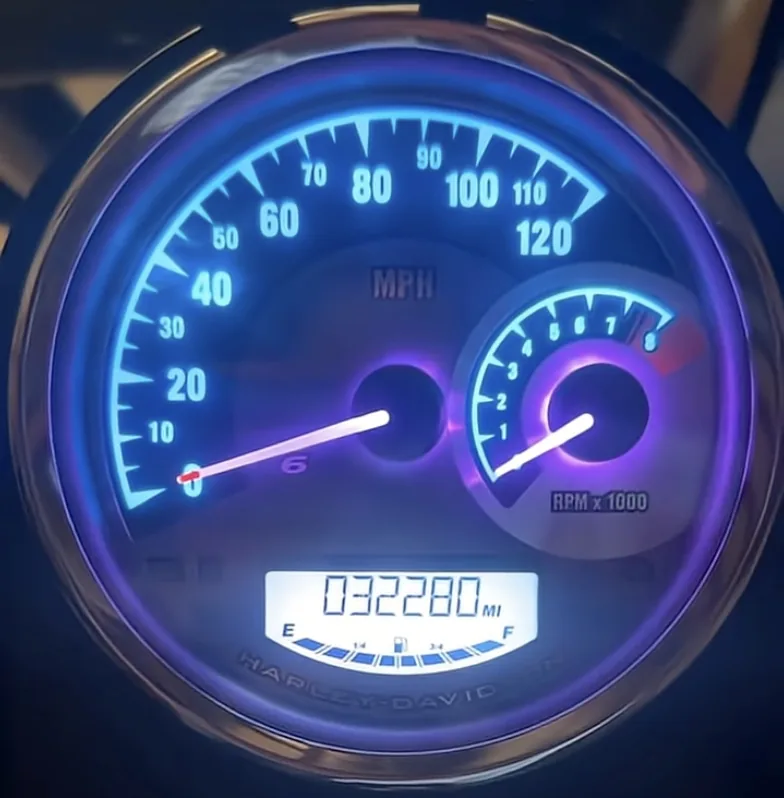
When I bought my 2007 Harley Night Train off Facebook Marketplace, it already had about 30,000 miles on it. And I’m going to be honest with you, that number scared me a little. Thirty grand of miles, on a used bike, from a guy I’d never met? For years that was the exact kind of thing that kept me off a motorcycle. I’d think, how much life is even left in that thing?
So I called my buddy Leo, who’s been riding 30 years. He just laughed. “Dude,” he said, “these engines can go 100,000 miles. You’re barely halfway.” And it turns out he was right. So I went digging: into the data, the manufacturer numbers, the guys who’ve actually put a million miles on one bike. Here’s what I found about how long a motorcycle really lasts.
So, how many miles do motorcycles last?
Most well-maintained motorcycles last somewhere between 50,000 and 200,000 miles. That’s a huge range, and there’s a reason for it: a high-revving sport bike and a laid-back touring bike are two completely different animals. But across the board, the bikes that get regular oil changes, get stored out of the weather, and get ridden with a little respect are the ones that go the distance. Motorcycle.com puts it well. A well-kept bike routinely runs “well past the 100,000-mile marker.”
There’s something most people miss, though. Motorcycles don’t rack up miles the way cars do. The average American motorcycle only travels about 2,587 miles a year, according to the Federal Highway Administration’s 2022 data. That’s roughly a fifth of what the average car does. So a 15-year-old bike with 30,000 miles isn’t “worn out” at all. At that pace it’s been ridden about as much as a car that’s barely two years old. That reframed everything for me when I was staring at my Night Train’s odometer.
What’s considered high mileage for a motorcycle?
“High mileage” isn’t one number. It depends entirely on the type of bike. A sport bike hits high-mileage territory way earlier than a touring rig, because it’s built to be revved hard and ridden aggressively. This table shows roughly where each type crosses into “high mileage,” and how far a well-kept example tends to go:
| Motorcycle type | “High mileage” starts around | Typical well-kept lifespan | Why |
|---|---|---|---|
| Sport bike (“crotch rocket”) | 20,000–30,000 mi | 30,000–60,000+ mi | High-RPM, high-compression, ridden hard |
| Standard / naked | 30,000–40,000 mi | 50,000–80,000+ mi | Middle ground — versatile, moderate stress |
| Cruiser (Harley, Indian) | 40,000–50,000 mi | 50,000–100,000+ mi | Low-RPM, relaxed, built to loaf |
| Touring (Gold Wing, RT) | 50,000–100,000 mi | 100,000–200,000+ mi | Built for distance at low stress |
| Adventure / dual-sport | Varies | 50,000–100,000+ mi | Depends heavily on street vs. off-road use |
Those sport-bike and cruiser thresholds line up with what Progressive tells used-bike buyers: high-performance sport bikes hit high mileage around 25,000 miles, while bigger cruisers often don’t get there until 40,000–50,000. My Night Train, a big air-cooled cruiser at 30,000 miles? Barely middle-aged.
Is 20,000 miles a lot for a motorcycle?
Short version: 20,000 miles is not a lot for most motorcycles, unless it’s a hard-ridden sport bike. On a cruiser or a tourer, 20,000 is still low. Use this odometer cheat-sheet to sanity-check any used bike you’re looking at:
| Odometer | Sport bike | Cruiser | Touring bike |
|---|---|---|---|
| 5,000 mi | Practically new | Practically new | Barely broken in |
| 20,000 mi | Getting up there | Low | Low |
| 40,000 mi | High — inspect closely | Moderate | Low–moderate |
| 60,000 mi | Very high — records essential | High | Moderate |
| 100,000 mi | Rare | High but doable | Mid-life |
Notice the pattern: the same number means something totally different depending on the bike. That’s the single most important thing to understand before you panic over a mileage figure.
Why sport bikes and cruisers age so differently
It comes down to how the engine is built and how it’s used. A sport bike engine is designed to spin to the moon — small-displacement cylinders, high compression, screaming RPM for maximum horsepower. A cruiser or touring engine is the opposite: big, slow-turning, low-compression, built to lope down the highway all day. As RideApart explains, “an engine designed to operate at a higher RPM and with greater compression, by design, won’t be as long-lived as a simple, overbuilt, low-compression, low-RPM engine.”
Then there’s the rider. Sport bikes tend to get ridden harder: quick launches, hard braking, redline pulls. Cruisers get ridden like, well, cruisers. So a sport bike at 30,000 miles has often lived a rougher life than a cruiser at 50,000. No brand here is junk and none is bulletproof. It’s just physics and riding style piling up over the years.
Can a motorcycle really last 100,000 miles?
Yes, and then some. Harley’s old Evolution engine earned a reputation as a “100,000-mile engine,” with owners routinely running well past 80,000 or 90,000 miles on the original bottom end. Honda Gold Wings are legendary for it. And the genuinely wild cases go way beyond six figures. These aren’t forum tall tales. The ones below are certified by the Iron Butt Association or documented by major outlets:
| Bike | Documented miles | Source |
|---|---|---|
| 1991 Harley-Davidson FXRT (Dave Zien) | 1,005,830 mi on one bike | Iron Butt Association |
| Honda Gold Wing (Donald Deuel) | 1,000,101 mi | Iron Butt Association (certified) |
| Honda (Phil Steiner) | 2,000,000 mi across Hondas | Iron Butt Association (certified) |
| Honda Gold Wing (hard-ridden owners) | Up to ~400,000 mi | MotorBiscuit |
| Harley Evolution engine | Routinely 100,000+ mi | TopSpeed |
A million miles on one Harley. My father-in-law is 74 and still rides a 1975 shovelhead up to Big Bear, and he says he’ll ride it “till the wheels fall off.” After digging into these numbers, I believe him.
What actually decides how long a motorcycle lasts
If there’s one takeaway, it’s this: maintenance matters more than mileage. Both Motorcycle.com and Kelley Blue Book land in the same place. KBB doesn’t even dock a fixed dollar amount for mileage on a bike, because condition tells you more than the odometer ever will. A few things actually move the needle, roughly in order:
- Maintenance history. Regular oil changes and valve adjustments at the factory intervals, with records to prove it. This is the big one.
- How it was ridden. A bike that got babied lasts longer than one that got stunted, raced, or run low on oil.
- Storage. Garaged and covered beats sitting out in the rain rusting. Air-cooled engines run hotter, so heat management matters too.
- Owner history. One careful owner with a folder of receipts beats three unknown owners and a mystery.
That’s why a 30,000-highway-mile bike with great upkeep can genuinely be a better buy than a 10,000-mile bike that got neglected. Progressive says exactly that, and it’s the lesson Leo drilled into me: buy the maintenance, not the miles.
Maintenance milestones that keep a bike alive
You want a bike to hit 100,000 miles? You keep up with the boring stuff. Always defer to your own bike’s owner’s manual, but the general intervals look like this:
| Job | Typical interval | Why it matters |
|---|---|---|
| Oil & filter change | Every 3,000–6,000 mi (or yearly) | The single biggest thing for engine life |
| Chain lube / tension | Lube ~500 mi; check ~1,000 mi | Chains typically last 15,000–20,000 mi |
| Valve clearance check | Every 6,000–16,000 mi (model-dependent) | Prevents burnt valves and lost compression |
| Brake fluid | Every 2 years | Fluid absorbs water and fades over time |
| Tires | Inspect yearly after 5 yrs; replace by ~10 yrs | Rubber ages out even with tread left |
My buddy Leo has an old line about all this: “You know what they say about Harleys — if it’s not leaking, it needs oil.” It’s a joke, but the point underneath it is real. Stay ahead of the fluids and the wear items, and these engines will give you decades. Fall behind, and a 20,000-mile bike can feel used up. If you want to go deeper on one wear item, I broke down how long a motorcycle battery lasts in its own guide. It’s the part that strands the most riders.
Are some brands more reliable than others?
They are, at least by the numbers we have. The most-cited hard data is Consumer Reports’ reliability survey of more than 11,000 owners. It’s from 2015 (covering 2008–2014 bikes), so treat it as the landmark study, not current-model data. The pattern it shows has held up in rider lore ever since. This is the predicted failure rate by the fourth year of ownership:
| Brand | 4-year predicted failure rate |
|---|---|
| Yamaha / Star | 11% |
| Suzuki | 12% |
| Honda | 12% |
| Kawasaki | 15% |
| Victory | 17% |
| Harley-Davidson | 26% |
| Triumph | 29% |
| Ducati | 33% |
| BMW | 40% |
The Japanese brands top the chart, Harley sits mid-pack, and the European bikes show more trouble. A lot of those “failures” are minor, though, and the average repair bill ran about $342. And look, I ride a Harley and I love it. To each his own. A higher failure rate won’t stop a bike from lasting; it just means you might spend a little more keeping it happy. Reliability and longevity aren’t the same thing.
Should you buy a high-mileage motorcycle?
Honestly? A high-mileage bike can be one of the smartest buys out there, if you check it right. High miles with a full service history and clean highway life beats low miles with a shady story every time. When you go look at one, run through this quick gut-check:
- Pull the dipstick. Good oil looks like syrup. Silver or milky oil means water in the engine, so walk away.
- Check tires, chain, and sprockets for uneven or severe wear, a tell for burnouts or track abuse.
- Ask for records. A folder of receipts is worth more than a low number on the clock.
- Get a pre-purchase inspection from a mechanic if you’re not sure. A couple hundred bucks can save you thousands.
If you’re working out what any of this should cost you in the first place, I put together a full breakdown of how much a motorcycle costs, covering purchase price plus the real ongoing numbers. And if the whole idea of buying still has you nervous, that’s normal. I also wrote a straight look at whether motorcycles are dangerous that lays out the actual risk data.
Find people to ride all those miles with
A bike’s miles are just a number. The rides are the part that actually lasts: the people, the routes, the Sunday runs. RideWolf helps you find riders and group rides near you so you’re never out there alone.
The bottom line on motorcycle mileage
So, how many miles do motorcycles last? Long enough that you should stop worrying about the odometer and start looking at the bike in front of you. Fifty thousand, a hundred thousand, and yeah, even a million if a guy named Dave Zien is any proof. Buy the maintenance, ride it with a little respect, keep up with the oil, and your bike will outlast almost every excuse you’ve got for not riding it.
That number on my Night Train scared me for about a week. Now it’s just miles, miles I’ve been adding to with my crew every weekend since. If you’ve been sitting on the fence over a used bike because of the mileage, do your homework, get it inspected, and then put that first foot forward and just do it. Peace.
Frequently asked questions
Is 20,000 miles a lot for a motorcycle?
For most motorcycles, no. On a cruiser or touring bike, 20,000 miles is still low, well within normal life. On a hard-ridden sport bike it’s getting up there and worth a closer look, but with good maintenance records even a 20,000-mile sport bike can have plenty of life left.
How long do motorcycles last in years?
Since the average motorcycle only covers about 2,587 miles a year, a bike that lasts 50,000–200,000 miles can easily last 20 to 40 years with proper care. Time matters less than upkeep. A garaged, well-maintained bike from the 1970s can still run strong today.
What is considered high mileage for a motorcycle?
It depends on the type. Sport bikes hit high mileage around 20,000–30,000 miles, cruisers around 40,000–50,000, and touring bikes not until 50,000–100,000. High mileage isn’t a dealbreaker; a well-maintained high-mileage bike often beats a neglected low-mileage one.
Can a motorcycle last 100,000 miles?
Absolutely. Well-maintained motorcycles routinely pass 100,000 miles, and touring bikes like the Honda Gold Wing regularly go well beyond. There are even certified cases of single motorcycles topping one million miles. Consistent maintenance is what gets a bike there.
Is it worth buying a high-mileage motorcycle?
It can be a great value. A high-mileage bike with full service records and clean highway miles is often a better buy than a low-mileage bike that was neglected. Check the oil, inspect the tires and chain, ask for records, and get a pre-purchase inspection if you’re unsure.
What is the average mileage on a motorcycle per year?
About 2,587 miles per year in the U.S., per Federal Highway Administration data, roughly a fifth of what the average car travels. Many riders do far less; surveys show nearly half ride under 1,000 miles a year. That’s why older bikes are often surprisingly low-mileage.