


Some links in this post are affiliate links. As an Amazon Associate I earn from qualifying purchases.
The guy who sold me my Night Train told me he’d changed the oil when I bought it. I took his word for it. I was so excited to get that bike home I’d have believed him if he said it ran on sunshine.
Then I started finding things. No rear turn signals. No brake light except the little bulb over the license plate. And later, a rear brake line held together with duct tape. That’s the thing about buying used off Facebook Marketplace. You buy the bike, and you buy every shortcut the last owner ever took along with it.
So when it came to the oil, I wasn’t going to wait 5,000 miles to find out what “I changed the oil” actually covered. In July I did my first oil change myself, all three holes, and I’m really glad I did. The engine oil looked fine. He’d told the truth about that. But the primary and the transmission came out really dirty. He’d changed one oil out of three.
This post is two things. The short answer to how often you should change motorcycle oil, straight from the factory schedule. And the Harley 3-hole oil change I did in my garage, step by step, for anybody with a Big Twin who’s been paying a shop to do it.
How often should you change motorcycle oil?
How often you should change motorcycle oil depends on your bike, so the owner’s manual is the only number that really counts. Harley’s 2007 Softail schedule calls for engine oil and a new filter at the first service and then every 5,000 miles. Change it sooner if you ride short trips, ride hard, or ride in dust or cold.
That’s the whole answer for most people. Every engine is different, the manufacturer built the schedule around that engine, and anything you read online (this post included) is second place to the book that came with your bike. If yours went missing, Harley’s manuals and service info live on the Harley-Davidson Service Information Portal.
On a Harley Big Twin there’s a wrinkle, though. There isn’t one oil. There are three.
Motorcycle oil change intervals from the Harley manual
Here’s what the 2007 Softail service manual says for my bike, the FXSTB Night Train. Same schedule for every 2007 Softail with the Twin Cam 96. The first service comes at 1,000 miles on the hydraulic-fork models, 500 on the Springer, and Harley says a dealer should do that one.
| What gets changed | First service | After that | How much it takes | Drain plug torque |
|---|---|---|---|---|
| Engine oil + filter | Yes | Every 5,000 miles | 3.0 quarts | 14–21 ft-lbs |
| Primary chaincase lubricant | Yes | Every 10,000 miles | 32 oz | 14–21 ft-lbs |
| Transmission lubricant | Yes | Every 20,000 miles | 32 oz | 14–21 ft-lbs |
Source: Harley-Davidson 2007 Softail Service Manual (99482-07), Table 1-1 and Table 1-2.
A couple of things jumped out at me when I actually read it. The engine oil is the only one on the 5,000-mile clock. The primary goes twice as long and the transmission four times as long. And the manual says the stock filter is a 5-micron synthetic-media filter, and hand-tightened, half to three-quarters of a turn after the gasket touches. No wrench on the way on.
Newer bikes run their own schedules, so check your own year and model before you copy anybody’s numbers, mine included.
When to change your motorcycle oil sooner
Treat the mileage as a ceiling. Harley’s manual says it plainly: “If the motorcycle is ridden hard, under dusty conditions, or in cold weather, the oil and filter should be changed more often.”
The cold weather part surprised me, so I read the winter section twice. Burning fuel makes water vapor. On a short ride the engine never gets hot enough to push that water back out, so it sits in the oil tank and mixes into a sludge. In the manual’s words, “An engine used for only short trips, and seldom allowed to thoroughly warm up, accumulates increasing amounts of water in the oil tank.” Below freezing, that water can turn to slush and clog the oil lines.
So the guy who takes his bike two miles to the coffee shop and back every morning may need an oil change sooner than the guy who rides 300 miles on a Sunday.
| Your situation | What to do |
|---|---|
| You just bought the bike used | Change all three now. “I changed the oil” usually means the engine oil only. |
| Mostly short rides, engine rarely gets fully hot | Change engine oil sooner than 5,000. Take it for a long ride now and then. |
| Riding in winter or below freezing | Harley says change more often in winter. The colder it gets, the more often. |
| Dusty roads, or you ride it hard | Harley says change the oil and filter more often. |
| Normal riding, bike gets fully warm every time | Follow the factory interval. |
| Oil level keeps dropping between changes | Check it before every ride, top it off, and find out why. |
My buddy Leo has a line about that last one. “You know what they say about Harleys, right? If it’s not leaking, it needs oil.” He’s kidding. Mostly.
Checking the level on a Softail is easy. Warm the bike up, park it on the jiffy stand, and read the dipstick in the oil tank. It should sit at the upper groove. Don’t overfill it.
What is a Harley 3-hole oil change?
A Harley 3-hole oil change means draining and refilling all three separate fluids in a Big Twin: the engine oil, the primary chaincase, and the transmission. Each one has its own drain plug, its own fill spot, and its own job. That’s where the name comes from. Three holes, three plugs, three fluids.
On a lot of bikes, especially Japanese bikes, one oil does everything. The engine, the clutch, and the gearbox all share it. Harley Big Twins keep them apart:
- Engine oil lives in the oil tank and runs through the filter. This is the one that works the hardest and gets changed the most.
- Primary chaincase is the case on the left side that holds the primary chain and the clutch. The clutch plates sit in that fluid.
- Transmission has its own case and its own fluid for the gears.
For 2007 Softails, Harley actually specs the same product for the primary and the transmission, its Formula+ Transmission and Primary Chaincase Lubricant, 32 ounces in each. A lot of aftermarket kits ship two different fluids instead. Mine did. Follow whatever your kit and your manual call for, and don’t mix up which bottle goes in which hole.
Do you have to change all three holes every time?
No. The factory schedule only puts the engine oil on the 5,000-mile clock. The primary is every 10,000 miles and the transmission every 20,000. Plenty of riders do all three every time anyway, because it’s cheap insurance and the bike’s already up on the stand, but the manual doesn’t require it.
You’ll see advice online that says do all three every 3,000 or 4,000 miles. That’s somebody’s preference. Harley’s own schedule is the one in the table above. If the extra changes let you sleep better, fine. To each his own.
My rule is simpler. The first oil change on a used bike is a full 3-hole change, no matter what anybody tells you. After that, you know exactly where you stand, and you can follow the book.
What you need for a Harley oil change
Before I touched a wrench, I read the manual and watched a few YouTube videos. Then I bought a kit, a funnel set and an oil pan, and that was pretty much it.
| What | Why you need it | What I used |
|---|---|---|
| Oil change kit (engine oil, primary fluid, transmission fluid, filter) | Everything in one box, matched to the engine | Maxima V-Twin synthetic kit for the Twin Cam |
| Drain pan | Catches 3 quarts from the tank plus two smaller drains | A basic oil pan |
| Funnels and fill tools | The primary fills through the clutch inspection cover, and the openings are tight | A Harley oil change tool kit off Amazon: primary funnel, crankcase fill tool, filter wrench, O-rings |
| Oil filter wrench | Harley’s manual calls for a filter wrench so you don’t damage the crank position sensor or its cable | Came in the same tool kit |
| Sockets + Torx bits | Three drain plugs, plus five Torx screws on the clutch inspection cover | |
| New O-rings for the drain plugs | Harley says to inspect them and replace any that are torn | The tool kit came with 30 of them |
| Torque wrench | Drain plugs are only 14–21 ft-lbs. Easy to overdo. | |
| Rags + a clean workspace | Oil on the rear tire is a crash waiting to happen | |
| Your owner’s manual | Capacities, torque specs, the order of things | The Night Train’s manual |
That kit made everything very easy. Mine was the synthetic version for the Twin Cam: four quarts of 100% synthetic 20W-50 engine oil, a quart of primary oil, a quart of 80W-90 transmission oil, and a black filter. Everything in one box, around a hundred bucks. One thing to know: the kit gives you four quarts of engine oil and my Softail’s tank only takes three, so the extra quart goes on the shelf for top-offs.
How to do a Harley 3-hole oil change (Twin Cam Softail)
These steps follow Harley’s 2007 Softail service manual. If you have a different bike, your steps and numbers will differ, so check your own manual before you start.
Engine oil and filter
- Ride the bike until the engine is at normal operating temperature. Warm oil drains faster and carries more of the junk out with it.
- Pull the oil filler plug and dipstick from the oil tank.
- Remove the oil tank drain plug and let it drain into the pan.
- Remove the filter with a filter wrench. Clean any old gasket off the mounting flange.
- Rub a little fresh oil on the new filter’s gasket. Screw it on by hand, then half to three-quarters of a turn more after the gasket touches.
- Check the drain plug O-ring, reinstall the plug, and torque it to 14–21 ft-lbs.
- Fill the tank with 3.0 quarts of oil.
- Start the engine, look for leaks around the plug and the filter, then check the level on the dipstick.
Primary chaincase
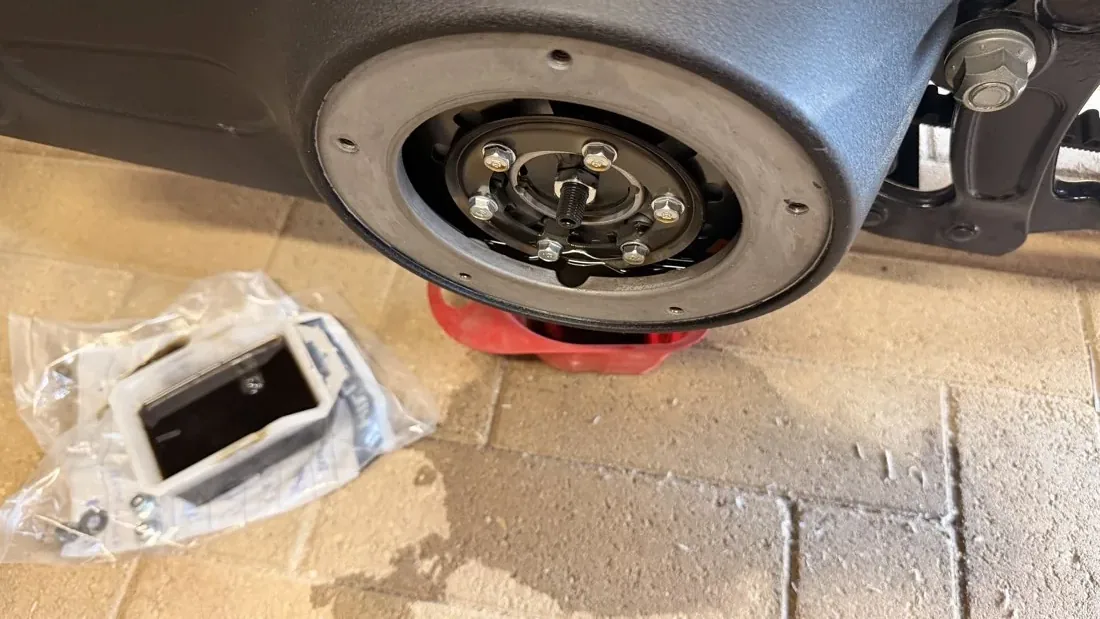
- Remove the drain plug at the bottom of the primary and drain it. Wipe the plug clean. If the plug has a lot of debris on it, Harley says to inspect the chaincase parts.
- Put a new O-ring on the plug, reinstall it, and torque to 14–21 ft-lbs.
- Remove the five Torx screws on the clutch inspection cover and take off the cover and gasket.
- Pour in 32 ounces of primary fluid through that opening. Don’t overfill it. Harley warns that too much can cause rough clutch engagement, clutch drag, and trouble finding neutral.
- Reinstall the cover.
Transmission
- Remove the transmission filler plug first, then the drain plug, and let it drain.
- Check the O-ring, reinstall the drain plug, and torque to 14–21 ft-lbs.
- Fill with 32 ounces.
- With the bike on the jiffy stand, wipe the dipstick, rest it on the top thread of the filler hole, pull it out, and read it. It should be at the FULL mark.
- Reinstall the filler plug.
One thing Harley repeats on every fluid: don’t let any of it get on the rear tire, the wheel, or the brakes. Wipe up every drip before the bike moves an inch.
What I found when I drained mine
When it all came out, the engine oil looked like somebody had recently changed it, because somebody had. The primary and the transmission were a different story. Really dirty. The seller wasn’t lying to me. He changed the oil. He just changed the one everybody thinks of and left the other two alone.
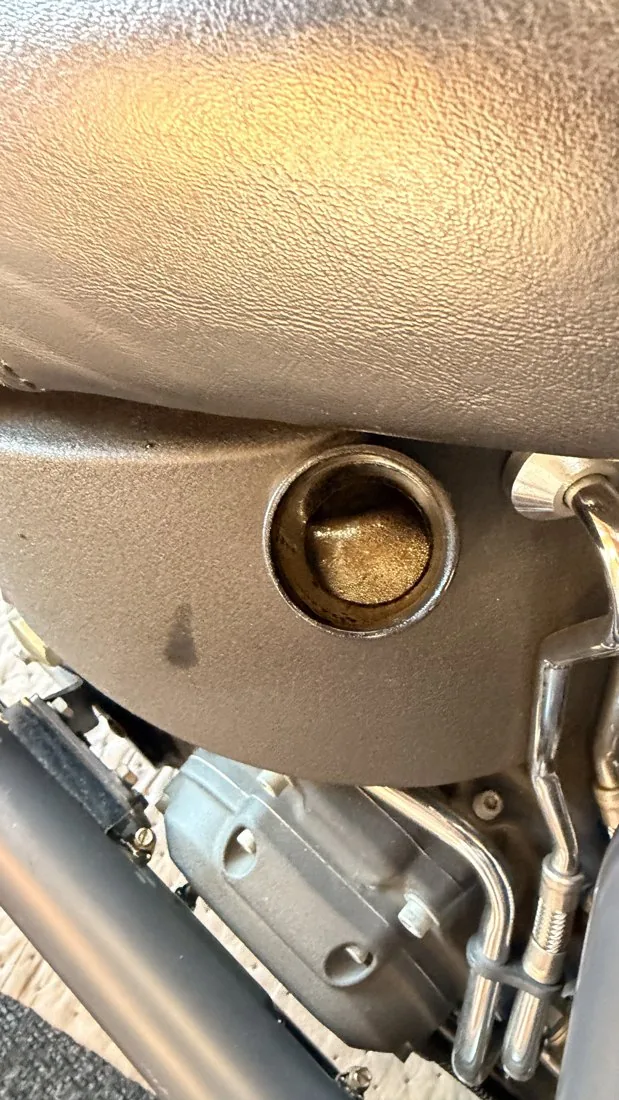
And look, I’m not mad at the guy. Plenty of people only ever change the engine oil and think they’re covered. That’s exactly why the first change on a used bike should be all three holes. When somebody tells you “I changed the oil,” ask which one. Better yet, do all three yourself and reset the clock on a bike you don’t know.
Nothing about the job surprised me. Overall it was pretty easy, between the kit, the manual, and a few good videos, and I’ll be doing my own oil changes from here on out. There’s a real satisfaction in knowing you did it with your own two hands. If you’re in a DIY mood, the next thing worth checking is how long your motorcycle battery has left.
Next on my list, once I save up a little more, is a Figurati Designs Performance Magnetic Oil Filter in gold. It’s a reusable filter with magnets that you clean instead of throw away. I’ll be straight with you on one thing I noticed while researching it: Figurati rates it at 25 microns, and my 2007 manual lists Harley’s 5-micron synthetic filter as the recommended replacement. That’s something I’ll weigh before I buy one. When I do, I’ll report back.
Is it worth changing your own motorcycle oil?
If you have a garage, a Saturday, and a little patience, yes. An oil change is one of the easiest jobs on a motorcycle and a great first one to learn. You get to know your bike, you see what comes out of it, and you stop guessing about the last time it was done.
It also makes you pay attention. When you drain your own oil you notice things. A plug with metal on it. A fluid that looks wrong. A seep that wasn’t there last time. While you’re down there, it’s a good moment to read the date code and check whether your tires are due too.
Know where your DIY ends, though. When my Night Train needed a new rear brake line and a master cylinder rebuild, it went to the shop, because that job needs a lift and I don’t have one. An oil change isn’t that. An oil change is you, a pan, and a box from the parts store. It’s the kind of job I collect in our motorcycle how-tos, the ones any rider can do at home.
Keeping up on the oil is a big part of why these engines last. When I dug into how many miles motorcycles actually last, maintenance kept coming up as the thing that separates a tired bike from one that keeps going.
Find people to ride with
Changing your own oil means you’ve got a bike you plan to keep riding. RideWolf is the app I’m building to help you find group rides and riders near you. Join the early access list and I’ll let you know the minute it’s out.
Motorcycle oil change FAQ
How often should you change the oil on a Harley-Davidson?
Harley’s 2007 Softail schedule calls for engine oil and filter at the first service, 1,000 miles on most models, then every 5,000 miles. The primary chaincase fluid is every 10,000 miles and the transmission every 20,000. Change the engine oil sooner for short trips, cold weather, dusty roads or hard riding, and always check your own model’s manual.
How much oil does a Harley Twin Cam Softail take?
A 2007 Twin Cam Softail takes 3.0 quarts of engine oil with a filter change, 32 ounces of primary chaincase fluid, and 32 ounces of transmission fluid, per Harley’s service manual. Check the engine level on the dipstick with the bike on the jiffy stand, and don’t overfill any of the three.
What happens if you overfill the primary on a Harley?
Harley’s service manual warns that overfilling the primary chaincase can cause rough clutch engagement, incomplete disengagement, clutch drag, and trouble finding neutral at idle. On a 2007 Softail the primary takes 32 ounces, poured through the clutch inspection cover. If you overfilled it, drain some out rather than riding it.
Can you use the same fluid in the primary and the transmission?
On 2007 Softails, yes. Harley specs its Formula+ Transmission and Primary Chaincase Lubricant for both, 32 ounces each. Many aftermarket kits ship a separate primary fluid and a heavier gear oil for the transmission. Either way, use what your manual or your kit specifies and label the bottles so they go in the right hole.
Should I change the oil on a used motorcycle right after buying it?
Yes. You don’t know when it was last done or what went in, and “I changed the oil” usually means the engine oil only. On a Harley, do a full 3-hole change so the engine oil, primary and transmission all start fresh. On my Night Train the engine oil was fresh, but the primary and transmission came out really dirty.
Does motorcycle oil break down if you don’t ride much?
Short rides are harder on oil than long ones. Harley’s manual explains that an engine that never fully warms up collects water in the oil tank, which mixes into sludge and speeds up engine wear. In freezing weather that water can turn to slush and block oil lines. If your rides are short, change the oil more often.
So that’s the answer. Read the book. Change it on the schedule, sooner if you ride short or cold. And if you just bought a bike from somebody else, don’t take their word for it. Pull the plugs and see for yourself.
It’s one Saturday. Put that first foot forward and just do it. Peace.