



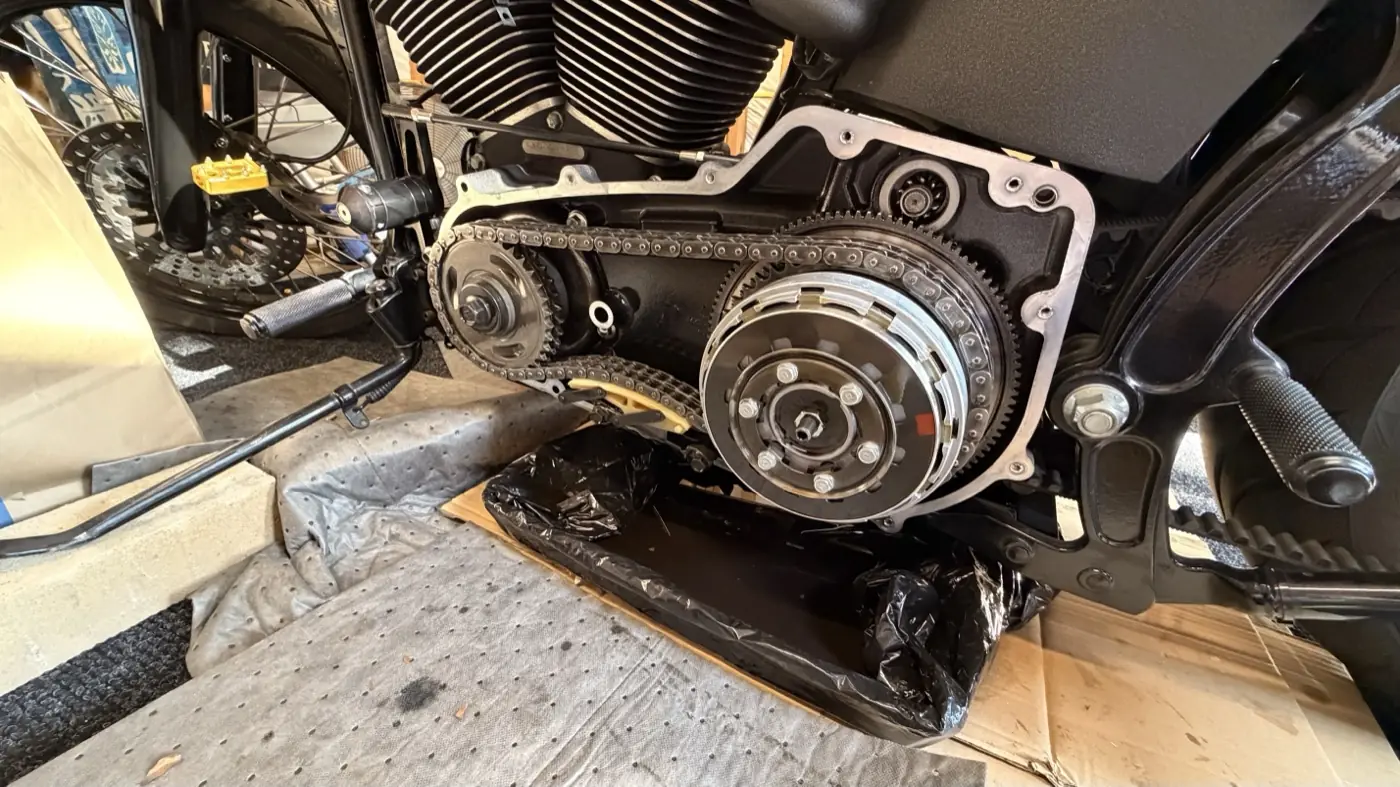
When I bought my Night Train, the seller told me he’d changed the oil. He had. One of them. When I did my first 3-hole oil change, the engine oil came out clean and the primary and transmission came out really dirty. Nobody lied to me. He just did the one job everybody thinks of and skipped the two nobody talks about.
That’s when I started treating the manual like the boss. A motorcycle has a lot more on its list than oil, and most of it is stuff you’ll never think about until it’s a problem. So I pulled Harley’s own service interval table for my bike, every line of it, and I’m putting it here. Then I’ll tell you which jobs I do in my garage and which ones I hand to somebody with a certificate on the wall.
What a motorcycle maintenance schedule is (and where to find yours)
A motorcycle maintenance schedule is the manufacturer’s list of what to inspect, adjust or replace, and at what mileage. It lives in your owner’s manual and in the service manual for your model. The miles are set for your engine, your brakes and your drive, so a schedule for a different bike is only a rough guide for yours.
Two things to know before you read any table, including mine. First, some items run on the calendar, not the odometer. Harley says to check the battery every year and to replace the brake fluid and flush the system every two years, however little you ride. Second, the miles are a ceiling. Harley’s service manual says that if the bike “is ridden hard, under dusty conditions, or in cold weather, the oil and filter should be changed more often.”
If you lost your manual, Harley’s factory schedules and manuals live on the Harley-Davidson Service Information Portal. Other brands publish theirs in the owner’s manual too, and most will sell you a replacement.
Harley-Davidson maintenance schedule: the factory table for my bike
This is Harley’s own Regular Service Intervals table for 2007 Softail models, which covers my Night Train. I trimmed the lines that don’t apply to most Softails (Springer forks, windshields, Tour-Paks). Everything else is word for word, mile for mile.
| What gets serviced | What you do | When (miles) | Dealer job? |
|---|---|---|---|
| Engine oil and filter | Replace | 1,000, then every 5,000 | No |
| Primary chaincase lubricant | Replace | 1,000, 10,000, 20,000 | No |
| Transmission lubricant | Replace | 1,000, 20,000 | No |
| Tires | Check pressure, inspect tread | 1,000, then every 5,000 | No |
| Brake pads and discs | Inspect for wear | 1,000, then every 5,000 | No |
| Brake fluid | Check level and condition | 1,000, then every 5,000 | No |
| Brake fluid (DOT 4) | Replace and flush the system | Every two years | No |
| Oil lines and brake system | Inspect for leaks | 1,000, then every 5,000 | Yes |
| Air cleaner | Inspect, service as required | 1,000, then every 5,000 | No |
| Rear belt and sprockets | Inspect, adjust belt | 1,000, then every 5,000 | Yes |
| Clutch | Check adjustment | 1,000, then every 5,000 | Yes |
| Throttle, brake and clutch controls | Check, adjust, lubricate | 1,000, then every 5,000 | Yes |
| Fuel lines and fittings | Inspect for leaks | 1,000, then every 5,000 | Yes |
| Spark plugs | Inspect | 1,000, then every 5,000 | No |
| Spark plugs | Replace | 20,000 | No |
| Electrical equipment and switches | Check operation | 1,000, then every 5,000 | No |
| Engine idle speed | Check adjustment | 1,000, then every 5,000 | Yes |
| Wheel spokes (if fitted) | Check tightness | 1,000, 5,000, 20,000 | Yes |
| Jiffy stand | Inspect and lubricate | 1,000, 10,000, 20,000 | Yes |
| Steering head bearings | Adjust | 1,000, 10,000, 20,000 | Yes |
| Steering head bearings | Lubricate | 10,000, 20,000; take apart, lube and inspect every 30,000 | No |
| Critical fasteners | Check tightness | 1,000, 10,000, 20,000 | Yes |
| Fuel filter in the tank | Replace | 25,000 | Yes |
| Rear fork bearings | Repack | 20,000 | Yes |
| Front fork oil | Replace | 50,000 | Yes |
| Battery | Check, clean connections | Every year | No |
| Road test | Verify everything works | 1,000, then every 5,000 | No |
Source: Harley-Davidson, Regular Service Intervals: 2007 Softail Models (Table 32). “Dealer job” = Harley’s note 1: “Should be performed by an authorized Harley-Davidson dealer, unless you have the proper tools, service data and are mechanically qualified.”
Read that table twice and a few things jump out. Almost everything gets looked at every 5,000 miles. The fluids are on three different clocks, which is exactly what my seller missed. And Harley flags about half the list as a dealer job unless you’ve got the tools, the data and the skills. That last column is the one I want to talk about.
Motorcycle service intervals by mileage
The same table, read the other way. If you want to know what’s due when the odometer rolls over, this is the version to tape inside the garage door.
| Service | What’s due on a 2007 Softail |
|---|---|
| 1,000 miles (first service) | Everything on the list gets done or checked once: oil and filter, primary, transmission, belt, clutch, steering head, fasteners, controls, plus the full inspection. Harley says a dealer should do this one. |
| Every 5,000 miles | Oil and filter. Check tires, brakes, brake fluid, belt and sprockets, clutch, controls, fuel and oil lines, spark plugs, electrical, idle. Road test. |
| 10,000 miles | The 5,000 list, plus primary fluid, steering head adjust and lube, jiffy stand, critical fasteners. |
| 20,000 miles | The 10,000 list, plus transmission fluid, new spark plugs, rear fork bearings, spokes if you have them. |
| 25,000 miles | The 5,000 list, plus a new fuel filter in the tank. |
| 30,000 miles | Steering head bearings come apart to be cleaned, lubed and inspected. |
| 50,000 miles | Front fork oil. |
| Every year | Battery check, clean the connections. |
| Every two years | Replace the DOT 4 brake fluid and flush the system. |
My bike is past 32,000 miles. By that table, the steering head bearings were due to come apart at 30,000. I bought the bike used, and I don’t think it was ever done. That’s the kind of question a used bike leaves you with, and it’s a job I’d hand to a mechanic.
What I do myself, and what goes to a certified mechanic
I’ll pretty much do anything on my bike, with a few exceptions. Here’s where I draw the line.
| I do it myself | A certified mechanic does it |
|---|---|
| 3-hole oil change (engine, primary, transmission) | Tire replacement |
| Electrical work | Brake rotor replacement |
| Cosmetic upgrades | Belts |
| Clutch work | Wheels: mounting them and getting the spacing right |
| Before-ride checks: tire pressure, brakes, oil level | Anything inside the engine |
The rule behind it is simple. If a job could make something fail while I’m riding, I want a pro on it. I know the clutch can do that too, so it’s not a perfect rule. But making sure a wheel is on right and spaced right is the kind of thing that causes real problems at speed, and a certified mechanic does that all day long. I’d rather pay for it than learn it at 60 miles an hour.
The tire people agree with me on at least one of those. The Motorcycle Tire Guide from the Motorcycle Industry Council and the U.S. Tire Manufacturers Association lists five tire tips, and one of them is “Have your tires professionally installed.” If you want to know when it’s time for new ones, I wrote up when to replace motorcycle tires, date codes and all.
The oil change was the first job I did myself. I learned it from the manual and a few good YouTube videos, and it was pretty easy. Your line might sit somewhere else. That’s fine. Just know where it is before you pick up the wrench.
Motorcycle maintenance checklist: before every ride
Before every ride I do three things. I check the tire pressure. I do a quick brake check. And I look at my oil level. It takes a couple of minutes and it’s the cheapest maintenance there is.
If you want the full version, the Motorcycle Safety Foundation’s pre-ride checklist is called T-CLOCS, and the Tire Guide prints the whole thing. Here’s the short form.
| T-CLOCS | What to check |
|---|---|
| T: Tires and wheels | Tread, cracks, bulges, anything stuck in the tire. Pressure checked cold and set for your load. Each brake alone keeps the bike from rolling. |
| C: Controls | Levers and pedal not bent or cracked, cables not frayed or kinked, hoses not cracked or leaking. Throttle moves freely and snaps closed. |
| L: Lights and electrics | Headlight high and low beam, tail and brake light on both brakes, turn signals, mirrors clean and aimed, battery terminals clean and tight. |
| O: Oil and fluids | Engine oil level per your manual, brake and clutch fluid, coolant if you have it, fuel. Look under the bike for leaks. |
| C: Chassis | Forks and shocks, chain or belt tension and wear, sprockets. |
| S: Stands | Side stand or center stand not cracked or bent, springs hold it up. |
Pressure gets checked cold, before you ride, because a warm tire reads high. Use the numbers in your owner’s manual or on the frame sticker, not the maximum printed on the tire.
Basic motorcycle maintenance Harley’s table doesn’t cover
My bike is air-cooled with a belt, so the Harley table skips a few jobs that a lot of riders do have. If your bike has any of these, your manual will have its own line for them.
- A chain. Chains need cleaning, lubing and tension checks far more often than a belt needs looking at. Your manual gives the interval and the slack measurement.
- Coolant. Liquid-cooled bikes have a coolant level to check before rides and a replacement interval.
- Valve clearance. Many engines need the valves checked and adjusted at a set mileage. That’s inside the engine, so on my list it’s a mechanic job.
- A battery that sits. If the bike goes days between rides, a smart maintainer saves you a lot of grief. I covered that in how long a motorcycle battery lasts.
- Storage. If your bike sits for a season, the winterizing steps are part of the schedule too.
Keep a log, especially on a used bike
Write it down every time. Date, miles, what you did, what you used. Harley’s owner’s manuals even have pages for it. A log tells you what’s due next, it backs you up on a warranty question, and when you sell the bike it’s worth real money to the next guy.
If you’re buying used, ask for the records before you hand over any cash. If there aren’t any, assume nothing has been done and start the schedule over from the fluids up. Keeping up with this stuff is also a big part of how many miles a motorcycle lasts. Bikes that get their service go a long way.
More of what my bike has taught me lives in the motorcycle how-to’s.
Bike’s serviced. Now go ride.
RideWolf is the app I’m building for whatever ride you’re doing, solo, with a group, or with riders you haven’t met yet. The first riders are testing it now. Join the early access list and you’ll hear from me when it’s ready.
Motorcycle maintenance schedule FAQ
How often should a motorcycle be serviced?
Follow the schedule in your owner’s manual. Many bikes, including Harley’s 2007 Softails, get a first service at 1,000 miles and then a service every 5,000 miles, with bigger jobs at 10,000 and 20,000. Some items run on time instead of miles, like brake fluid every two years and a battery check every year.
What is included in a Harley 5,000-mile service?
On a 2007 Softail, Harley’s table calls for new engine oil and filter, plus checks of the tires, brake pads and discs, brake fluid, belt and sprockets, clutch adjustment, controls, fuel and oil lines, spark plugs, electrical switches and idle speed, then a road test. Primary and transmission fluid are on longer intervals.
How often should you change motorcycle brake fluid?
Harley’s 2007 schedule says to replace the DOT 4 brake fluid and flush the system every two years, and to check the level and condition at every service. Brake fluid absorbs moisture over time whether you ride or not, which is why the interval is set by the calendar instead of the odometer. Check your own manual for your bike’s fluid type.
When should Harley spark plugs be replaced?
Harley’s 2007 Softail table says to inspect the spark plugs at 1,000 miles and every 5,000 after that, and to replace them at 20,000 miles. Newer models and other brands can differ, so look up the interval for your exact bike in its owner’s or service manual before you buy plugs.
What should you check before every motorcycle ride?
At minimum, tire pressure, brakes and oil level. That’s my routine. The Motorcycle Safety Foundation’s full pre-ride checklist is T-CLOCS: tires and wheels, controls, lights and electrics, oil and fluids, chassis, and stands. It takes a few minutes and catches most problems before they reach the road.
Can I do my own motorcycle maintenance?
A lot of it, yes. Oil changes, electrical work, cosmetic upgrades and pre-ride checks are well within reach with a manual and the right tools. Harley marks about half its schedule as dealer work unless you have the proper tools, service data and skills. I leave tires, rotors, belts, wheels and engine internals to a certified mechanic.
I used to think maintenance meant oil. Now I think of it as a list somebody at the factory already wrote for me, and my job is just to follow it and be honest about which parts I should be doing myself. That beats guessing.
So find your manual, check your miles against the table, and do the next thing that’s due. Thank you guys for reading.
Put that first foot forward and just do it. Peace.