


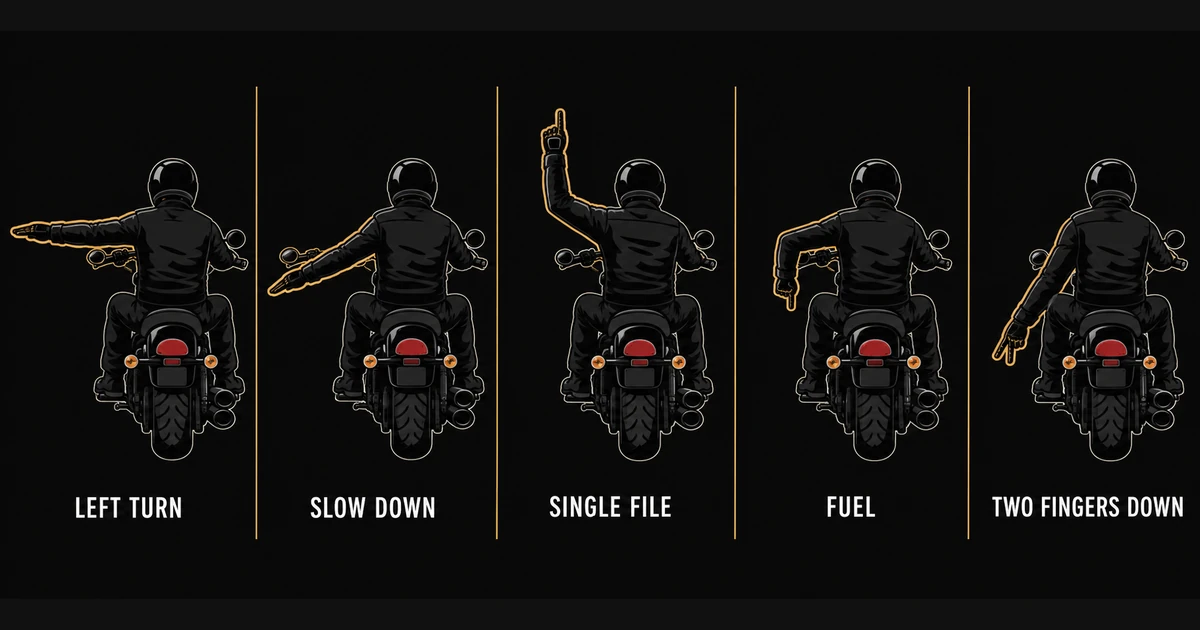
You know the signal. Two fingers down, low off the left grip, as another rider rolls past. The first time somebody threw it at me, I gave him back a big full-hand wave, like a guy on a parade float. Nobody hands you a dictionary when you start riding. There’s a whole language out here, and you learn it one slightly embarrassing wave at a time.
I started riding at 50, after wanting it for 30 years. And I did it the way I do everything: got my license two years before I ever rode, took the safety course, researched until my eyes crossed. Even then, the course covered maybe a third of the signals I’d actually see once I found my crew. The rest I picked up the way most of us do, watching the arm of the rider ahead of me and copying whatever it just did.
So this is the guide I wish somebody had handed me. The three signals the law requires. The fourteen the Motorcycle Safety Foundation standardized. How they actually move through a group. And the ones riders will debate at every fuel stop until the end of time.
Which Motorcycle Hand Signals Does the Law Require?
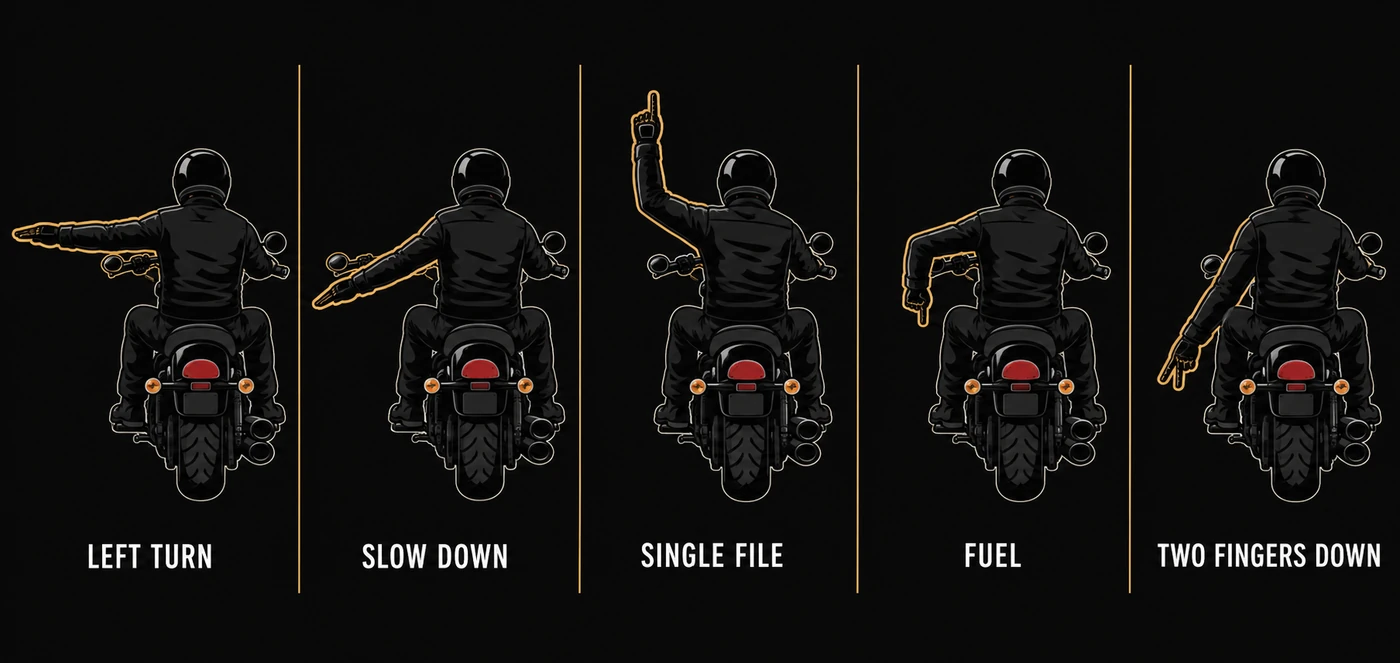
The law defines three hand signals, and all three are given with the left arm: left turn (arm straight out), right turn (arm bent up at the elbow), and stop or slowing (arm extended down). In California that’s Vehicle Code §22111, and §22110 makes them mandatory the moment your signal lamps stop working.
Most riders file hand signals under biker culture, take it or leave it. Three of them are actually law. If a blinker bulb dies mid-ride, you don’t get a pass; the code says hand and arm signals take over, given continuously for the last 100 feet before your turn. Every state writes it a little differently, but the three positions barely change:
| Signal | How you give it (left arm, always) | Where it’s written (CA) |
|---|---|---|
| Left turn | Hand and arm extended horizontally, straight out from your side | CVC §22111(a) |
| Right turn | Hand and arm extended upward, bent at the elbow, palm forward | CVC §22111(b) |
| Stop or slowing | Hand and arm extended downward | CVC §22111(c) |
Notice what’s missing: your right arm. The straight-out right-arm turn signal you sometimes see is a bicycle exception in the code, not a motorcycle signal. On a bike your right hand has one job, and that job is the throttle and front brake. The left arm does all the talking.
What Are the 14 Standard Group Riding Hand Signals?
The MSF’s group riding guide defines exactly 14 standard hand signals: stop, slow down, speed up, follow me, you lead, single file, double file, hazard in roadway, highbeam, pull off, turn signal on, fuel, refreshment stop, and comfort stop. The “16 signal” and “18 signal” charts floating around add club variations on top. None of the 14 covers riding between the cars. Lane splitting is its own skill with its own law, so it got its own post.
These are the group riding hand signals worth memorizing, straight from the MSF sheet:
| Signal | How to make it | What it tells the group |
|---|---|---|
| Stop | Arm extended straight down, palm facing back | Stopping, now — brake lights aren’t enough warning |
| Slow down | Arm straight out, palm down, patting the air | Speed is coming down; something’s ahead |
| Speed up | Arm straight out, palm up, lifting motion | Pace is too slow; close it up |
| Follow me | Arm straight up from the shoulder, palm forward | Leader’s taking point; stay with him |
| You lead / come | Arm up at 45°, index finger out, swung front in an arc | Move up; you’re taking the lead |
| Single file | Arm and index finger straight up | One column — curves, bad surface, tight road |
| Double file | Index and middle finger straight up | Back to staggered formation |
| Hazard in roadway | Left hand points left hazards; right foot points right ones | Gravel, pothole, debris — don’t hit it |
| Highbeam | Tap on top of helmet, open palm down | Check your lights (see the myths below) |
| Pull off | Right-turn arm position, forearm swung toward shoulder | Group’s leaving the road |
| Turn signal on | Open and close the hand, fingers and thumb extended | Somebody’s turn signal has been blinking for miles |
| Fuel | Point at the tank with finger extended | Gas stop needed |
| Refreshment stop | Fingers closed, thumb to mouth | Food or drink break |
| Comfort stop | Forearm out, fist clenched, short up-and-down motion | Nature calls; find a stop |
The detail almost every blog gets wrong: hazards on the right get pointed out with your foot. Your right hand never leaves the throttle. The MSF thought that through so we don’t have to learn it the hard way.
How Do Hand Signals Move Through a Group Ride?
One rider’s signal is the whole group’s signal. The leader throws it, every rider repeats it as it comes back, and it reaches the sweep rider before the hazard does. The MSF recommends a riders’ meeting before departure, an experienced lead and sweep, and a group of five to seven bikes so the message doesn’t die in the middle.
This is the part no chart teaches you. A signal that stops at one rider protects one rider. So the arm goes up at the front. The arm repeats down the column. The arm reaches the last man before the gravel does. That’s the whole system, and it only works if everybody passes it on.
It’s also why the riders’ meeting matters. The MSF guide says to talk route, stops, and hand signals before anybody rolls, and to keep staggered formation with a second of cushion, dropping to single file when the road gets curvy or ugly. If that formation talk is new to you, I wrote a whole guide to motorcycle group riding that covers it.
Now, full disclosure: the crew I rode with invested in Bluetooth comms early, so on a normal Sunday we were all linked up and the arms mostly stayed holstered. But I’ll cop to my own record here. One time we needed gas, and I did not throw that clean MSF point-at-the-tank signal. I just aggressively pointed at the offramp until everybody got the message. It worked. The real signal would have worked sooner. And Bluetooth is great right up until a battery dies or a new rider joins the group without a headset. The signals are the floor. Everything else is a bonus.
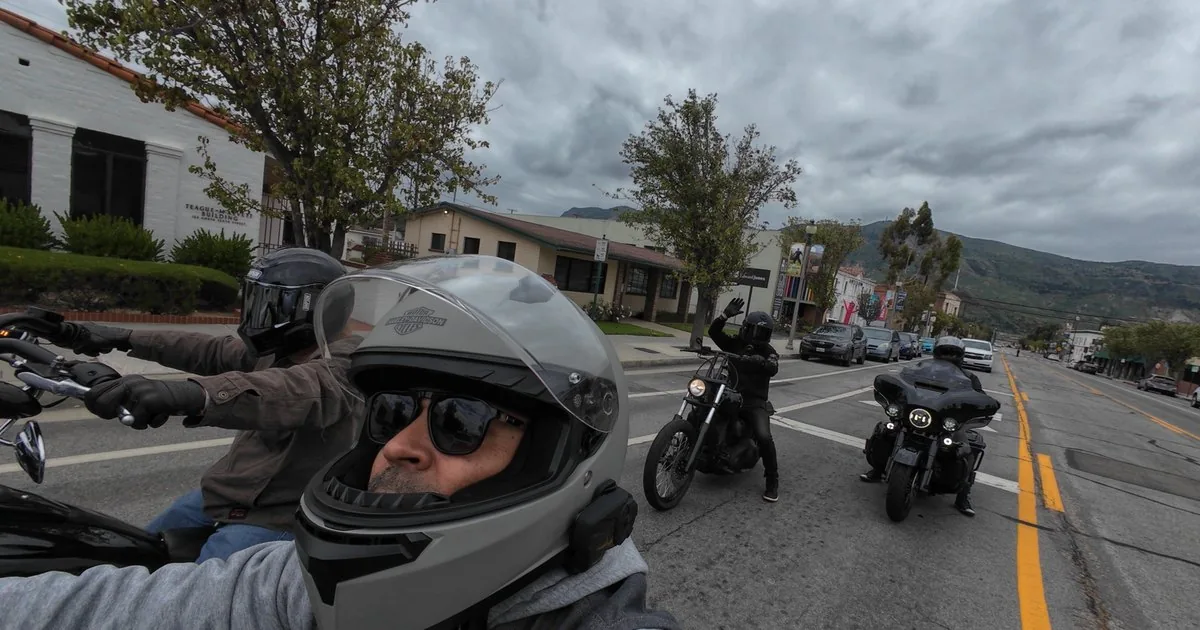
I’ll be honest with you: my first group ride, I was nervous about all of it, the formation, the pace, whether I’d hold everybody up. And then we rolled out and all that went out the window. Part of what made it click was realizing the group was talking the whole time. Nobody’s winging it. Somebody up front is watching the road for you, and his arm tells you so every few miles.
What Do Two Fingers Down and the Helmet Tap Really Mean?
Neither one is an official signal. Two fingers down is a greeting between riders, culture rather than curriculum. The helmet tap officially means “highbeam” in the MSF guide, though half the riders you meet will swear it means police ahead. If your crew uses the lore versions, agree on it at the riders’ meeting.
Biker hand signals come in two flavors: the standardized set above, and the folklore. The folklore is where the arguments live, so here’s what the sources actually support:
| The signal | What riders will tell you | What the official sources say |
|---|---|---|
| Tap on the helmet | “Cops ahead” | MSF defines it as highbeam. The police meaning appears in no official source — it’s rider lore (widespread lore, but lore) |
| Two fingers down | “Biker respect” | Not in any official sheet. It’s the rider wave: keep both wheels down. Culture, and proud of it |
| Right arm out for right turn | “Looks logical” | CA law says left arm bent up. The right-arm version is a bicyclist exception |
| “Staggered formation” | Various made-up gestures | The MSF signal is double file: two fingers straight up |
| Pointing at right-side hazards | Right hand point | MSF says right foot — the throttle hand stays put |
None of this means the lore is wrong to use. It means don’t assume the rider next to you learned the same dialect. The crew I rode with settled it the boring way: we said it out loud before we rode. To each his own, but everybody on the same page.
When Should You Use Hand Signals Instead of Blinkers?
Use hand signals when your lamps can’t do the job: a dead blinker (the law requires the arm), bright sun washing out your lights (the California DMV handbook specifically recommends hand signals for this), and any group instruction a blinker can’t say, like fuel or single file. At night, skip the arm and rely on your lamps.
The California DMV Motorcycle Handbook makes the sunlight point, and it’s one you feel immediately on a summer ride: your amber blinker is invisible at 4 PM in August. An arm straight out is not. Signals also make you bigger. So I went digging in the stats, and here’s the number that stuck with me: per NHTSA’s 2023 data, 6,335 riders died on US roads that year, and in 46% of the fatal two-vehicle crashes, the other vehicle was turning left across a motorcycle going straight. Anything that makes you more visible, earlier, to more drivers is worth doing. An arm out the side is the cheapest visibility upgrade there is.
One more thing worth knowing: this language is older than the blinker. Flashing turn signals didn’t show up on a production car until Buick offered them in 1939, and they weren’t federally required on motorcycles until the early 1970s. Every rider before that ran on arms alone. We’re just keeping the original equipment in working order.
Learn the Language, Then Get Somewhere to Speak It
Look, you can memorize all fourteen signals tonight. They only mean something with other riders around, and finding those riders is the part nobody helps you with. I know what it’s like to pull up somewhere like Neptune’s Net, see a crazy group of bikers, and think, “Dude, I don’t know, man.” Knowing the language is half of walking up. Having people expecting you is the other half.
That’s the whole reason RideWolf exists. It took me 30 years to find people to ride with; it shouldn’t take you that long. If you’re still learning the basics, start with how to ride a motorcycle, browse group rides near you, and join the RideWolf waitlist so you’ve got a crew to throw signals at when the app opens up. You guys are why we’re building it.
Motorcycle Hand Signals FAQ
What does it mean when bikers point two fingers down?
It’s a greeting. Two fingers down is the rider wave, a quick “keep both wheels down” passed between strangers heading opposite directions. It’s not part of any official signal set and never needed to be. You get it, you return it, and you ride on a little lighter.
Is tapping your helmet the signal for police ahead?
Officially, no. The MSF group riding guide defines the helmet tap as “highbeam,” a check-your-lights reminder. The police-ahead meaning is rider lore, common enough that many crews use it anyway. That’s exactly why you agree on signals at the riders’ meeting before rolling out.
Are motorcycle hand signals required by law?
Three are, whenever your signal lamps aren’t working. California Vehicle Code §22110 says hand and arm signals take over if your lamps fail, and §22111 defines left turn, right turn, and stop, all given with the left arm. Most states mirror this. Group signals like fuel or single file are convention, not law.
Do you signal a right turn with your right arm or left arm?
Left arm, bent up at the elbow, palm forward. The left arm gives all three legal signals; the straight-out right-arm version you sometimes see is a bicycle exception in the vehicle code. On a motorcycle it works out anyway, because your right hand should stay on the throttle and front brake.
How many riders should be in one group?
Smaller than you’d think. The MSF calls five to seven riders ideal, and the California DMV handbook says to split anything bigger than four or five into smaller groups. Signals ripple rider to rider, and the longer the column, the slower the message moves and the sloppier it arrives.
Do hand signals work at night?
Not well. An arm in the dark is invisible to the driver behind you, so at night lean on your lamps: turn signals, brake taps, a highbeam flash. Save hand signals for daylight, and if your group rides after dark, brief the plan before you leave.
Thank you guys for reading. Learn the three legal ones this week, practice the MSF fourteen until they’re boring, and then go find people to use them with. Put that first foot forward and just do it. We’ll see you on the next one. Peace.