


So this one happened to me on the Fourth of July. We went up north for the day, and man, it was hot. The kind of hot where you’re sitting at a light feeling the engine through your jeans, going, how much longer am I going to be sitting here?
On the way back we got stuck between a parade route and all the traffic backed up behind it. Start. Stop. Roll four feet. Stop. I was on that clutch for what felt like an hour, easing it out, pulling it in, holding the bike still, over and over. And when we finally broke free we ran home fast, so I was working it there too.
Somewhere in all that I started smelling burning coming out of the primary.
Then the clutch started acting up. I could feel it pulling. It wasn’t smooth going through the gears anymore, and anybody who’s ridden the same bike long enough knows what I mean by that. You don’t need a diagnostic code. Your hands tell you. I knew something was wrong.
I’m telling you that story up front because this whole article is about a lever most of us are scared of at first, and I got it wrong myself. I paid that bill.
Can you brake without the clutch on a motorcycle?
Yes. You can slow down and brake with the clutch fully out and the bike still in gear, and that’s what you should be doing for most of your slowing. The engine helps slow the bike, the drivetrain stays connected, and the motorcycle feels planted underneath you. You only need the clutch at the end, so the engine doesn’t stall as you come to a stop.
Now, if you go looking for that answer online, you’re going to get a mess. The top results for this question are a Reddit thread from 2013, a Facebook group, a Quora page from a decade ago, and a parts store’s blog. Half of them tell you never to touch the clutch while braking. The other half tell you it’s fine. Google’s own AI summary manages to say both things in the same box.
So I went and read what the people who actually teach riding say. Not blogs. The Motorcycle Safety Foundation’s own materials and the operator manuals that states use to license riders. And what they say is not what the internet says.
What the rider manuals actually say about the clutch
Here’s the part that surprised me. The training material doesn’t tell you to keep the clutch out when you stop. It tells you to squeeze it in.
| Source | What it says about the clutch when you stop |
|---|---|
| MSF Basic RiderCourse Rider Handbook (Ed. 7.1, p. 23) | “Squeeze the clutch and the front brake lever while pressing on the rear brake pedal and downshifting to first gear.” |
| MSF, You and Your Motorcycle: Riding Tips (5th ed., p. 63) | “Gradually apply both brakes and squeeze the clutch, downshifting to first gear at the same time. Keep the clutch squeezed in.” |
| Ohio Motorcycle Operator Manual | “Begin braking first, then squeeze the clutch and downshift to first gear before the motorcycle stops completely.” |
| California Motorcycle Handbook (DL 665) | “Shift down through the gears with the clutch as you slow or stop. Remain in first gear while stopped so you can move out quickly, if needed.” |
| PennDOT Motorcycle Operator Manual (PUB 147) | Scores “pull in the clutch and coast” as a wrong answer on its licensing test. |
Read those again and you’ll notice they’re not in conflict. Every one of them describes the same stop: brakes doing the work, clutch coming in, downshifting to first, and you sitting there in first gear when the bike is stopped.
What none of them describe is pulling the clutch in at 55 and freewheeling to the light. And that right there is the whole argument.
The real mistake isn’t the clutch. It’s coasting.
Pennsylvania settles this one for us, because Pennsylvania puts it on the licensing test.
PUB 147 carries a test bank with a printed answer key. Question 25 asks what to do when slowing for a normal stop. One of the choices is “pull in the clutch and coast.” The answer key marks it wrong. The correct answer is “shift down through the gears as you slow.” Question 34 does the same thing again, marking “pull in the clutch and use both brakes” wrong when you’re reducing speed before a turn.
So the thing riders argue about online is a distinction the licensing exam already drew. Holding the clutch in while you finish a stop is taught. Holding the clutch in and rolling along disconnected is a wrong answer. Those are two different acts, and the internet mashes them into one question and then fights about it.
Coasting is worse for the same reason engine braking is good. When the bike is in gear and the clutch is out, the engine is slowing you, the chassis is settled, and you’re one twist of the wrist away from having power again. Clutch in and coasting, you’ve got brakes and nothing else, and if you need to accelerate out of a bad spot you have to find a gear first.
When you do want the clutch in
The clutch is just a tool in the bag. There are times you want it and times you don’t, and knowing the difference is most of the skill.
| Situation | Clutch | Why |
|---|---|---|
| Normal slowing from road speed | Out, bike in gear | The engine helps slow you and the bike stays settled and connected. |
| Finishing a stop | In | Keeps the engine from stalling. MSF has you in first gear by the time you’re stopped. |
| Sitting at a light | In, first gear | Every manual says stay in first so you can move if you have to. |
| Parking lot, U‑turns, walking pace | Friction zone | Partial engagement is how you control the bike below about walking speed. |
| Rolling to a stop in traffic | In, at the end | Same as any stop. Just don’t start coasting a block early. |
| Freewheeling downhill | Never | This is the coasting the exams mark wrong. |
You’ll notice there’s no speed in that table. That’s deliberate, and it’s worth saying out loud, because you will absolutely read somewhere that the rule is “pull the clutch below 10 mph.”
I went looking for that number. It isn’t in the MSF Motorcycle Operator Manual, and it isn’t in the California, Texas, Florida, Pennsylvania, Washington or Ohio manuals either. Not 10 mph, not 5, not 15. No rider-training document I could find puts a speed on it.
The actual rule is about gear, not speed: be in first, with the clutch in, before the bike actually stops. You feel it rather than read it off the speedo. The engine starts to lug and complain as the revs fall toward idle, and that feeling is the cue. After a few hundred stops your left hand does it without asking you.
Engine braking, and why California never taught you the words
Engine braking is what’s happening when you roll off the throttle in gear and the bike slows down on its own. The engine is being turned by the rear wheel instead of the other way around, and it resists. Florida’s manual puts the condition on it plainly: that effect happens “when the clutch is not squeezed in.” Squeeze the lever and you’ve switched it off.
Then I found something I wasn’t expecting. I searched the full text of seven rider manuals for the phrase “engine braking.”
| Manual | Times it says “engine braking” | Length |
|---|---|---|
| California Motorcycle Handbook (DL 665, rev. 2/2024) | 0 | ~16,200 words |
| Pennsylvania (PUB 147) | 0 | ~17,200 words |
| Ohio Motorcycle Operator Manual | 1 | ~3,500 words |
| MSF Motorcycle Operator Manual (18th ed.) | 2 | ~20,700 words |
| Texas (TDLR, 2025) | 2 | ~23,900 words |
| Florida Motorcycle Operator Handbook | 2 | ~23,900 words |
| Washington (DOL) | 5 | ~20,300 words |
Zero. Sixteen thousand words in the book California uses to license motorcyclists, and the phrase never appears. I got my license in this state. I rode for years out here before anybody used those two words near me, and it turns out that’s not because I wasn’t paying attention. California teaches you to downshift as you slow. It just never gives the effect a name.
So if you’ve been riding around SoCal feeling like everybody else got a vocabulary lesson you missed, you’re not crazy. You did miss it. It wasn’t in the book.
How to downshift a motorcycle as you slow down
The sequence is simpler than the arguing about it suggests. Roll off the throttle. Get on both brakes together, front and rear. As the revs drop, squeeze the clutch, click down a gear, and ease the lever back out. Repeat that until you’re in first, and hold the clutch in as you settle to a stop.
Three things worth knowing on top of that.
Ease the clutch out, don’t dump it. The MSF manual is specific here: on a downshift you should “ease out the clutch lever through the friction zone” and let the engine speed stabilize before the next one. Dumping the lever in a low gear shoves the engine’s braking straight into the rear tire. The manuals warn that the bike will “lurch” and the rear wheel “may skid,” and Ohio compares it to stepping hard on the rear brake.
A little throttle makes it smooth. Riders call this rev matching, though interestingly none of the training documents use that term. MSF describes the technique without naming it: squeeze the clutch in, “rev the engine a little to let it catch the lower gear smoothly, and shift down.” It sounds fussy written out. It’s a blip. You’ll get it in an afternoon.
You can skip gears. You don’t have to click through every one on the way down. The MSF manual allows that “it is possible to shift through more than one gear while the clutch lever is squeezed,” and Ohio spells out the method: hold the clutch in, press the lever down once per gear, let it return to center between presses. When it won’t go down any further, you’re in first.
If any of this is new, it might be worth backing up a step. I wrote a walkthrough on how to ride a motorcycle from the parking lot to the road that covers the friction zone and the basic shift pattern before you start layering technique on top.
What riding the clutch cost me
Back to the Fourth of July.
What I’d done, sitting in that parade traffic, was slip the clutch for a very long time on a very hot day. That’s partial engagement, which means the plates are rubbing against each other instead of locking together, and rubbing makes heat. That’s the whole job of the friction zone and it’s a legitimate technique, but it’s a tool for walking speed and short bursts, not something to live in for an hour. Then I ran the bike hard on the way home and asked it for more.
The burning smell out of the primary was the clutch telling me. The grabbiness through the gears afterward was it slipping, which is what a cooked clutch does. It stops fully locking up, so power feeds through unevenly and shifts stop being clean.
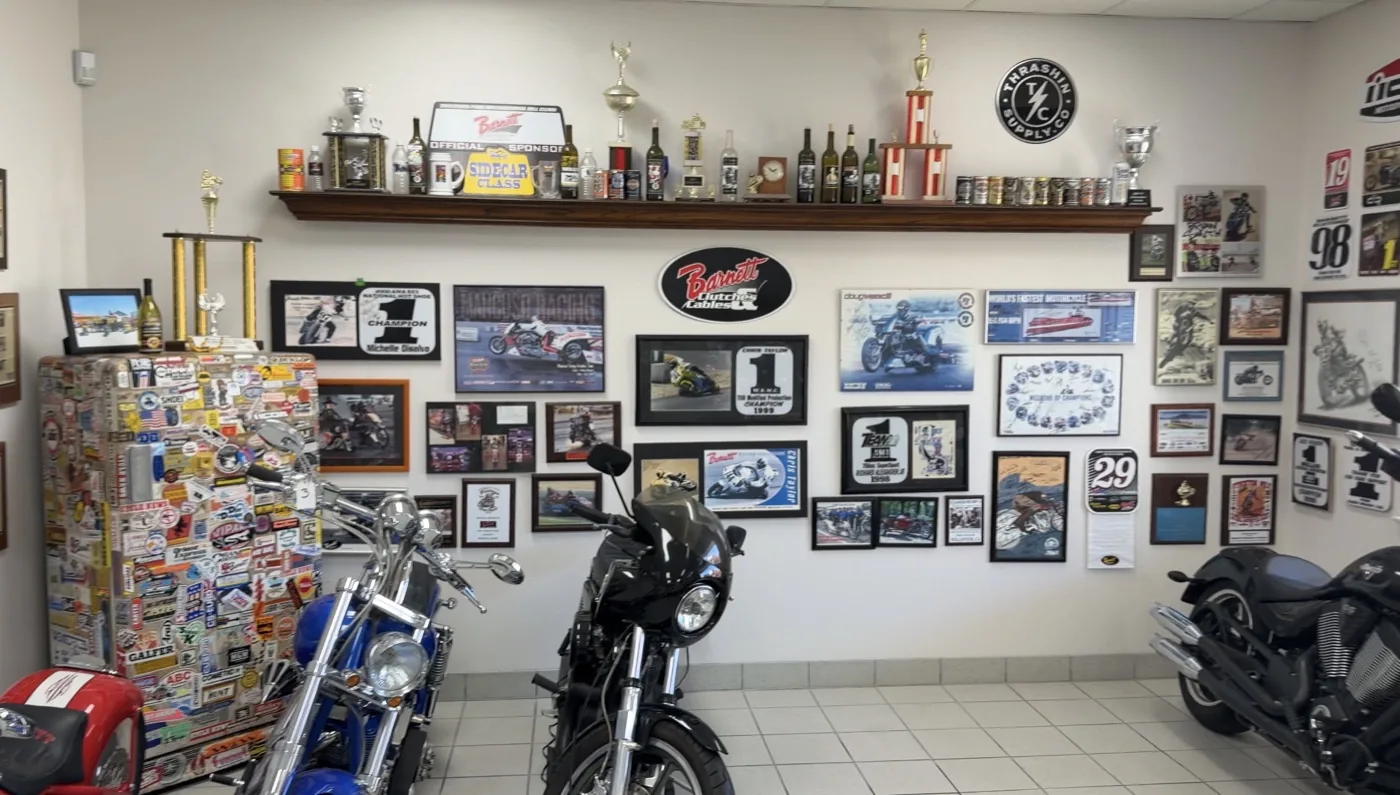
The next day I got home and did some research and decided to make the drive out to Ventura, to Barnett Clutches & Cables, and buy a carbon fiber clutch kit. I went carbon fiber for one reason: out here we spend our weekends in the canyons, twist after twist after twist, and it gets hot. I wanted something that would take more heat than what came out of it.
Then I got home and got to work. Drained the primary fluid, pulled the cover, took out every stock plate, put the Barnett kit in. Then a full adjustment on the clutch lever itself.
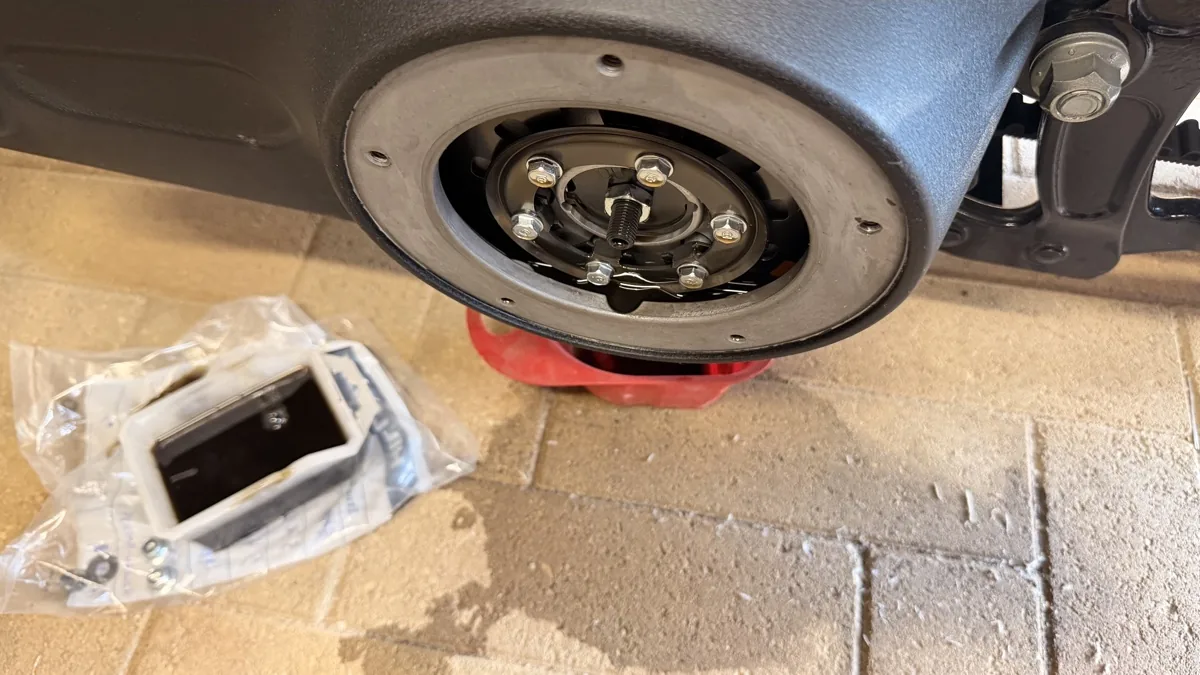
(Draining the primary on a Harley is a fun exercise in finding out where the fluid has already been going. My buddy Leo says if it’s not leaking, it needs oil. He’s not entirely joking.)
Two things I want you to take from that. The first is that clutches are consumable and this is a repair, not a catastrophe, and doing it yourself is genuinely satisfying. The second is the part that matters for this article: I didn’t wear that clutch out by braking without it. I wore it out by riding it. Sustained slipping under load and heat is what kills these things, and every minute you spend rolling along with the lever half out is a withdrawal from that account.
Which is a long way of saying that the habit this article is arguing against has a price, and I can tell you what it is, because I paid it.
What about emergency stops?
This is where I have to be straight with you rather than confident.
I read every quick-stop and maximum-braking procedure I could find. MSF’s Motorcycle Operator Manual, the Basic RiderCourse handbook, MSF’s own practice guide, and the California, Washington, Florida and Pennsylvania manuals. All of them tell you the same things: apply both brakes, squeeze progressively instead of grabbing, keep the bike upright and straight, look where you’re going, don’t brake and swerve at the same time.
Not one of them mentions the clutch.
Not to recommend it, not to warn you off it. The instruction simply isn’t there. So when you see someone online state flatly that pulling the clutch in a panic stop is forbidden and adds distance, understand that they’re not quoting the curriculum, because the curriculum doesn’t address it.
Manufacturers do, though, and they don’t all agree. BMW’s rider’s manual for the R 1300 RT, in the section on minimizing stopping distance, tells riders whose bikes don’t have the automated shift assistant to “remember to pull the clutch at the same time.” That’s a factory manual telling you to pull it in a maximum-effort stop.
I’m going to be honest with you, and this part is me talking, not the manuals: in a real emergency you have exactly one job, and that’s to not hit the thing in front of you. Both brakes, hard and progressive, eyes up, bike straight. Whether your left hand comes in is not the variable that saves you. Your braking is. Practice maximum braking somewhere safe until it’s reflex, and let the clutch sort itself out.
Why your back end skips on a hard downshift
If you’ve ever banged down two gears coming into a corner and felt the rear tire hop and chatter, that’s engine braking overwhelming the traction the rear tire has to give. The engine is asking the rear wheel to slow faster than the tire can manage.
Modern bikes increasingly have hardware for this. Honda describes the slipper clutch in its owner’s manuals as a system that “helps to prevent the rear tire from locking up when the deceleration of your vehicle produces a strong engine braking effect.” BMW calls its version an anti‑hopping clutch. MV Agusta lists “assist and slipper clutch with back torque limiting device.” Different names, same idea: let the clutch give a little under back torque so it never reaches the tire.
If your bike doesn’t have one, the fix is free. Downshift one gear at a time, ease the lever out instead of dropping it, and add that little blip of throttle. That’s the technique the hardware is imitating.
Worth knowing: ABS generally will not save you here. ABS manages the pressure your brakes apply. Rear wheel lockup caused by the engine comes through the drivetrain, not the brake line, which is exactly why slipper clutches exist as separate hardware.
The group-ride problem nobody mentions
This one took me by surprise, and it’s the reason I care about any of this beyond the mechanical trivia.
Washington’s manual is the only one I found that raises it. Engine braking, it points out, has a real downside: “your brake light does not engage to let drivers behind you know you are slowing.” Its advice is to flash your brake light a few times when you’re slowing on the engine.
Now think about that on a group ride. You’re third in a staggered formation. The rider in front of you rolls off and drops two gears coming into a corner, shedding real speed. No brake light. Nothing behind them changes color at all. The only warning you get is the gap closing, and by the time you read a closing gap you’re already reacting late.
That’s not a reason to avoid engine braking. It’s a reason to ride with more space than feels necessary and to be deliberate about covering your brake in a pack. It’s also one more thing that gets easier when you ride with the same people often enough to know how they slow down. We get into this more in the complete guide to group riding, and it’s honestly one of the better arguments for finding a regular crew instead of joining a different twenty-bike ride every weekend.
Stuff you’ll read that isn’t true
While I was researching this I kept running into numbers that sounded authoritative and turned out to be invented. Since this article is going to sit next to those ones, let me be specific.
| What you’ll read | What’s true |
|---|---|
| “Pull the clutch in below 10 mph” | No rider-training manual gives any speed threshold. The rule is about being in first gear before you stop. |
| “Engine braking reduces crash risk by 40%, per MSF” | MSF has published no such figure. This traces to a blog citing MSF with no document behind it. |
| “29% of fatal wrecks are caused by bad stops, per NHTSA” | NHTSA publishes no such category or statistic. |
| “Engine braking cools your brake pads by a third” | Traces back to a site that no longer exists, with no test data behind it. |
| “Braking without the clutch will kill your bike” | It stalls the engine. That’s the entire consequence. |
| “Never touch the clutch while braking” | MSF’s own handbook has you squeeze it as you complete the stop. |
One more, because it comes up. If somebody tells you MSF endorses pulling the clutch while braking and points at the manual, check which section. There is exactly one sentence in all of that material saying to squeeze the clutch when braking, and it’s in the three-wheel supplement, about riding a rig with a sidecar. That’s a different machine with different physics.
FAQ
Do you need to pull the clutch when braking on a motorcycle?
Not for most of the stop. Brake with the bike in gear and the clutch out so the engine helps slow you, then squeeze the clutch in as you finish stopping so the engine doesn’t stall. MSF teaches downshifting to first with the clutch in as you complete the stop.
Is it okay to shift a motorcycle without the clutch?
Clutchless upshifting is common and generally harmless when your timing is right, which is why factory quickshifters exist. Clutchless downshifting is harder on the gearbox and much easier to get wrong. For normal street riding there’s no real benefit to skipping the lever.
Is a clutch needed for braking?
No. Your brakes stop the motorcycle and they work whether the clutch is in or out. The clutch only disconnects the engine from the rear wheel. You need it at the end of a stop so the engine doesn’t stall, not to make the brakes work.
Can you start a motorcycle without holding the clutch?
On most modern bikes, only in neutral. Safety interlocks require the clutch to be pulled in to start in gear, and many bikes won’t crank otherwise. Check your owner’s manual, since the wiring differs by model and year.
What happens if you brake without pulling the clutch at all?
The engine lugs down as the revs fall and eventually stalls, usually with a lurch right as you stop. It’s embarrassing, not damaging. Every rider has done it. Squeezing the clutch as you finish the stop is what prevents it.
Does engine braking damage your motorcycle?
No. Engine braking is a normal function of a bike in gear with the throttle closed, and rider manuals in several states teach it. What does cause wear is riding the clutch, meaning long periods of partial engagement under load, which builds heat in the friction plates.
One more thing before you go
If you’re newer and this all felt like a lot, here’s what I’d actually keep.
Brake with the bike in gear. Let the engine help. Squeeze the clutch in as you finish the stop and be in first when your foot goes down. Don’t coast. And go easy on that lever in stop-and-go traffic on a hot day, because the bill comes eventually and I have the receipts from Ventura to prove it.
The rest of it, the blipping and the skip-shifting and the smooth downshift that doesn’t upset the bike at all, that comes from riding. Not from reading. A few hundred stops from now your hands will just know what to do, and you won’t even be able to tell me when they learned it.
The best way I know to get those miles is with people who’ve already got them. Riding with a crew that knows the roads is how I learned most of what’s in this article, and it beats figuring it out alone in a parking lot. That’s the entire reason we’re building RideWolf: to help you find motorcycle rides and a group near you so you’re not doing this by yourself.
We’re pre-launch right now, and if you want in early you can join the waitlist here. No spam, just a heads up when it’s ready.
Be safe out there, take care of that clutch, and put that first foot forward and just do it. Peace.