


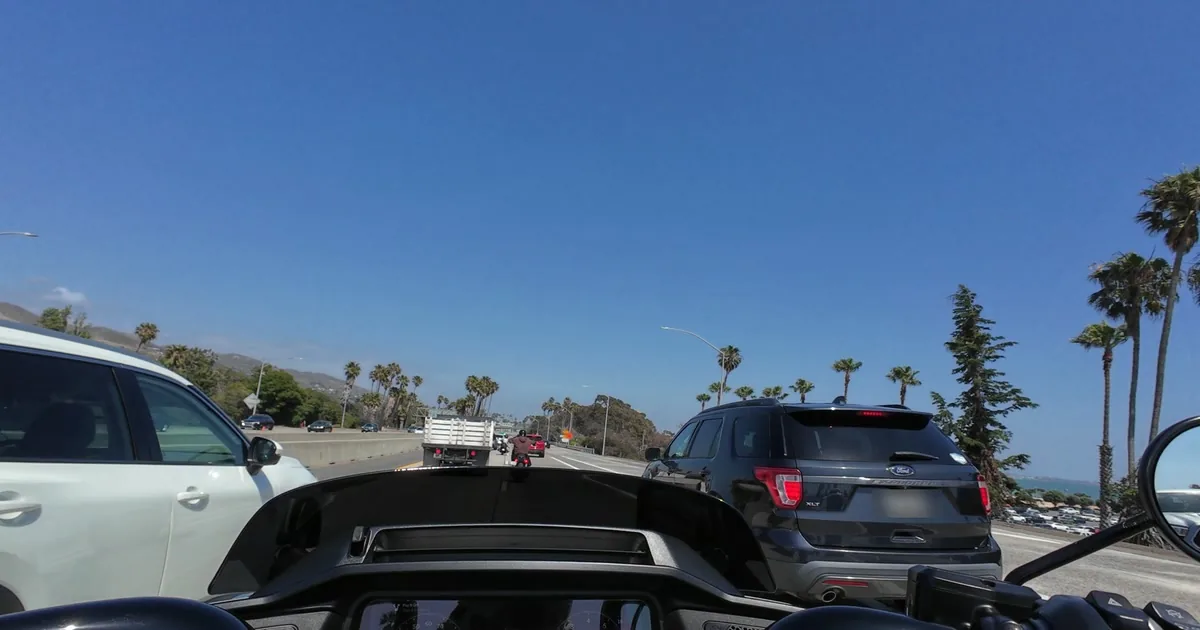
The first time I split lanes, it was nothing like I thought it would be.
I had this picture in my head of squeezing a 680-pound Harley through tiny little openings, mirrors an inch off my knuckles, one twitch from disaster. That is not what it is. There is plenty of room. Most of the cars move over. My buddy Leo led the way that day on the 101, revved his engine, and the cars just started opening up in front of us. I said it on camera and I still mean it: it was like watching the Red Sea part.
I still split lanes today, the same way I did then: 10 to 30 mph when the traffic is dense and heavy, a little faster when it is just two cars to get past and everything around me is moving. I also get asked about it more than any other thing I do on the bike, mostly by riders in states where it is illegal and by drivers who think it should be. So I went and read the actual laws, all six of them, plus the one real study anybody has done on it. Here is what they say, state by state, and then how I actually do it in Los Angeles traffic.
What is lane splitting, and how is it different from lane filtering?
Lane splitting is riding a motorcycle between lanes of traffic moving in the same direction, whether that traffic is stopped or rolling. Lane filtering is the slow-speed version: moving past stopped cars, usually to the front of the line at a light. California allows splitting. The other five states only allow filtering, and each one defines it with its own speed numbers.
The words get mixed up constantly, including by the people writing the laws, so here is how the American Motorcyclist Association and the states themselves use them.
| Term | What it means | Where you’ll see it |
|---|---|---|
| Lane splitting | Riding between clearly marked lanes of traffic going the same direction, stopped or moving | California (legal). Minnesota allows a limited version at 25 mph or less |
| Lane filtering | Passing stopped (or in Montana, crawling) vehicles in the same lane to get to the front, at a set low speed | Utah, Montana, Arizona, Colorado, Minnesota |
| Lane sharing | Two motorcycles riding side by side in one lane | Legal in most states; not the same thing as splitting |
| Shoulder riding | Passing on the paved shoulder | Illegal everywhere. The CHP says flat out it is not lane splitting. Hawaii tried a shoulder law in 2019 and it expired in 2020 |
Where is lane splitting legal? All six states, with the actual rules
As of October 2026, one state allows lane splitting and five allow lane filtering. I pulled every row below from the statute or the state’s own DOT page, not from somebody’s blog, because half the blogs I read still list Hawaii, and Hawaii’s law has been dead for six years. Links are at the bottom of each state section.
| State | What’s allowed | Traffic must be | Your max speed | Where | Since | Watch for |
|---|---|---|---|---|---|---|
| California | Lane splitting | Stopped or moving | No number in the law | Any road, divided or undivided | Never illegal; defined in the Vehicle Code 2017 | Shoulder is off limits |
| Utah | Lane filtering only | Stopped | 15 mph | 2+ lanes same direction, speed limit 45 or less, or a multi-lane off-ramp. Not on-ramps | May 2019 | Splitting banned Jan 1, 2026 (90-day suspension). Filtering law sunsets July 1, 2027 |
| Montana | Lane filtering | Stopped or moving 10 mph or less | 20 mph | Lanes wide enough to pass safely | Oct 2021 | Only state that lets you filter past slow traffic, not just stopped |
| Arizona | Lane filtering | Stopped | 15 mph | 2+ lanes same direction, speed limit 45 or less | Sept 2022 | Since Sept 12, 2026, splitting outside these rules is charged as reckless driving |
| Colorado | Lane filtering | Stopped | 15 mph | Lane wide enough; pass on the left; no shoulder, no opposing lane | Aug 7, 2024 | Law expires Sept 1, 2027 unless renewed |
| Minnesota | Filtering + limited splitting | Stopped (filtering) or slow (splitting) | 25 mph, and no more than 15 over traffic | Not in roundabouts, school zones, single-lane work zones or freeway on-ramps | July 1, 2025 | Newest law; drivers are not required to make room |
California
California is the only state where you can ride between lanes of moving traffic. The law is Vehicle Code 21658.1, passed as AB 51 in 2016. It does two things. It defines lane splitting as riding a two-wheeled motorcycle between rows of stopped or moving vehicles in the same lane, on divided and undivided streets. And it tells the California Highway Patrol it may publish safety guidelines. That is it. No speed limit, no speed differential, no lane restrictions written into the law. The CHP’s tips fill that gap, and I cover them below, because they match what I do almost line for line.
Utah
Utah was second, in 2019, and it just got stricter. Section 41-6a-704 lets you filter past a stopped car at 15 mph or less on a road with two or more lanes in your direction and a speed limit of 45 or less, or on a multi-lane off-ramp. Never on an on-ramp. Then on January 1, 2026, a new Section 41-6a-704.1 kicked in: “An individual may not engage in lane splitting.” First conviction suspends your motorcycle endorsement for 90 days, second for 180, third revokes it, and the officer can impound the bike. One more thing riders in Utah should know. The filtering law has a sunset date of July 1, 2027. The Legislature reviewed it in May 2026 and has to vote to keep it or it goes away.
Montana
Montana’s Section 61-8-392, from 2021, is the most generous filtering law in the country. You can pass a vehicle that is stopped or moving at 10 mph or less, as long as your own speed stays under 20 mph, the lanes are wide enough to pass safely, and conditions let you ride in a reasonable and prudent way. That “10 mph or less” part matters. In every other filtering state the car you pass has to be fully stopped.
Arizona
Arizona’s rule, in Section 28-903, reads almost like Utah’s: stopped traffic, two or more lanes in your direction, speed limit 45 or less, you at 15 mph or less, and only if the move can be made safely. The 2026 change is the penalty. House Bill 2941, signed this year, says a motorcyclist who passes in the same lane or rides between lanes outside that exception “is guilty of reckless driving.” That is a class 2 misdemeanor, not a traffic ticket. It took effect September 12, 2026.
Colorado
Colorado’s SB24-079 has been live since August 7, 2024. Traffic has to be stopped, the lane has to be wide enough, you stay at 15 mph or less, and you pass on the left. No shoulder, no passing to the right of the far-right lane, no crossing into oncoming traffic. CDOT adds a line I like: if cars are slowing down or creeping, “traffic is not considered stopped.” And when the cars start rolling again, you get back in line. The law expires September 1, 2027 unless the Legislature renews it after CDOT reports on the crash data.
Minnesota
Minnesota is the newest and the one that comes closest to California. Since July 1, 2025, Statute 169.974 lets you pass within or between lanes at “not more than 25 miles per hour” and “no more than 15 miles per hour over the speed of traffic.” The Department of Public Safety breaks that into filtering past stopped cars at 15 mph or less and splitting slow traffic at 25 or less, and says to get back in your lane once traffic hits 25. Roundabouts, school zones, single-lane work zones and freeway on-ramps are off the table. Drivers are asked to be aware of you but are “not obligated to accommodate” you.
Is lane splitting legal in Texas? What about everywhere else?
No. Texas has no exception for motorcycles. Transportation Code 545.060 says every driver on a laned road “shall drive as nearly as practical entirely within a single lane,” and that includes you on a bike. Texas lawmakers have looked at filtering bills and none has passed. The same answer holds for the other 43 states.
Some states spell it out. Tennessee’s Code 55-8-182 says “no person shall operate a motorcycle between lanes of traffic or between adjacent lines or rows of vehicles,” with an exception for police. Most states get there the Texas way, with a single-lane rule that was written for cars and applies to everything on the road.
Two states deserve a footnote. Hawaii passed a law in 2018 letting the DOT designate shoulders where motorcycles could pass stopped traffic at 10 mph. It repealed itself on December 31, 2020, and it was never lane splitting. Oregon’s Legislature actually passed filtering in 2021 and the governor vetoed it, writing that law enforcement and the public “remain concerned that lane filtering is unsafe.” If you ride in a state with a bill in the works, the AMA tracks them.
Is lane splitting safe? What the Berkeley study actually found
The only serious study is from UC Berkeley’s Safe Transportation Research and Education Center, published in 2015. It looked at 5,969 motorcyclists who crashed in California over 14 months and compared the 997 who were lane splitting at the time with the ones who were not. Lane splitters were hurt less badly, but the study only covers riders who crashed. It does not tell you whether splitting makes a crash more or less likely in the first place.
I have mentioned this study on camera before, so I finally sat down and read the whole thing. Here is what the report says, in its own numbers.
| Among riders who crashed (June 2012 to Aug 2013) | Lane splitting | Not lane splitting |
|---|---|---|
| Head injury | 9% | 17% |
| Torso injury | 19% | 29% |
| Extremity injury | 60% | 66% |
| Fatal injury | 1.2% | 3.0% |
| Rear-ended by another vehicle | 2.6% | 4.6% |
| Wearing a full-face helmet | 81% | 67% |
Two things jump out of that table. The lane splitters were a different crowd: more weekday commuters, better helmets, lower speeds, less alcohol, fewer passengers. Some of the gap is who they are, not what they were doing. And the one number that drives everything else is speed. The report found “no meaningful increase in injury incidence until traffic speed exceeded roughly 50 MPH,” and that the difference between your speed and traffic’s was “a stronger predictor of injury” than speed itself. Up to 15 mph faster than the cars, injuries did not climb. Above that, they did, for every kind of injury.
The researchers’ own conclusion: lane splitting “appears to be a relatively safe motorcycle riding strategy if done in traffic moving at 50 MPH or less and if motorcyclists do not exceed the speed of other vehicles by more than 15 MPH.” Those two numbers, 50 and 15, are the closest thing we have to a rule. They are also, almost exactly, the numbers Minnesota wrote into its law ten years later.
So when I see a rider rip through the gap at 50 mph, I don’t get angry. I just think about how the chances of something going wrong went way up for that guy, and he can’t see it from inside his helmet.
How I split lanes in Los Angeles
How fast I split depends on how the traffic has built up. When it is dense and heavy, stopped or crawling, I am at 10 to 30 mph. When it is just two cars to get past and the lanes are moving, my speed comes up with theirs, because what matters is the difference between my speed and the cars, not the number on the dash. I have never once been blocked by a car. Here is my routine, next to what the CHP tells riders to do, because I did not plan it this way but they line up.
| CHP safety tip | What I actually do |
|---|---|
| “Danger increases at higher speed differentials” and “as overall speed increases” | 10 to 30 mph in dense, stopped or crawling traffic. Passing just two cars in moving traffic, my speed comes up with theirs and I keep the difference small |
| “It is typically safer to split between the far left lanes” | Lanes 1 and 2, always. That is where the cars expect you and where nobody is exiting |
| “Avoid lane splitting next to large vehicles (big rigs, buses, motorhomes)” | The one spot I treat differently. Next to a big rig I need to know I can get through quickly. If I can’t, I wait behind it. You do not want to be caught in that pocket |
| “Avoid remaining in the blind spots of other vehicles or lingering between vehicles” | Keep moving. Lingering is how you end up in a mirror nobody is checking |
| Not in the CHP list | I do not split on a curve. The gap changes shape as the cars track through it, and the sightline is gone. I wait for the straight |
| Not in the CHP list | If two cars are too close, I rev the engine before I get there. It alerts them, and most of the time they move over a little more. I do it as a preventive habit even when the gap looks fine |
| “Help drivers see you” with bright or reflective gear and high beams | Most days I am in black or darker colors, and I know that works against me, so some days the long-sleeve shirt is white on purpose. High beam is on in the daytime, every ride |
The rev thing is the part nobody tells you. I thought it would come off as aggressive. It does not. Drivers hear a motorcycle, look in the mirror, and give you a foot they were not giving you before. Leo taught me that on the 101 by doing it, not by explaining it, and it has worked on every freeway since.
The CHP also has two lines for drivers that every rider should know by heart. “Intentionally blocking or impeding a motorcyclist in a way that could cause harm to the rider is illegal.” And “opening a vehicle door to impede a motorcyclist is illegal.” I have never had either one happen to me. I have had plenty of drivers in the far left lane slide over to give me room, which is the other thing the CHP asks them to do, and I give them the wave every time. If you want the rest of the on-bike sign language, I wrote up all the motorcycle hand signals riders actually use.
One honest caveat from the CHP that I agree with: lane splitting “should not be performed by inexperienced riders.” I rode in a lane for a long time before I split one. If you are still working on the basics of riding a motorcycle, the clutch, the friction zone, slow-speed balance, stay in your lane a while longer. The gap will still be there when you are ready for it.
What it feels like, and who taught me
I had every fear about riding you can have, and lane splitting was its own little fear inside all the others. I pictured it wrong. The reality is slower, calmer and roomier than it looks from a car window. It is also one of the reasons riding in LA works at all. Twenty minutes of freeway at 15 mph between two lanes of stopped cars beats an hour of sitting in it. If you want the full list of what scared me and what the numbers say about it, I put it in are motorcycles dangerous.
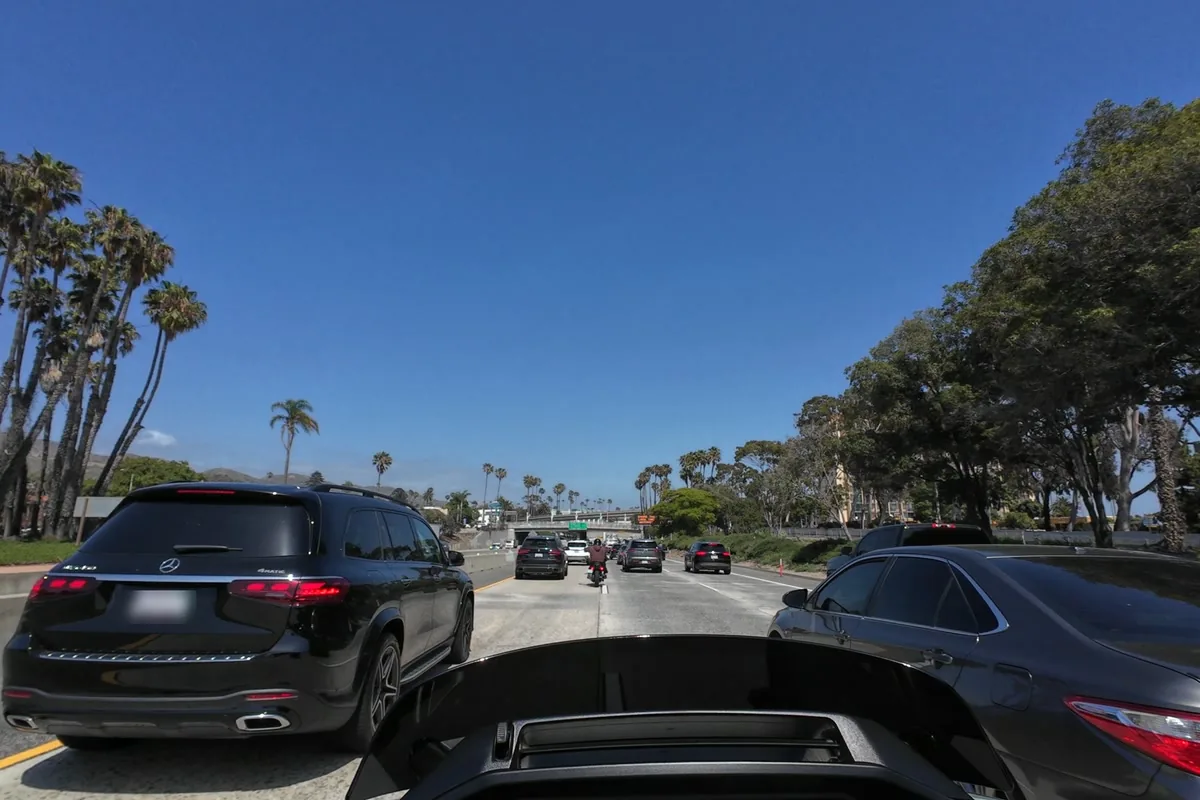
I did not learn this from a video. I learned it from a guy in front of me who had done it ten thousand times, and I copied his line through the gap. That is what riding with people does. It compresses years of figuring things out into one Sunday on the 101. It is the whole reason I built the RideWolf app: so a new rider in Los Angeles or anywhere else can find someone to follow instead of guessing. The group riding guide covers how a ride like that works, and you can browse motorcycle rides by state to see what is out there.
Ride with people who already know the gap
RideWolf is a free app for finding riders and rides near you. It is in early access right now, and the waitlist is how you get in.
Lane splitting FAQ
Is lane splitting legal in California?
Yes. California is the only state where lane splitting is legal between moving traffic. Vehicle Code 21658.1 defines it as riding a two-wheeled motorcycle between rows of stopped or moving vehicles in the same lane. The law sets no speed limit; the CHP’s guidelines say danger rises with speed and with the speed difference between you and the cars.
Is lane splitting legal in Texas?
No. Texas Transportation Code 545.060 requires every vehicle, motorcycles included, to stay as nearly as practical within a single lane, and Texas has no filtering exception. Riding between lanes or between rows of cars in Texas is a traffic violation. Filtering bills have been introduced in Austin and none has become law as of 2026.
What states allow lane splitting or lane filtering?
Six as of October 2026. California allows full lane splitting. Utah, Montana, Arizona, Colorado and Minnesota allow lane filtering past stopped or, in Montana, crawling traffic, at 15 to 25 mph depending on the state. Utah banned true lane splitting in January 2026, and the Utah and Colorado filtering laws both expire in 2027 unless renewed.
What is the difference between lane splitting and lane filtering?
Lane splitting is riding between lanes of traffic that is moving, stopped or both. Lane filtering is passing stopped cars at low speed to reach the front of the line, usually at a red light. California allows splitting. The five filtering states only allow the stopped-traffic version, each with its own cap, from 15 mph in Utah, Arizona and Colorado to 25 mph in Minnesota.
How fast can you lane split in California?
The law gives no number. The CHP says danger increases with overall speed and with the speed difference between you and traffic. UC Berkeley’s 2015 crash study found injuries did not rise until traffic exceeded about 50 mph or the rider went more than 15 mph faster than the cars. I split at 10 to 30 mph in dense, stopped or crawling traffic, and a little faster when it is only two cars in moving traffic, keeping the difference small.
Is lane splitting safer than sitting in traffic?
Nobody has proven that. The Berkeley study found riders who crashed while lane splitting had lower rates of head, torso and fatal injury and were rear-ended half as often, but it only studied riders who crashed. The AMA argues filtering reduces exposure to rear-end hits in stop-and-go traffic. Keep your speed difference under 15 mph and the data is on your side.
Can a driver block a motorcycle that is lane splitting?
Not legally in California. The CHP states that intentionally blocking or impeding a motorcyclist in a way that could cause harm is illegal, and so is opening a door to block one. Drivers in the far left lane are asked to move left within their lane to make room. In Minnesota, drivers are asked to be aware of filtering riders but are not required to make room.
Put that first foot forward
If you ride in California, lane splitting is a tool in the bag, not a dare. Learn the gap slowly, keep the speed difference small, stay out from next to the big rigs, and wait out the curves. If you ride somewhere it is illegal, know the exact line your state draws, because in two of them that line just got a lot more expensive to cross. And if you ride somewhere it is being debated, go read the Berkeley numbers before you form an opinion.
Thank you guys for reading. Find somebody who has done it before you, follow their line, and put that first foot forward. Peace.