



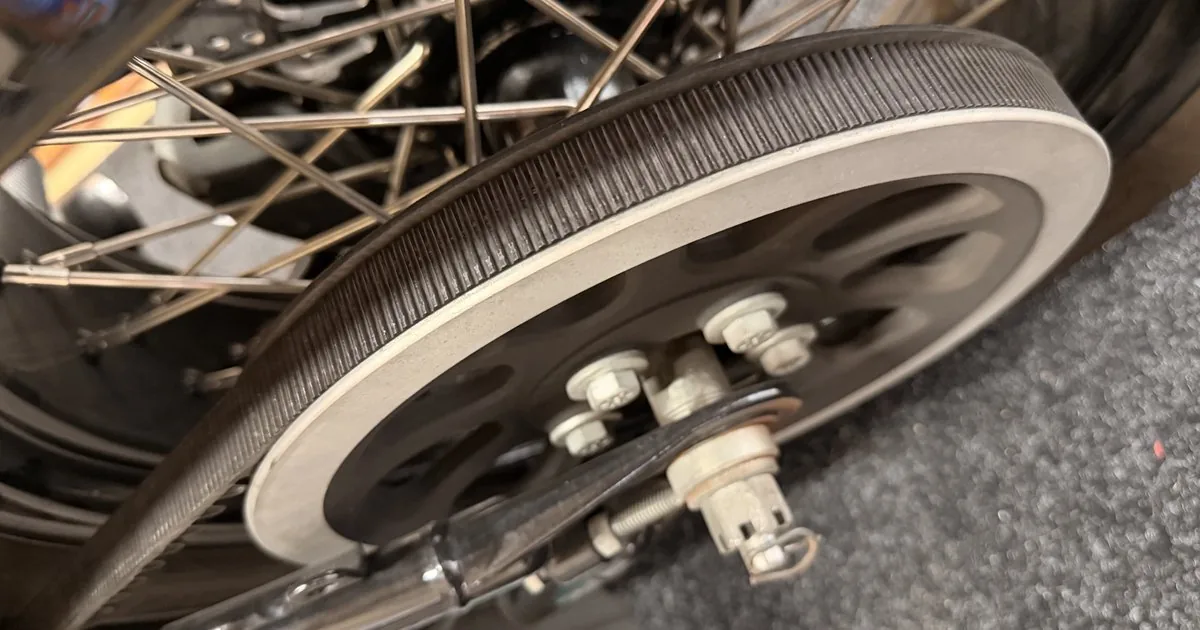
I have never lubed a motorcycle chain in my life. Don’t be impressed. The bike made that decision for me. My 2007 Night Train came with a belt out back, like every Harley has for a long time now, and when I bought it used I didn’t even think about it. The seller said “belt drive” and I nodded like I knew what that meant.
Thirty-two thousand miles later I know what it means. It means my rear wheel is clean. It means there’s no chain oiler, no fling on the swingarm, no stiff link to find on a Sunday morning. And it means that when the belt finally does need replacing, I’m not the guy doing it. So let’s talk about what a belt drive actually is, how it stacks up against a chain and a shaft, and what Harley says to check.
What a motorcycle belt drive actually is
Every bike needs a way to get the power from the transmission to the rear wheel. That’s the final drive. There are three ways to do it: a chain on sprockets, a belt on toothed pulleys, or a driveshaft with gears at the wheel.
A belt drive uses a wide, flat, toothed belt. The teeth lock into matching teeth on the pulleys, so it doesn’t slip like the V-belt on your truck’s alternator. Inside the rubber are tensile cords that carry the load. Early belts used aramid, and today’s are mostly carbon fiber. Gates, the company that makes a lot of them, says its newest motorcycle belt pairs an ultra-high-tensile carbon-fiber cord with an 11-millimeter tooth profile and claims up to 84 percent longer service life than the belt it replaced. That’s the manufacturer talking, so take the number for what it is. The point is the belt is built like a cable, not like a rubber band.
Harley didn’t invent the idea, but they bet the company on it. The 1980 FXB Sturgis was the first production Harley with belt drive, and Cycle World’s road test from that year reads like a list of everything I like about my bike today: no lubrication, less adjustment, a quieter driveline, less unsprung weight and a cleaner rear end. The final-drive belt on that bike was 1.5 inches wide with 126 teeth. Over the next dozen years or so the whole lineup went to belts, and the cruiser world mostly followed.
Belt drive vs chain drive motorcycle: the honest comparison
Here’s where my chain-riding friends and I go back and forth. A chain is lighter per inch, cheaper to buy, easy to re-gear and fixable with a master link in a parking lot. A belt is quieter, cleaner and needs almost nothing from you between inspections. Neither one is wrong. They’re different kinds of work.
| What matters | Chain drive | Belt drive |
|---|---|---|
| Lubrication | Yes. D.I.D says clean every 300 miles and lube every other cleaning; RK says every 300 miles for sealed chains, 200 for non-sealed | None. The belt runs dry |
| Cleaning | Wipe with a seal-safe cleaner. No kerosene, gasoline, thinner or wire brushes on a sealed chain | Rinse off road grit when you wash the bike |
| Inspection | Stretch, stiff links, rust, missing seals. D.I.D’s replacement limit is 1% stretch on a sealed chain | Cracks, missing teeth, edge damage, stone damage, tension. Harley: every 5,000 miles |
| Mess | Chain lube flings onto the wheel, swingarm and your pants | Clean |
| Noise | Audible whir, louder as it wears | Quiet. A belt that’s set wrong will chirp |
| Roadside fix | Master link and a chain tool can get you home | No master link. A broken belt is a tow |
| Changing gearing | Easy. Swap a sprocket | Hard. Pulley size is tied to belt length and swingarm clearance |
| Replacement job | Chain and sprockets, no major disassembly | On a Softail the primary comes apart to get the belt on |
| Part cost | Chain and sprocket kits vary a lot by bike | Aftermarket Softail belts list at roughly $155 to $212 (Cycle Gear, J&P Cycles, Dennis Kirk, October 2026) |
Chain intervals: D.I.D Chain Maintenance and RK’s guidance as reported by Cycle Trader. Belt interval: Harley-Davidson’s 2007 Softail service table, linked below.
Notice what’s missing from that table. I didn’t put a lifespan row in it, because almost every number you’ll read for that is somebody’s guess. The pages ranking above this one say a belt lasts 60,000 to 100,000 miles and a chain lasts 30,000 to 50,000, and none of them say where that came from. What I can tell you is that the 2007 service schedule for my bike lists the belt as inspect and adjust. There’s no replacement mileage on it. And RK warranties its sealed chains for 20,000 miles of street riding, which tells you where a chain maker’s confidence sits.
Motorcyclist’s Ari Henning, who has spent more time around belts than I have, puts a properly cared-for belt at a hundred thousand miles. I’m at 32,000 on a belt I didn’t install, so I’ll let you know.
Shaft drive vs chain drive, and where the belt sits
Shaft drive is the third option. A driveshaft runs inside the swingarm to a gearbox at the rear wheel. You see it on big touring bikes and on BMW’s boxer twins. It’s the cleanest and the longest-lived of the three, and it’s also the heaviest and the most expensive to fix when it breaks. It isn’t maintenance-free either. There’s gear oil in that final drive, and the manual has a schedule for changing it.
| Chain | Belt | Shaft | |
|---|---|---|---|
| You see it on | Sportbikes, dual sports, dirt bikes, most standards | Harleys, most cruisers, a lot of electric bikes | Big tourers, BMW boxers, some adventure bikes |
| Routine work | Clean and lube every few hundred miles, adjust slack | Inspect and check tension on the service schedule | Change the final drive gear oil on the service schedule |
| Feel | Direct, a little lash | Smooth, quiet | Smooth, slight lift under throttle on older designs |
| Weight | Lightest | Light, aluminum rear pulley | Heaviest |
| When it fails | Fixable roadside | Tow | Tow, and a bigger bill |
If you’re shopping for a first bike and this is on your list, I wouldn’t let the final drive decide it. Pick the bike. The drive comes with it. I’ve got more on that in best beginner motorcycles.
Harley belt tension: how to check it
This is the one thing a belt asks of you, and it’s on the same clock as everything else. Harley’s 2007 Softail service table says to inspect the rear belt and sprockets and adjust the belt at 1,000 miles, then every 5,000. Harley flags it as a dealer job unless you’ve got the tools and the know-how. I wrote up the whole table in my motorcycle maintenance schedule post.
The check itself is simple. Bike on the jiffy stand. Push up on the bottom run of the belt, halfway between the pulleys, with 10 pounds of force, and measure how far it moves. Harley sells a belt tension gauge that applies the 10 pounds for you. Rotate the wheel and check a few spots, because belts aren’t perfectly even all the way around.
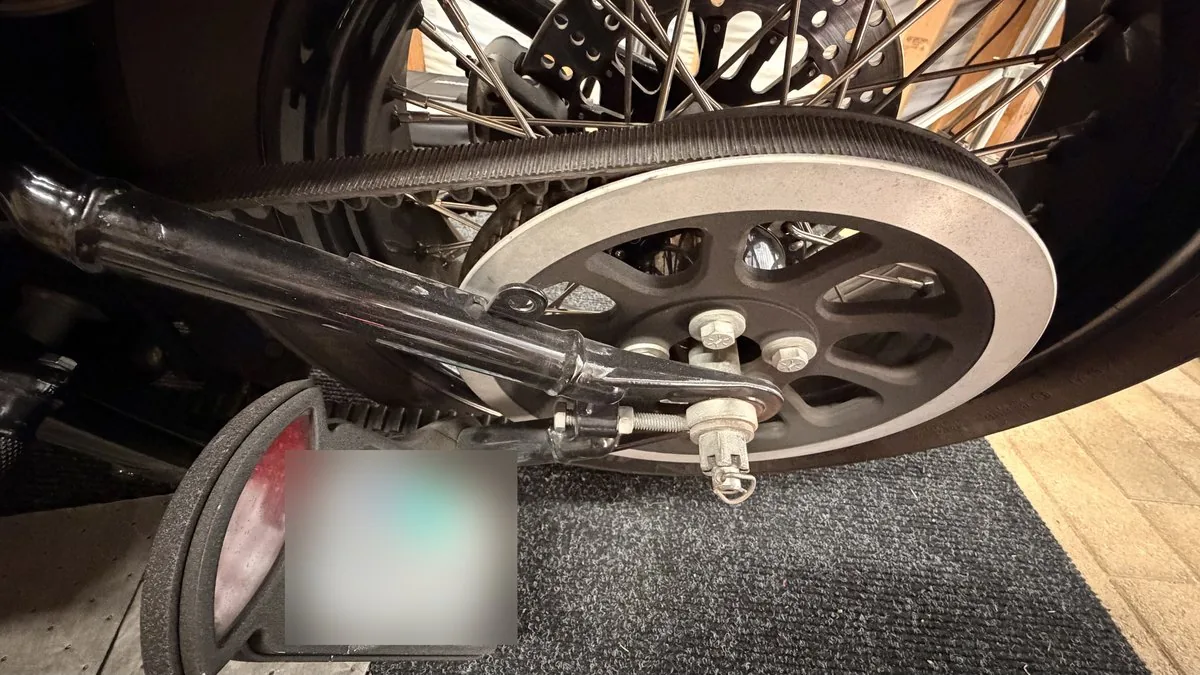
The number you’re looking for depends on your model and year, and this is where I’ll stop you from copying a spec off a blog, including mine. It changes. When Harley launched the 2018 Softails, the deflection spec printed in the owner’s manual was wrong before the bikes hit the showroom, and Harley put out a service bulletin to fix it. Here’s the corrected 2018 table, just so you can see what one looks like.
| 2018 Softail (service bulletin M1453) | Deflection at 10 lb |
|---|---|
| Belt with more than 1,000 miles | 1/2 to 9/16 in (12.7 to 14.2 mm) |
| New belt, under 1,000 miles | 3/16 to 5/16 in (4.7 to 7.9 mm) |
Two things in that bulletin are worth more than the numbers. First, a new belt gets set tighter than a broken-in one, so the spec on the sticker under your seat may not be the spec for the belt that just went on. Second, Harley says the wrong setting “does not effect belt durability or safety, but may cause increased belt noise.” If your belt chirps, tension is the first place to look.
While you’re under there, look at the belt itself. Spin the wheel and go around the whole thing, both faces.
| What you see | What Harley’s service procedure says |
|---|---|
| Hairline cracks inside the teeth | Okay to run. Keep an eye on it |
| Cracks on the outside of the teeth, or missing teeth | Replace the belt |
| Stone damage on the edge of the belt | Replace the belt |
| Stone damage with cord showing | Replace the belt |
| Stone damage anywhere | Inspect the pulleys too, and replace any that are damaged |
| Chrome pulleys | Check the plating isn’t flaking (Motorcyclist) |
Source: Harley-Davidson drive belt inspection procedure. Harley’s wording on cracks has shifted between manual versions, so follow the one for your year.
A rock is the thing that actually kills belts. It gets between the belt and the pulley, punches a hole or splits an edge, and the crack grows from there. Fraying on the edge and a nick or two in the teeth is normal wear. A crack that reaches the edge is not.
The one time my belt has come up was a safety check. I took the bike in to have the whole thing looked over, and the belt came back with one note: still good, just needed tightening. That’s the entire belt story at 32,000 miles. A tension adjustment.
Belt’s checked. Now go ride.
RideWolf is the app I’m building for whatever ride you’re doing, solo, with a group, or with riders you haven’t met yet. The first riders are testing it now. Join the early access list and you’ll hear from me when it’s ready.
Harley drive belt replacement: why it’s a bigger job than it looks
Here’s the catch with belts, and it’s been the catch since 1980. There’s no master link. A belt is one continuous loop, so to get it off the bike, something has to come out of the way. On the Sturgis it was the primary belt, and Cycle World quoted a Harley mechanic at about two hours for the job. On my Softail the inner primary has to come off and the swingarm pivot bolt has to come out before the new belt can go on. That’s why the parts are cheap and the labor isn’t.
| Harley drive belt replacement on a Softail | What’s involved |
|---|---|
| The belt | Aftermarket belts for a 2007 to 2011 Softail listed at $155 to $212 in October 2026; genuine Harley belt priced through a dealer |
| The pulleys | Harley’s procedure says if you replace the belt, replace the rear, idler and transmission sprockets with it |
| Getting in there | Seat, primary cover, inner primary, swingarm pivot bolt, final drive pulley |
| Putting it back | Primary reassembly with new gaskets, belt tension set to the new-belt spec, then rechecked after 1,000 miles |
| Shop time | Several hours. Rates vary. Get a quote from your dealer or an independent Harley shop |
This is on my mechanic’s side of the line, and I’m fine with that. The rule I use is simple: if a job could make something fail while I’m riding, a pro does it. Oil changes, electrical, clutch work, that’s me in the garage. Tires, rotors, wheels and belts go to a certified mechanic. A belt that’s tensioned wrong or a pulley that’s misaligned eats itself slowly, and I’d rather pay for the alignment than learn about it at 70 on the freeway.
Living with a belt
Day to day, a belt is the part of the bike I think about least. I check tire pressure before every ride. I check the brakes. I look at the oil. The belt gets a glance when I’m washing the bike and a real look at service time. That’s it. No lube can, no rag, no 300-mile reminder in my head.
A few habits that matter:
- Keep gravel out of it. Dirt roads and construction zones are where belts pick up rocks. Slow down and stay out of the loose stuff when you can.
- Don’t pressure-wash the pulleys. Rinse, don’t blast. The bearings behind them don’t like it.
- Listen. A belt is quiet. The day it isn’t, check tension and look for damage.
- Know your spec. It’s in your owner’s manual, and for a new belt it’s different for the first 1,000 miles.
And if you ride a chain bike, none of this makes your bike worse. Different tools in the bag.
Belt drive FAQ
How long does a motorcycle belt drive last?
Longer than most riders keep the bike. Harley publishes an inspection interval, every 5,000 miles on a 2007 Softail, and no replacement mileage. Motorcyclist’s Ari Henning puts a well-cared-for belt at around 100,000 miles. Rock damage, not mileage, is what usually ends a belt early.
Is a belt drive better than a chain drive?
For a cruiser or commuter, usually yes. No lube or mess, it runs quiet, and the routine work is an inspection every few thousand miles. A chain is lighter, cheaper, easy to re-gear and fixable on the roadside with a master link. Sportbikes and dirt bikes stay with chains for those reasons. Neither is wrong. Pick the bike you want and the drive comes with it.
Do belt drive motorcycles need lubrication?
No. A drive belt runs dry and should stay dry. Don’t spray chain lube, silicone or dressing on it. Rinse road grit off when you wash the bike, let it dry and leave it alone. The only maintenance is inspection and tension on your service schedule.
How often should I check Harley belt tension?
Harley’s 2007 Softail table says inspect the belt and sprockets and adjust the belt at 1,000 miles, then every 5,000. Measure deflection with 10 pounds of force at the middle of the bottom run with the bike on the jiffy stand, and use the spec for your model and year. A new belt uses a tighter spec for its first 1,000 miles.
What happens if a motorcycle drive belt breaks?
The rear wheel stops getting power and you coast to a stop. There’s no master link, so you can’t splice it on the roadside. The bike gets towed, and because the belt is a closed loop, the primary comes apart to fit the new one. Belts rarely snap without warning; a cracked edge or missing teeth show up first.
Why does my Harley drive belt squeal or chirp?
Tension is the usual cause. Harley’s 2018 Softail service bulletin says an incorrect deflection setting doesn’t hurt durability or safety but can increase belt noise. Check deflection against the spec for your model, look for debris in the pulley teeth, and make sure the rear wheel is aligned evenly on both sides.
I spent a long time thinking a belt was just the thing Harleys came with. It turns out it’s one of the reasons I get to spend my garage time on the fun stuff. Check it when the manual says to, keep rocks out of it, and let a pro swap it when the day comes.
Thank you guys for reading. Put that first foot forward and just do it. Peace.