

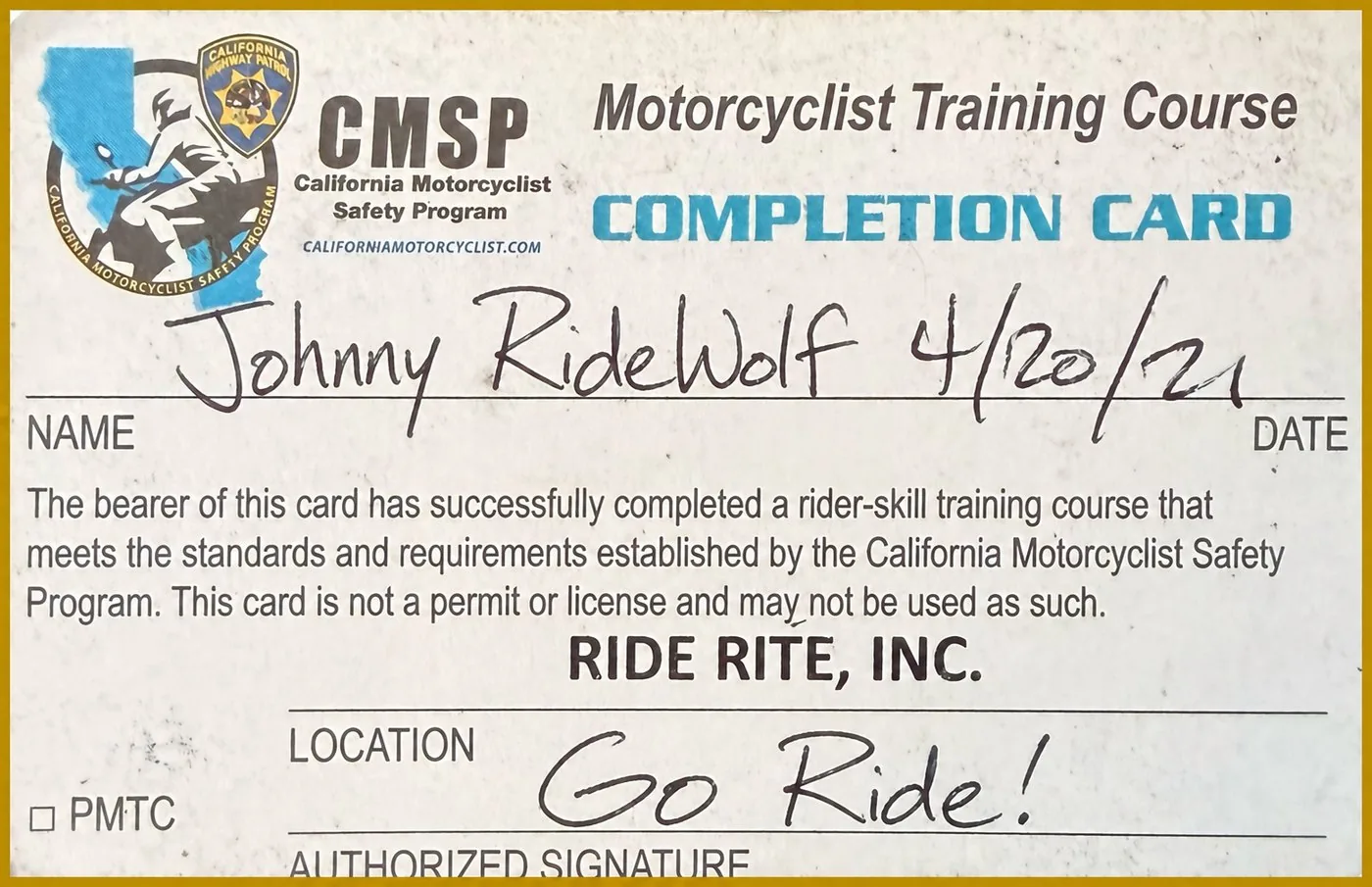
I had my motorcycle license two years before I owned a motorcycle. Two years. I’d wanted to ride since I was thirteen, I finally decided at fifty that I was going to do it, and the very first thing I did was get legal. Not the bike. Not the gear. The license. I wanted to be prepared, so I took the safety course, a three-day thing, and passed it. They hand you a certificate at the end that exempts you from the riding part at the DMV, so all I had to do there was the written test. Made the appointment online, went in, took it on one of their computers. Quick and easy. I did everything I was supposed to do. And then the card sat in my wallet while I kept telling myself it wasn’t the right time.
So I know this process from the seat of somebody who was nervous about it, and I also know what it looks like from the other side. It’s not hard. It’s a weekend and a DMV appointment. The hard part is everything that comes after, and I’ll get to that at the end.
Here’s the whole thing laid out, with the California version in detail because that’s where I ride, and a table of how it changes in other states because the rules genuinely do change once you cross a border.
Do you need a motorcycle license?
Yes. Every state requires either a separate motorcycle license or a motorcycle endorsement on your regular driver’s license before you ride a two-wheeler on a public road. A permit lets you practice with restrictions. It does not let you ride like a licensed rider, and in most states it expires if you never finish the job.
I’ll be honest about why this one matters to me beyond the ticket. When I finally decided to ride, I went digging in the crash numbers, because everybody I knew had told me I was going to die. And what I kept finding was that a huge share of the people in those numbers had no license, no helmet, or had been drinking. NHTSA’s 2023 motorcycle report puts a figure on the first one: 34% of riders in fatal crashes in 2023 were riding without a valid motorcycle license, against 15% of car and light-truck drivers without a valid license. That’s not the license itself saving anyone. It’s what the license stands for: somebody sat in a class, somebody rode the figure-eight in a parking lot, somebody was told what a decreasing-radius turn does to you before they found out on a canyon road. The guys skipping that step are overrepresented in the worst column there is. I wasn’t going to be one of them.
What class is a motorcycle license?
Depends on the state, and this trips people up. Some states give you a motorcycle endorsement, a letter added to your existing driver’s license. Others issue a separate motorcycle class. California does the class thing, and it has two of them. Per the DMV’s motorcycle license page, a Class M1 lets you ride any two-wheeled motorcycle plus everything under M2, and a Class M2 covers a motorized bicycle, moped, or any bicycle with a motor attached. If you want to ride an actual motorcycle, you want the M1. Nobody I ride with has an M2.
And some things you’d assume need a motorcycle license don’t. So here’s what the DMV’s motorcycles, mopeds and scooters page actually says you need for each one in California.
| What you want to ride | License you need in California | Notes |
|---|---|---|
| Two-wheeled motorcycle (any size) | Class M1 | The one almost everybody reading this needs |
| Moped / motorized bicycle | Class M1 or M2 | “A moped has 2–3 wheels… less than 4 gross brake horsepower” |
| Three-wheel motorcycle, or a bike with a sidecar | Class C (a regular driver’s license) | “Motorcycles with 3 wheels or a side car require only a Class C driver’s license” |
| Motorized scooter (stand-up, with a floorboard) | Any class of driver’s license | Still needs a helmet, still not for the freeway |
That three-wheel line surprises a lot of people. My father-in-law is 74 and still rides his shovelhead to Big Bear, and if he ever went to a trike he wouldn’t need to touch his license at all. Check your own state before you count on that, because a Slingshot or a Can-Am is a “motorcycle” in some places and an “autocycle” in others.
How to get a motorcycle license: the two paths
Almost every state gives you two roads to the same card. You can take a state-approved rider course and use the completion certificate to skip the DMV riding test, or you can practice on your own permit and ride the DMV’s skills test on your own bike. RevZilla’s guide frames it the same way and so does every DMV page I read for this. So here’s the honest comparison.
| Path 1: The safety course | Path 2: The DMV skills test | |
|---|---|---|
| What you do | Classroom (in person or online) plus two days on a range with an instructor | Practice on a permit, then ride a set course at the DMV: pre-trip check, slow riding, gear shifting, set track paths |
| Bike | Provided, small and light, usually with a helmet | Yours. You bring it, and you bring proof of insurance |
| Time | About 15 hours over a weekend in California | However long your practice takes, plus one appointment |
| What it waives | The riding test. You still take the written knowledge test at the DMV | Nothing. You take both tests |
| Cost in California | Up to about $425 for the course, plus the $46 DMV fee | The $46 DMV fee, and a small retest fee if you fail |
| Required? | Yes if you’re under 21 in California. Yes for everyone in Texas and Florida | Only if you skip the course and you’re old enough |
I took the course. Mine was through Ride Rite in April 2021, spread over three days, and the completion card they handed me at the end meant I never rode a DMV test course at all; the only thing I did at the DMV was the written part. I’d ridden a dirt bike in the woods at nineteen, so I wasn’t starting from zero, but a 125 on a trail and a 600-pound Harley on Ventura Boulevard are two different sports, and I wanted somebody who does this for a living to watch me ride before the state did. I wrote about what that day is actually like in how to ride a motorcycle. Short version: they put you on a bike that’s easy to pick up, they teach you the clutch in a parking lot, and by Sunday afternoon you’re doing the same figure-eights and quick stops the DMV would test you on, except with a coach standing there.
How to get a motorcycle license in California, step by step
This is the exact order, pulled from the DMV’s own page and the permit page. If you already have a California driver’s license, you’re adding the M1 to it. If you don’t, you can still get a motorcycle-only license, you’ll just show more paperwork.
- Read the handbook. The knowledge test is built from the California Motorcycle Handbook, the passing score is 80%, and the DMV says it won’t start a knowledge test within 30 minutes of closing. Go early.
- Fill out the application. The Driver’s License/ID application, online or at the office. The fee is $46 and it covers you for 12 months and three attempts at each test.
- Bring your documents. Social security number, an identity document with your current name on it, your California license if you have one, and proof of residency if you’ve never held a California DL or ID. If you want the card to be a REAL ID, bring the REAL ID set.
- At the office: vision test, fingerprint, photo, and the knowledge test. Three attempts. Fail three times and the application is dead and you start over with a new fee. My version of this step: booked the appointment online, walked in, took the test on one of their computers, walked out. The whole visit was shorter than the line I was dreading.
- Get the permit if you need it. Under 21, this is mandatory, and you hold it for six months. Over 21, it’s optional, but it’s the only legal way to practice on your own bike before the skills test. More on the permit rules below.
- Take the course, or take the test. The course is the California Motorcyclist Safety Program. Finish it and you get a DL 389 certificate that waives the DMV riding test for 12 months. That’s the paper I walked in with. Skip the course and you schedule a motorcycle driving test instead, by appointment, on your own bike, with proof of insurance in your pocket.
- Walk out with a temporary license. It’s good for 60 days while the real card comes in the mail.
Under 21 vs. 21 and over
This is the fork that decides how long the whole thing takes. Everything below is the DMV’s wording, not mine.
| Under 21 | 21 and over | |
|---|---|---|
| Permit | Required. Hold it for at least six months before the license | Not required. You can go straight to the license |
| Safety course | Mandatory. The CMSP course and DL 389 are required before the DMV will even issue the permit (ages 15½ to 21) | Optional. Take the course and waive the riding test, or take the DMV driving test instead |
| Minimum age | 15½ for the permit. Under 18 also needs driver ed and driver training certificates, and a parent’s signature | 21 |
| Fastest realistic timeline | About seven months (course, permit, six-month hold, license) | A couple of weeks: one weekend course, one DMV visit |
Motorcycle permit rules in California
People ask about the permit more than anything else, and the rules aren’t DMV policy, they’re state law. Vehicle Code 12509.5 says a rider on a motorcycle instruction permit “shall not operate… during the hours of darkness, shall stay off any freeways that have full control of access and have no crossings at grade, and shall not carry any passenger” other than a licensed instructor. Three rules. No night. No freeway. No passenger. The same section says the permit is valid for up to 24 months.
Which means if you’re on a permit in Los Angeles, the 101 is off limits, the 405 is off limits, the PCH is fine, and the Sunday ride has to be a daytime ride. I can tell you from experience that this is not a hardship. Daytime surface streets are where you want to be learning anyway.
How much does a motorcycle license cost?
Less than a tank of gas for the DMV part. The course is where the real money goes, and it’s still cheaper than a decent helmet. Here’s the California bill, from the DMV fee schedule and a CMSP training provider’s current pricing.
| Item | Cost | Notes |
|---|---|---|
| DMV application: original M1/M2, or adding M1/M2 to a Class C | $46 | Covers 12 months and three attempts at each test |
| Riding test retake | $9 | The DMV fee page says $9; its motorcycle page still says $7. Either way, cheap |
| CMSP Motorcyclist Training Course, age 21+ | up to $425 | 15 hours, bike and helmet provided, DL 389 waiver at the end |
| CMSP course, age 20 and under | up to $395 | Mandatory at this age, so it’s part of the price of the license |
| Replacement card if you lose it | $37 | Don’t lose it |
| Total, test route (21+) | about $46–$55 | You supply the bike and the insurance |
| Total, course route | about $440–$470 | What I paid, give or take, and what I’d pay again |
One thing that’s easy to miss: the course fee buys you the bike. If you’re doing the DMV test route, you need a motorcycle to test on, which means you already bought one, insured it, and figured out how to get it to the DMV legally on a permit. When I added it up, the course was cheaper than the other path once you count what the other path assumes you already own. And if you’re looking at the bigger number, the bike, the gear, the insurance, that’s all in how much a motorcycle actually costs.
How long does it take to get a motorcycle license?
If you’re 21 or over in California and you take the course: about two weeks, and most of that is waiting for a course date. The course itself is one weekend. The DMV visit is one morning if you book the appointment. The DL 389 is good for 12 months, so there’s no rush between the two.
If you’re under 21, the floor is six months on the permit, so call it seven months from your first class to the card. Other states have their own clocks, and this is where the rules really scatter. Virginia makes adults hold the permit 30 days and minors nine months. New York and Arizona make under-18s wait six months. So the honest answer is “a weekend, unless you’re young, in which case a season.”
How it changes in other states
I pulled this straight from each state’s own DMV or DPS page, because the SERP for this question is full of law-firm blogs quoting each other. Six states, the ones most of you are searching from.
| State | Course required? | Permit holding period | Course waives the riding test? | Certificate good for |
|---|---|---|---|---|
| California | Under 21 only | 6 months if under 21; none if 21+ | Yes (DL 389) | 12 months |
| Arizona | No | 6 months if under 18 | Yes (MSF card) | Not stated |
| Texas | Yes, everyone | None | Yes for adults with a full Class A/B/C; minors 15–17 still test | 24 months |
| Florida | Yes, everyone (Basic RiderCourse) | None | The course is the test | 1 year |
| New York | No | 6 months if under 18; permit riders must stay within ¼ mile of a licensed supervisor age 21+ | Yes, within 2 years of the course | 2 years |
| Virginia | No | 30 days if 18+; 9 months if under 18 | Yes, and it waives the knowledge exam too | 1 year |
Two takeaways. First, if you’re in Texas or Florida, the “should I take the course” question is already answered for you. Second, a lot of states let one weekend course replace the DMV riding test, and Virginia will even let it replace the written one. The course is the shortcut almost everywhere, and it’s the one shortcut in motorcycling that makes you safer instead of less safe.
What the safety course actually is
In California it’s the California Motorcyclist Safety Program, run by the Highway Patrol through a contractor. Their page says the Motorcyclist Training Course “is a 15 hour course which includes 5 hours of classroom instruction and 10 hours of actual riding,” it’s mandatory under 21, and more than 1.5 million riders have gone through it since 1987. There’s also a longer Premier Program with 7.5 hours of classroom and 13.5 on the bike if you want more seat time before you’re on your own.
Outside California, the course most states approve is the Motorcycle Safety Foundation’s Basic RiderCourse: about five hours of learning, often online, then ten hours on a motorcycle over two days. Same shape, same figure-eights, same little bikes. Whichever one you take, you show up in a helmet (or borrow one), long pants, over-the-ankle boots, and gloves, which is the same list I laid out in motorcycle gear for beginners. They will not let you on the range without it, and that’s the first lesson before you’ve turned a key.
And this is the part I’d say to anybody who “already knows how to ride” and wants to skip it. I knew how to ride, sort of. A bike in the woods at nineteen. The course still taught me things I’d never done, like a real quick stop from speed and a swerve around an obstacle without touching the brake. A parking lot with a coach is where you find out what you don’t know. A canyon is a bad place to find that out. If you want the full argument for why I ride the way I ride, it’s in are motorcycles dangerous, and the short version is: I’m careful because I have a six-year-old who expects me home.
The DMV skills test, if you go that way
The DMV’s description of the motorcycle driving test is short: “a pre-trip inspection, riding in different track paths, slow riding, and gear shifting.” It’s low speed, it’s in a lot, and the things that fail people are the things that fail people in the course too: putting a foot down in the slow box, running wide in the U-turn, stalling on the start. You get three attempts on your $46, on separate days, and after three fails you reapply.
Bring the bike you’ll actually ride, insured, on a valid permit, in daylight, with no passenger, and get there without a freeway. If that sentence just made you realize you’d have to trailer the bike to the DMV, that’s another quiet argument for the course. I never rode this test. The certificate from the course was my whole riding exam, and I’m fine with that.
Also, and I say this with love for the fine people at the Department of Motor Vehicles: the DMV waiting room is the only place in California where you can see every kind of rider at once and not one of them is smiling. Book the appointment.
The license is the easy part
Here’s what I’d tell my fifty-year-old self, license in hand, bike nowhere in sight. The card is a weekend. The two years I sat on it were the real problem, and it wasn’t the DMV that cost me those years. It was that I didn’t know a single person who rode. No one to ask which bike, no one to follow on a Sunday, no one to text “is this normal?” when the thing wouldn’t start. My buddy Leo ended up riding my Night Train home from the seller because I wasn’t comfortable doing it myself, and I’d had a license for two years at that point. Two years.
So get the license. Do it this month, do it the careful way, and then don’t do what I did. Find people. The whole reason RideWolf exists is that gap between the card in your wallet and the first real ride with a crew, and there are group rides mapped near you for the day you’re ready.
Got the license? Now find the crew.
RideWolf is a free iOS app for finding and joining group rides near you. It’s in early access, and the waitlist is where you get in first.
Motorcycle license questions, asked and answered
How old do you have to be to get a motorcycle license?
In California you can apply for a motorcycle instruction permit at 15½, and you must hold it six months before the license, so 16 is the earliest for the M1. Under 18 also needs driver education and training certificates and a parent’s signature. Other states set their own floors: Arizona issues a permit at 15 and a half, New York at 16.
Can you get a motorcycle license at 16?
Yes, in California and most states. In California a 16-year-old needs the six-month permit behind them, the CMSP safety course certificate, driver ed and training, and a parent’s signature on the application. Texas restricts riders under 16 to 250cc or smaller. Virginia makes anyone under 18 hold the permit nine months.
Do you need a motorcycle license for a moped, scooter, or trike?
In California a moped needs an M1 or M2, a stand-up motorized scooter can be ridden on any class of driver’s license, and a three-wheel motorcycle or a bike with a sidecar needs only a regular Class C license. Three-wheelers like the Slingshot are classed differently from state to state, so check your own DMV.
Do I need a regular driver’s license before a motorcycle license?
Not in California. You can apply for a motorcycle-only M1 with no other license, though the DMV may add an observation test and you’ll need the full identity and residency paperwork. Some states do require a regular license first: Florida wants a Class E, and Texas only waives the riding test for adults holding a full Class A, B, or C.
What happens if I fail the motorcycle test?
In California your $46 application buys three attempts at the knowledge test and three at the riding test. A failed riding test means a new appointment on another day and a retest fee of about ten dollars. Fail either one three times and the application is void, so you pay the fee again and start over. Most people who fail the riding test go take the course.
Is the safety course worth it if I already know how to ride?
Yes. It replaces the DMV riding test in most states, it supplies the bike and usually the helmet, and it drills the quick stop and the swerve that riders who taught themselves almost never practice. I’d ridden a dirt bike years before I took it and still learned things on that range I use every Sunday.
That’s the whole process. A book, a test, a weekend, a card. If it’s been sitting on your list for years the way it sat on mine, the only thing between you and a motorcycle license is one DMV appointment and a Saturday morning in a parking lot.
Book it. Put that first foot forward and just do it. Peace.