


I waited thirty years to ride. When I finally did it, I did it the careful way: license two years before I ever bought a bike, the safety course, the whole checklist. And the gear was the part I went down the rabbit hole on hardest, because the gear is the part of this you actually get to control.
The bike can break. The guy in the Camry can turn left in front of you. The weather can do whatever it wants. What you put on your body before you throw a leg over is the one decision that’s a hundred percent yours, every single ride.
So I went and pulled the actual numbers, the standards, the labels, the stuff nobody explains at the counter. Here’s what I found, and what I’d buy first if I were starting over.
What gear do you actually need to ride a motorcycle?
Five things. A helmet, a jacket, pants, gloves, and boots. The Motorcycle Safety Foundation’s own protective gear sheet draws the same picture: a DOT helmet, face protection, a sturdy jacket and pants that resist abrasion, full-fingered gloves that fit, and sturdy boots that come up over the ankle. Everything else, the airbag vest, the heated liners, the fancy comms, is a layer on top of those five.
| Piece | What it’s protecting | What to look for | Sane starting price |
|---|---|---|---|
| Helmet (full-face) | Your brain, your face, your jaw | DOT label on the back (the law); ECE 22.06 or Snell on top is a bonus | $150–$300 |
| Jacket | Shoulders, elbows, back, the skin on your arms | CE rating AA or better, Level 2 armor in the shoulders and elbows, add a back protector | ~$200 |
| Pants or riding jeans | Hips, knees, the skin on your legs | CE rating AA, knee and hip armor included, not “pockets for armor sold separately” | $100–$150 |
| Gloves | Palms, knuckles, wrists (the first thing that hits) | Full-finger, leather or reinforced palm, a wrist strap so they stay on | $50–$80 |
| Boots | Ankles, feet, shins | Over the ankle, oil-resistant sole, low wide heel | $80–$150 |
The prices are what I see at the big retailers for entry-level gear with real ratings on it. RevZilla’s own beginner guide calls a $300 helmet and a $200 jacket the baseline, which matches what I priced out when I added up what a motorcycle actually costs. Call it $600 to $900 for the full set, and closer to $800 if you don’t buy the cheapest of everything. I’ll be straight with you: I spent more than that table says on my helmet and my vest, and I’ll tell you why in a minute. That was a choice, not a requirement.
Which piece of gear matters most?
The helmet. Nobody argues that one. NHTSA puts helmets at 37% effective at preventing rider deaths, 41% for passengers, and estimates they saved 1,872 lives in one year with another 749 who’d have lived if everyone had worn one. For every hundred riders killed without a helmet, thirty-seven of them would have made it home.
But here’s where it got interesting for me. Apart from helmets, almost nobody had measured what the rest of the gear is worth until an Australian team interviewed 212 riders who’d actually crashed and compared what they were wearing to whether they ended up in a hospital bed. So here’s what the numbers say.
| What the rider was wearing | Chance of being hospitalized | Chance of injury to that body part |
|---|---|---|
| Motorcycle jacket | 21% lower | Upper body 23% lower with fitted armor |
| Motorcycle pants | 51% lower | Legs 40% lower with fitted armor |
| Motorcycle gloves | 59% lower | Hands and wrists 45% lower with armor |
| Boots (even non-motorcycle boots vs. sneakers) | — | Feet and ankles 54% lower |
Source: de Rome et al., 2011. One honest note: 212 riders is a real study but not a huge one, and it was done in Australia, so treat the percentages as the shape of the truth rather than gospel. But look at the shape. The jacket, the thing everybody buys second, is the weakest of the four. The gloves and the pants, the two things everybody skips “for now,” cut your odds of a hospital stay in half or better.
That study found one more thing I can’t stop thinking about. Between a quarter and a third of the motorcycle-specific jackets, pants and gloves those riders were wearing failed in the crash. Tore open, burst a seam, wore through. Gear that was sold as motorcycle gear. That’s the whole reason the labels in the next two sections exist.
How do you pick a helmet that’s actually legal and actually safe?
Start with the law, because it’s simpler than people make it. Every helmet sold for road use in the United States has to meet Federal Motor Vehicle Safety Standard 218, and NHTSA’s own 2023 motorcycle report says it plainly: make sure your helmet has a valid DOT label, because novelty helmets without one “will not provide the best protection needed in a crash.” That same report is where the ugly number lives: in states without a universal helmet law, 51% of the riders killed in 2023 weren’t wearing one. In states with the law, 10%.
Here in California the law is Vehicle Code 27803, and I like how it’s written, because it accidentally gives you the fit test. Wearing a helmet, legally, means it’s on your head, fastened with the straps, and “of a size that fits the wearing person’s head securely without excessive lateral or vertical movement.” Buckle it, grab it with both hands, try to rotate it and rock it. If your skin moves with it, it fits. If the helmet moves and your head doesn’t, it’s the wrong size, no matter how comfortable it felt in the store.
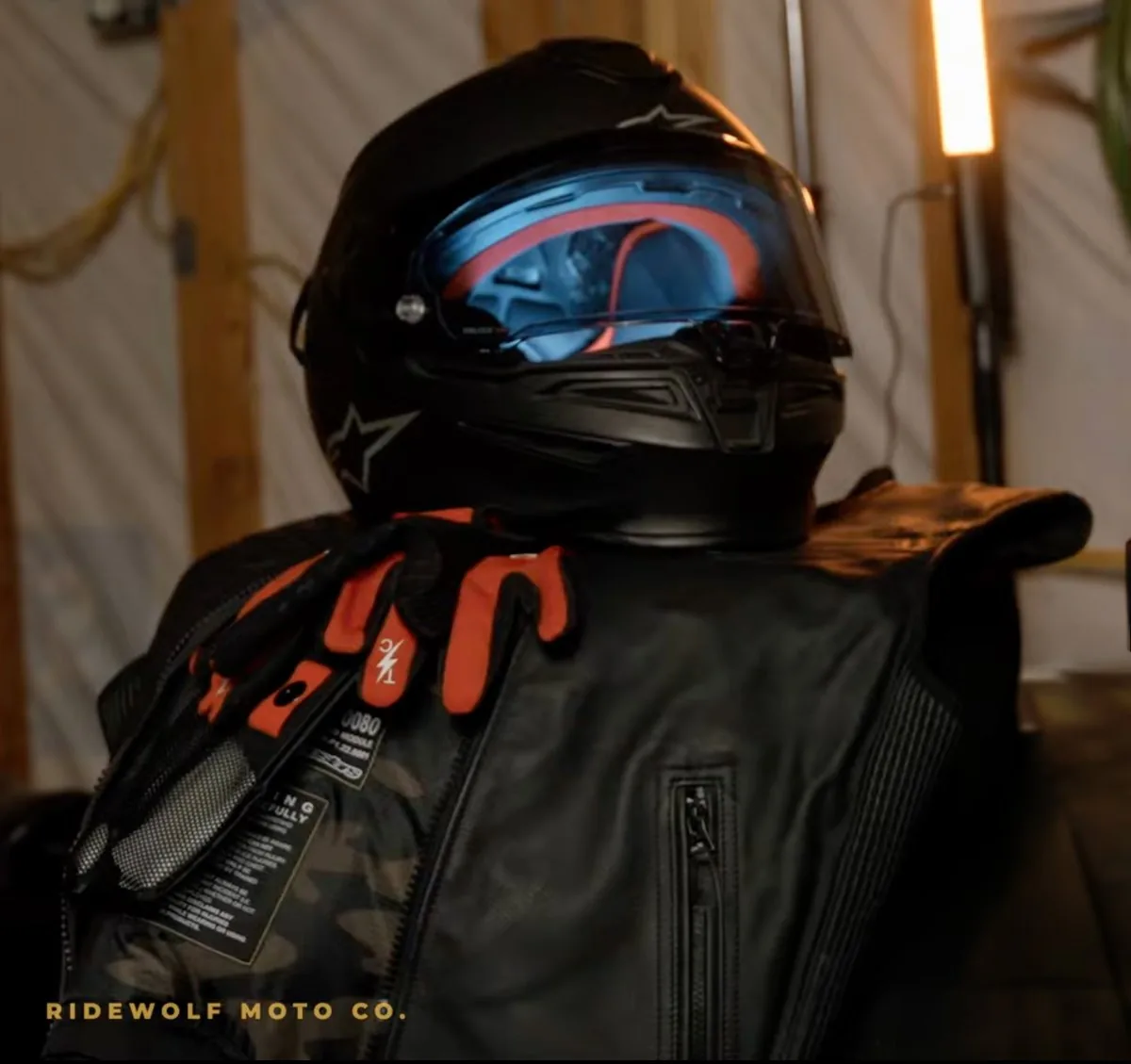
And “comfortable in the store” is a trap I walked right into. My first helmet was a cheaper one from Cycle Gear. Felt fine at the counter. I got it home, wore it around the house, and the top of the shell was pressing down on my head hard enough to give me a headache. That’s not a break-in problem. That’s a shape problem, and no amount of riding fixes it. So I took it back, and one of the sales guys there, who was really cool about it, spent real time with me trying on shells until we found the one that actually fit my head. I ended up in the Alpinestars S-R7. It’s certified to both DOT and ECE 22.06, it has what Alpinestars calls the A-Head system, a micro-adjustable pad inside that lets you fine-tune the height and the angle the helmet sits on your head, and it’s got two of their Plasma inserts in the liner for shock absorption. I wanted the latest technology I could get on my head and I did not want to skimp on this piece. Full retail is about $680, which is more than double the top of that price table. You don’t need to spend that. You do need to go back to the counter if the first one gives you a headache.
One more thing on that helmet, since people ask: I run Alpinestars’ A-Connect system inside it, so I’ve got music, phone, and the crew in my ear over mesh the whole ride. If you ride with a group, that’s the next purchase after the gear, and I compared the options in the best communication systems for group rides.
How to spot a fake in about ten seconds
Those beanie-style “novelty” helmets with a DOT sticker slapped on are a real problem, and the Army’s safety center reprinted NHTSA’s checklist for telling them apart. A real one has an inner liner of firm polystyrene foam about an inch thick. It weighs about three pounds; the fakes weigh a pound or less. It has a sturdy chinstrap with solid rivets. And nothing can stick out more than two-tenths of an inch from the shell, so if it’s got spikes, it’s a costume.
| Label | Who’s behind it | What it means for you |
|---|---|---|
| DOT (FMVSS 218) | US federal standard | The legal minimum. Label on the back. Non-negotiable. |
| ECE 22.06 | UN regulation, used across Europe | Newer test (in force since 2023) that adds an angled impact to measure how much the helmet spins your head, plus more impact points on the shell. A good sign on any helmet. |
| Snell (M2020 and later) | Non-profit foundation, voluntary | Tougher lab test, mostly seen on sport and track helmets. Snell says its US helmets “cannot be any harder than DOT allows.” |
Full-face, for what it’s worth, is the whole face. The MSF’s gear sheet cites the Hurt Report finding that riders with shields over their faces had fewer facial injuries, and that full-coverage helmets with strong chin pieces were “especially effective in reducing face injuries.” Your chin is not optional. I ride in a full-face every single ride, and nobody has ever looked cool putting one on in a parking lot. Nobody. I’ve checked.
When do you replace a helmet?
Two answers, one from a crash and one from a calendar. The MSF is direct about the first: the shell and the liner spread the force of one impact through the material, so “if a helmet has been damaged in a crash, it will not be protective in another mishap and should be replaced.” The five-year rule is softer than people think. The Snell Foundation’s own FAQ says an unused helmet stored well doesn’t automatically expire at five years; the rule is a judgment call based on how the pads and foam liner wear down from simply putting the thing on and taking it off. And if you drop it off the seat onto the driveway? Snell’s answer is “probably not.” The real damage comes when the helmet hits something with a head inside it.
What do the CE labels on a jacket and pants mean?
This is the part I wish somebody had explained to me at the counter, because it’s two different labels and the tag never tells you which is which.
The first label rates the garment: how well the fabric survives a slide. The European standard is called EN 17092, and per SATRA, the lab that tests to it, the abrasion test simulates a 165-pound rider sliding from speed to a stop on a real concrete surface. Garments get a class, and the class tells you what’s inside too.
| Class | Abrasion protection | Armor required | Who it’s for |
|---|---|---|---|
| AAA | Highest | Shoulders, elbows, knees, hips | Track and fast road riding; heavier and hotter |
| AA | High | Shoulders, elbows, knees, hips | The sensible middle for most street riders |
| A | Minimum for a protective garment | Shoulders, elbows, knees (hips optional) | Urban, low-speed, hot weather |
| B | Same as A | None | Abrasion only, usually a base layer or jeans |
| C | None | Only where the armor sits | A harness that holds armor under something else |
The second label rates the armor: the pads in the shoulders, elbows, hips and knees. That standard is EN 1621, and it works by dropping a weight on the pad and measuring how much force gets through to the fake bone underneath. Less force through, better pad. SATRA’s summary puts Level 1 limb armor at under 35 kilonewtons transmitted on average; Level 2 has to get that under 20. Back protectors have their own scale: Level 1 under 18, Level 2 under 9. So “Level 2” on the tag means the pad passes through roughly half the force of a Level 1 pad. Same size pocket, half the hit.
What that means for a first jacket: class AA, Level 2 in the shoulders and elbows, and check whether the back protector is actually in there or if it’s a square of foam with a suggestion to buy the real one separately. It’s usually the foam. Budget for the real one.
Gloves and boots: the cheap stuff that does the most
Go back to that Australian table. Gloves cut the odds of a hospital stay by 59%, and they’re the cheapest thing on the list. There’s a reason: your hands go out first. Every human being who has ever fallen has put their hands out. On pavement at thirty miles an hour, bare palms are gone in a second.
The MSF wants them full-fingered, and fitted: too loose and you’re fumbling the controls, too tight and your hands go cold. A gauntlet that goes over the sleeve keeps wind out of your jacket, and a strap at the wrist keeps the glove on your hand when it matters, because a glove that slides off on the first bounce did nothing for you.
Full disclosure on my own hands, because I’d rather tell you than have you spot it in a photo. Most days I ride in Thrashin’s Stealth gloves in red, because all my gear is black and the red on the bars just looks right to me. They’re 38 bucks, one-piece reinforced palm, Velcro cuff, touchscreen fingertips. No armor, no CE label. My colder-weather pair is black leather, and if I take that Australian table at its word, the leather pair should probably be the everyday pair. That’s the kind of trade every rider makes somewhere. Just know you’re making it.
Boots are the same story. Sturdy, over the ankle, oil-resistant sole so your foot doesn’t skate off the peg, and a heel that’s low and wide so it doesn’t hang up. The de Rome study found that even regular boots beat sneakers on foot and ankle injuries by more than half. Real motorcycle boots with ankle armor and a stiff sole do better than that. But if it’s a choice between good boots and no boots this month, buy the boots that cover your ankle and upgrade later.
Do beginners need an airbag vest?
No. I’ll say that first, because I wear one and I don’t want you to think you can’t ride without it. The five pieces above come first. But once you’ve got them, this is the upgrade I’d point you at before any of the fun stuff.
The racing world settled this argument years ago. From the 2018 season, the FIM made airbag suits compulsory in every MotoGP class, covering at least the shoulders and collarbone, and triggering without any tether to the bike. The street versions are the same technology wearing a vest. Sensors watch how your body is moving, an algorithm decides you’re crashing, and the vest inflates around your chest, back and shoulders before you land. The European standard for them, EN 1621-4, even tests how fast they inflate with a camera running at 200 frames a second. Alpinestars claims its top system cuts impact force by up to 95% compared to a normal back protector. That’s a manufacturer’s number, so take it as a manufacturer’s number, but the direction is not in dispute.
Here’s my version. For two years before I bought the bike, I knew I wanted an airbag vest. Safety is the thing that held me back from riding for most of my life, so when I finally decided to do it, I decided to do it with the vest, and that was that. The problem was they were all kind of ugly. Every one of them looked like a piece of equipment. Then Alpinestars put out the Tech-Air 3 V2 in leather and I knew that was the one, because it looks like a regular biker vest and you still get the airbag: full chest and full back coverage, six sensors inside, no tether to the bike. Between the helmet and the vest it was a real investment. But you can’t put a price on your head and your spine.
Two things nobody tells you about actually living with it. It gets hot on warm days. Leather over an airbag over a shirt in August is a lot, and there are days I think about leaving it on the hook, either because of the heat or because I want a different look that day. I put it on anyway, because in the end it’s not worth it. And I actually bought the canvas version first, then took it back for the leather because I liked the look better. Now, in the heat, I’m starting to wonder if that was the right call, because the canvas one breathed a lot better. If you run hot, that’s your answer.
Be seen: the upgrade that costs nothing
One more data point that surprised me, and it’s about colour. A New Zealand study of 463 crashed riders against 1,233 who weren’t found that riders wearing anything reflective or fluorescent had a 37% lower risk of a crash injury. A white helmet instead of a black one: 24% lower. Headlight on in the daytime: 27% lower. The Hurt Report found only two of its 900 crashed riders were wearing bright colours at all.
That one stung, because every piece of gear I own is black. Black helmet, black vest, black jacket, black boots. The only colour on me is the red gloves. I’m not going to pretend I’m about to ride out in a white helmet, but I’d be lying if I said I didn’t think about that number now at every intersection. If you’re standing at the counter choosing between the black helmet and the white one, that’s a 24% question, and you get to answer it before you’ve built the whole black kit like I did.
How much should a beginner spend on gear?
Here’s how I’d split the same $800 three different ways, depending on what you’ve got.
| Budget | What you get | What you’re giving up |
|---|---|---|
| ~$500 (get on the road) | DOT full-face, armored textile jacket, full-finger gloves, over-the-ankle boots. Ride in the jacket and jeans until next paycheck. | Real pants. Your legs are the gap, and the data says it’s a big one. |
| ~$800 (the sensible kit) | All five, class AA jacket and riding jeans with Level 2 armor, a real back protector. | Not much. This is the kit most of us should own. |
| ~$1,500+ (the kit I’d build again) | The $800 kit plus an ECE 22.06 helmet and an airbag vest. | Nothing that matters. |
The one thing I’d tell you not to do is spend the whole budget on the helmet and ride in a hoodie. A $600 helmet and no gloves is worse than a $200 helmet and everything else. The helmet handles one kind of crash. The other four pieces handle the crash you’re far more likely to have, which is a low-speed drop in a parking lot or a slide at an intersection where your hands, knees and hips take the hit.
What I’d buy first if I were starting over
In this order, and the order is the whole point.
- Helmet. Full-face, DOT, fits with no wobble. It’s the law and it’s the 37%.
- Gloves. Fifty bucks. Fifty-nine percent. The best money in motorcycling.
- Jacket. AA, Level 2 shoulders and elbows, then a real back protector.
- Boots. Over the ankle. Cover them before you cover anything else on your legs.
- Pants. The one everybody skips. Don’t skip it. Fifty-one percent.
- Airbag vest. When the first five are done. Not before, not never.
Look, I’m not going to pretend I got all this right on day one. I bought a helmet that gave me a headache and a vest I returned for the one that looks better and breathes worse. What I’d change is the order: I’d buy the gloves and the pants before I spent a dime on looks, because that’s what the data says, and the data didn’t care how I looked at the gas station.
And the safety course is where all of it gets road-tested for the first time. They put you in the gear before they put you on the bike, which is the right order, and I wrote about the rest of that day in how to ride a motorcycle. If you want the numbers on the risk this gear is fighting, all of them, that’s in are motorcycles dangerous.
Then find people to ride with. I know I say it every time, but the guys I ride with on Sundays are the reason I ride in the gear I ride in. Nobody in our crew skips the helmet or the gloves, and when everyone around you does it right, you do it right without thinking. That’s worth more than any label on the tag. There are rides mapped near you when you’re ready.
Find a crew that gears up
RideWolf is a free iOS app for finding and joining group rides near you. It’s in early access, and the waitlist is where you get in first.
Beginner motorcycle gear, asked and answered
What gear do I need to start riding a motorcycle?
Five pieces: a full-face helmet with a DOT label, a jacket with CE-rated armor in the shoulders and elbows, pants or riding jeans with knee and hip armor, full-finger gloves, and boots that cover the ankle. That’s the same list the MSF’s protective gear sheet draws, and everything else is a layer on top.
Is a DOT helmet enough, or do I need ECE or Snell?
DOT is the legal minimum in the US and a properly fitting DOT full-face is genuinely protective. ECE 22.06 adds an angled-impact test for rotation and more test points on the shell, so it’s a good sign on a helmet. Snell is a tougher voluntary test seen mostly on track helmets. Fit matters more than the third sticker.
How much does beginner motorcycle gear cost?
Plan on $600 to $900 for all five pieces from the big retailers, or about $800 if you don’t buy the cheapest of everything. A helmet runs $150 to $300, a real jacket about $200, riding jeans $100 to $150, gloves $50 to $80, and boots $80 to $150. An airbag vest is an upgrade on top of that.
When should you replace a motorcycle helmet?
After any crash where the helmet took a hit, because the liner absorbs one impact by crushing and can’t do it twice. The five-year rule is a judgment call based on pad and liner wear, per the Snell Foundation, and a helmet stored unused doesn’t automatically expire. Dropping it empty off the seat usually doesn’t mean replacing it.
Do I really need a CE-rated jacket?
Yes, and check both labels. The garment class (A, AA, AAA) tells you how the fabric survives a slide, and AA is the sensible middle for the street. The armor level (1 or 2) tells you how much force the pads let through, and Level 2 passes roughly half of Level 1. In one crash study, a quarter to a third of motorcycle gear failed.
Are airbag vests worth it for a new rider?
They’re the best upgrade after the five basics, not a substitute for them. MotoGP has required airbags in every class since 2018, and the street versions inflate around your chest, back and shoulders before you land. I wear one every ride. Buy the helmet, gloves, jacket, boots and pants first, then save for the vest.
Nobody gets into this because they love reading standards. I get it. But an hour on this stuff once is what lets you stop thinking about it for the next ten years of Sundays. Buy the five pieces. Buy them in the right order. Make sure the helmet doesn’t wobble.
Then put that first foot forward and just do it. Peace.