



I’ve done exactly one ride after dark. I didn’t plan it. I was coming home from a ride, it got dark, and I was still in the canyons. I did not like it.
That was my first time riding a motorcycle at night, and I learned two things about my own setup before I got home. So this post is part confession and part homework. I went and pulled what the government crash numbers say about riding at night, what a state motorcycle handbook tells you to do about it, and I asked a rider who does 50 miles in the dark before most of us are awake.
What changes when you ride a motorcycle at night
The Wisconsin Motorcyclists’ Handbook says it in one line: “At night it is harder for you to see and be seen.” Then it explains the part I felt in the canyon and couldn’t name. Your eyes use shadows and contrast to judge how far away something is and how fast it’s coming. At night those are “missing or distorted under artificial lights.”
It goes both ways. The handbook says drivers have a hard time picking your one headlight or taillight out of all the car lights around you. You’re working with less, and so is everybody looking for you.
| What changes | In daylight | After dark |
|---|---|---|
| What you can see | The whole road, the shoulder, what’s coming out of the side street | What your headlight and the cars around you light up |
| Judging distance | Shadows and contrast do the work | Harder. The handbook says to leave more room |
| Being seen | A whole bike and a rider | One headlight or one taillight in a crowd of car lights |
| Your visor | Tinted is fine | Has to be clear |
| Animals | You see them in the field | You see their eyes in your headlight, if you’re lucky |
Is riding a motorcycle at night more dangerous? What the numbers say
I don’t trust a scary number until I can see what’s inside it. So here’s the count first, and then what’s inside it.
NHTSA’s motorcycle fact sheet for 2023 breaks the year’s 6,335 motorcyclist deaths down by how light it was.
| Light condition | Share of motorcyclist deaths, 2023 |
|---|---|
| Daylight | 56% |
| Dark | 39% |
| Dusk | 4% |
| Dawn | 1% |
Most riding happens in the daytime, so most deaths happening in daylight isn’t a surprise. What stands out is the 39 percent. I can’t tell you the risk per mile, because nobody publishes how many miles riders put on after dark. But I don’t know many people who do four out of every ten miles at night.
The Insurance Institute for Highway Safety counts the same thing by the clock. These are its 2024 numbers. The share column is my math, out of the 6,175 deaths where the hour was known.
| Time of day | Motorcyclist deaths, 2024 | Share |
|---|---|---|
| Midnight to 3 a.m. | 478 | 8% |
| 3 to 6 a.m. | 261 | 4% |
| 6 to 9 a.m. | 350 | 6% |
| 9 a.m. to noon | 504 | 8% |
| Noon to 3 p.m. | 901 | 15% |
| 3 to 6 p.m. | 1,322 | 21% |
| 6 to 9 p.m. | 1,392 | 23% |
| 9 p.m. to midnight | 967 | 16% |
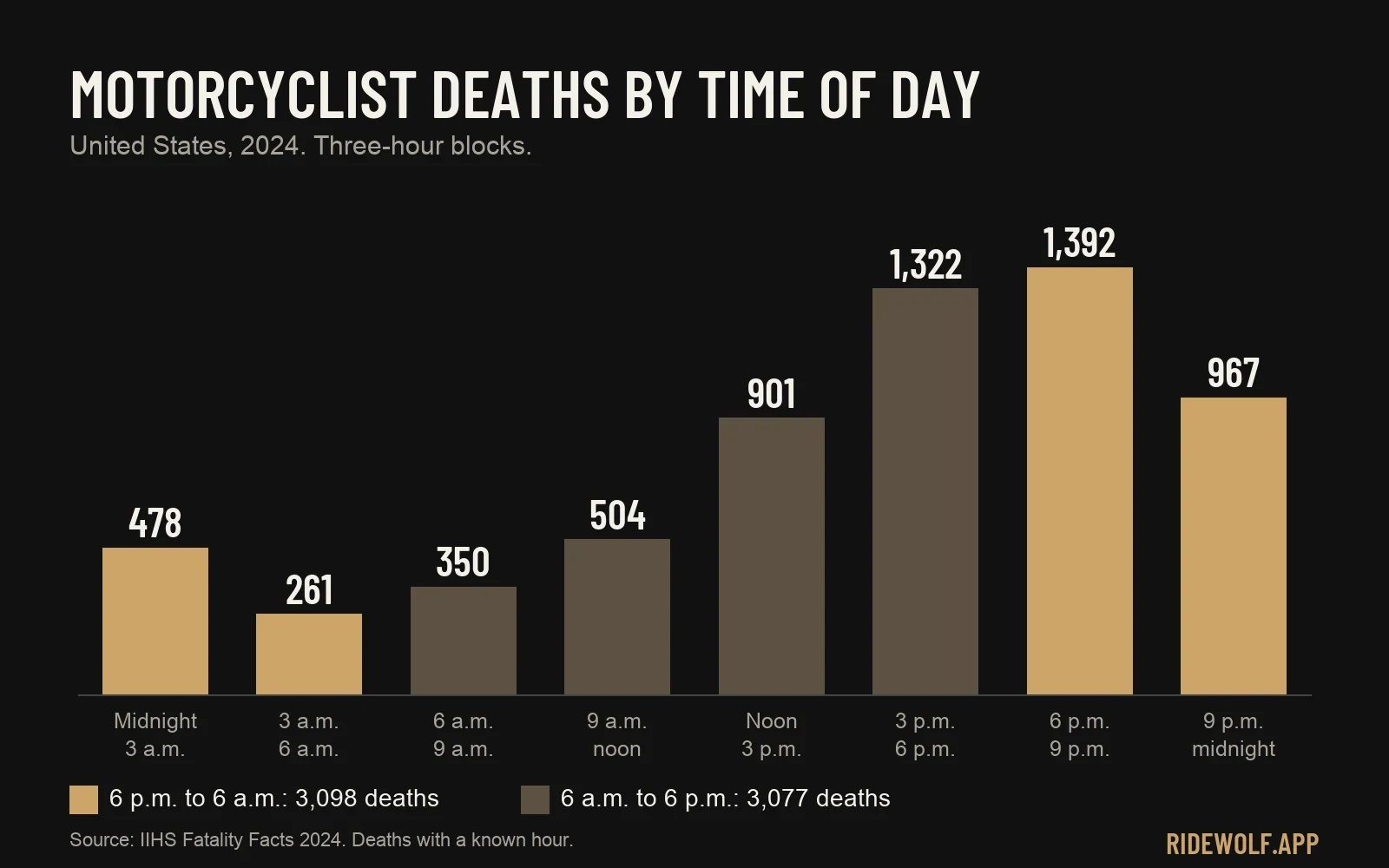
Add up 6 p.m. to 6 a.m. and you get 3,098 deaths. That’s half the day and half the deaths. Some of those early-evening hours are still light in the summer, so don’t read all of it as darkness. The worst three hours on the whole clock are 6 to 9 p.m., which is when the light goes for a lot of the year.
What’s inside the night number
Here’s the part that changes how I read it. NHTSA says riders killed at night in 2023 were two and a half times more likely to be alcohol-impaired than riders killed during the day: 38 percent against 15 percent. The IIHS has the same pattern for 2024. Between 9 p.m. and 6 a.m., 44 percent of the motorcycle drivers who died were at or over the legal limit. The rest of the day it was 19 percent.
So the dark is only part of it. A lot of the night number is drinking. If you’re sober, you’ve already taken yourself out of the biggest group in that table. I broke the rest of the risk down the same way in are motorcycles dangerous.
My one night ride, and the two things I got wrong
Back to the canyon. I want to be straight about how little experience I have here. One ride. It was dark in the canyons, with no streetlights, and I was not comfortable. It’s probably different on streets where there are lights. I’m sure it is. I still lean toward daytime riding.
But two things about my setup made that ride worse than it had to be, and both were my doing.
I had my dark visor on
I had my darker visor on my helmet that day. Then it got dark, and I was looking at a dark road through a dark visor. If there’s any chance you’ll be out past sunset, make sure the clear visor is the one on your helmet.
Some states don’t leave that up to you. Wisconsin’s handbook quotes its own statute, 347.485(2): “eye protection worn during hours of darkness may not be tinted or darkened.” Then it says it plainly. Faceshields, goggles and glasses worn at night must be clear, and riding in the dark with tinted eye protection is illegal there. I haven’t checked all fifty states, so look up your own. The physics doesn’t change at the state line though.
My headlight has a tinted shield in front of it
My Night Train has a good headlight. It also has a fairing with a darker shield, and that shield masks the light a bit. So it’s a good headlight wearing sunglasses. For my bike, the way it’s set up right now, night is probably not the best idea.
That’s worth a look on your own bike before you get caught out like I did. Whatever sits between your eyes and the road, and whatever sits between your headlight and the road, should be clear. Tinted windshield, smoked headlight cover, dark visor. Every one of them costs you light you can’t spare.
Motorcycle night riding tips, straight from the handbook
I’m not going to hand you night riding tips from one ride. These five come from the Wisconsin handbook’s section on riding at night.
| What to do | What the handbook says |
|---|---|
| Reduce your speed | Ride slower than you would in the day, “particularly on roads you don’t know well” |
| Increase distance | Distances are harder to judge at night. Leave a bigger following gap and more room to pass and be passed |
| Use the car ahead | Its headlights can show you more road than your high beam. Taillights bouncing up and down warn you about bumps |
| Use your high beam | “Get all the light you can.” High beam whenever you are not following or meeting a car |
| Move around in your lane | Change to whatever part of the lane helps you see best |
The third row is easy to miss. The car in front of you is carrying two more headlights, so let it light the road for you and stay back far enough to use what it shows you.
Gear matters more at night too. If you’re all in black like I am, you’re hard to see in the day and worse after dark. I went through what I wear and what it’s rated for in motorcycle gear for beginners.
Deer, and the dusk to dawn hours
The same handbook tells riders to “be alert for deer, especially during the dusk to dawn hours,” and to watch for the reflection of your headlight in their eyes. If you see one, slow down and sound the horn, because there are usually more. If you have to avoid one, it says to brake first and then swerve, and not to do both at once.
This time of year that isn’t a small thing. The Highway Loss Data Institute found that animal-strike insurance claims in November run more than twice the yearly average. And Wisconsin’s DOT counted 221 motorcycle-deer crashes in 2024, with about 42 percent of them ending in a death or serious injury. I got into that more in winter motorcycle riding.
A rider who does 50 miles in the dark
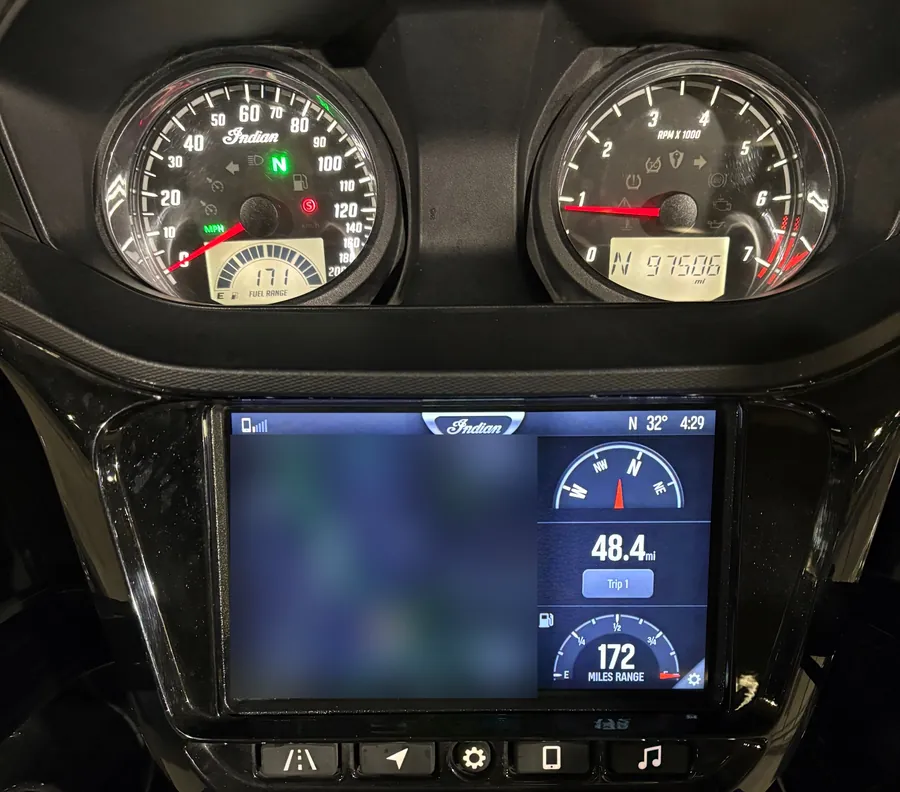
I’m not the guy to tell you night riding is fine, so I’ll point you to somebody who does it. Breezy B rides out of Rhode Island. He’s been riding 50 years, and his commute is 50 miles each way, on a bike with over 97,000 miles on it. He leaves at 3:30 in the morning.
He doesn’t pretend it’s nothing. When I asked him about commuting, he listed what he has to think about: cold mornings and warm afternoons, rain in the morning and sun later, and in his words, “being able to handle changing conditions in the dark.” He also told me why he likes that hour. “Less cars on the road and the air is cool and refreshing. It invigorates me. I feel alive, ready to start the day.”
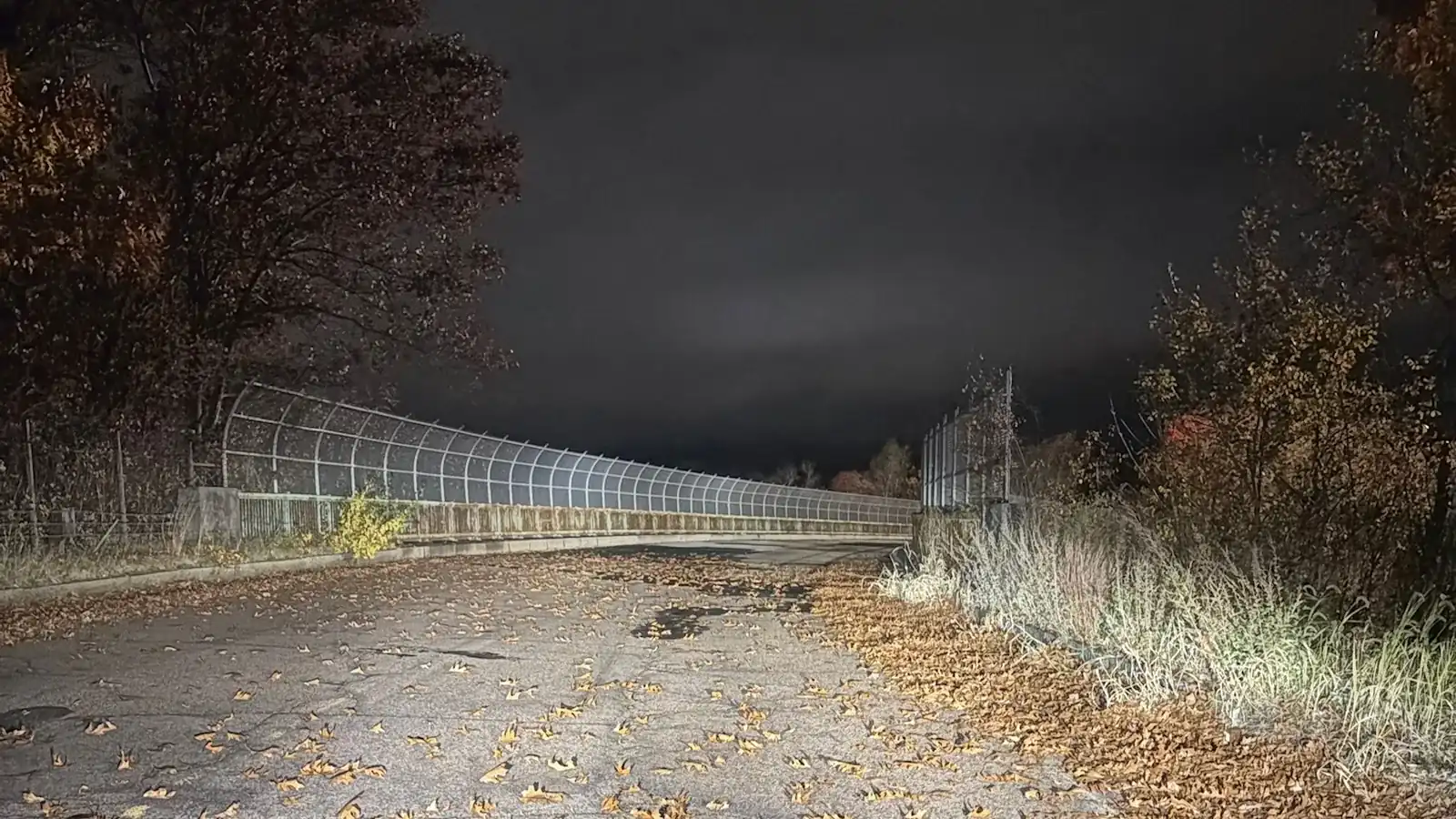
Look at the table again. The hours he rides, 3 to 6 a.m., are the quietest three hours on the whole clock, with 261 deaths out of more than 6,000. The roads are empty and he’s dressed for it. That is a very different night ride from the one that starts when the bars close. The photo at the top of this post is his, a leaf-covered bridge at 4 a.m. with nothing but headlights on it. His whole routine is in the motorcycle commuting post.
So should you ride at night?
I’m not going to tell you not to. Breezy does it every working day and he’s got 50 years on me. What I’ll tell you is what I’d do differently, because it could happen again.
- Clear visor on the helmet any time the ride could run late.
- Know what your headlight really puts on the road. Mine is behind a tinted shield, and I found that out in a canyon.
- Pick the lit road home. If the choice is a dark canyon or a boulevard with streetlights, I’m taking the boulevard.
- Slow down more than feels necessary. The handbook says it first for a reason.
- Don’t drink and ride. That one is most of the night number all by itself.
For now I’m a daytime rider who knows what to fix before the next time. I’ll take that over pretending I’ve got it figured out.
Riding a motorcycle at night FAQ
Is it safe to ride a motorcycle at night?
It is harder than riding in the day. You see less, drivers have a harder time picking you out, and distances are harder to judge. NHTSA says 39 percent of motorcyclist deaths in 2023 happened in the dark. Slowing down, leaving more room, using your high beam and wearing a clear visor all cut the risk.
Can you wear a tinted visor on a motorcycle at night?
You shouldn’t, and in some states you can’t. Wisconsin law says eye protection worn during hours of darkness may not be tinted or darkened. A dark visor takes away light you need to see the road. If your ride could run past sunset, put the clear visor on before you leave.
Should you use your high beam on a motorcycle at night?
Yes, whenever you are not following or meeting another vehicle. The Wisconsin Motorcyclists’ Handbook says to get all the light you can. When you are behind a car, drop to low beam and use its headlights to read the road ahead of it.
What time of day do most motorcycle deaths happen?
Late afternoon and evening. In the IIHS count for 2024, 6 to 9 p.m. had the most motorcyclist deaths of any three-hour block, with 1,392. Next was 3 to 6 p.m. with 1,322. The quietest block was 3 to 6 a.m., with 261.
Why are so many motorcycle deaths at night?
Less light is one reason. Alcohol is another. NHTSA found that riders killed at night in 2023 were two and a half times more likely to be alcohol-impaired than riders killed in the day, 38 percent against 15 percent. Animals on the road between dusk and dawn add to it.
How can I see better riding a motorcycle at night?
Wear a clear visor and keep it clean. Use your high beam when no one is in front of you. Follow a car at a safe distance and use its headlights. Check that nothing tinted sits in front of your headlight. And slow down, so you have time for what the light does show you.
So that’s where I’m at with riding a motorcycle at night. One ride, a couple of mistakes, and a list of what to fix. If you’re new, get your daylight miles in first. Night will find you on its own.
If you want people to ride with while you get those miles, that’s why I built RideWolf. The app is out now and it’s free. You can get it on the App Store here. Browse more motorcycle how-to’s, or find motorcycle rides near you.
Put that first foot forward and just do it. Peace.